When one considers that the Piano Quintet in
D minor is a work that sounds superb, taxes the soloists and
is quite frankly a high-point of post-romantic English music,
it is surprising that it is a piece that is hardly known.
There is at present only one other recording available – from
ASV.
There is also a version for chamber orchestra and piano available
as realised by Paul Hindmarsh.
According to the sleeve-notes, the Quintet’s
original incarnation was a “muscular, four-movement work,
with a huge piano part, brim full of musical ideas”. Yet there
appears to be a down-side. Hindmarsh notes that it was a “rather
unwieldy [quintet] and certainly lacking the refinement and
elegance of his mature chamber works.”
After a couple of performances in 1907 the
work was withdrawn and suppressed by the composer. Yet the
Quintet continued to interest him. Five years later he revised
the work: in fact it was largely a complete re-write. For
one thing the second and the third movements were condensed
into a ‘single span’. The ‘scherzo’ material from the former
‘allegro con brio’ now formed the middle section of the slow
movement. Finally, Bridge made the work ‘cyclic’ by re-introducing
themes from the first movement into the final allegro.
Without the original work for comparison, the
listener will have to take the work as presented. However
the programme notes suggest that “most of the angularities
from 1905 have been smoothed out and there is a greater reliance
on Fauré-inspired arpeggiated figuration.”
All these changes led to a work which is fresh,
enjoyable, moving and deserving of greater popularity. It
is rapidly becoming a favourite of mine from the considerable
catalogue of Frank Bridge’s chamber music.
The strange thing about the Three Idylls
is that they are best known through the lens of Benjamin Britten.
The second was used to provide the theme for Britten’s well
known Variations on a Theme of Frank Bridge. This was
the pupil’s ‘affectionate’ tribute to his master.
Perhaps the term ‘Idyll’ is a little misleading
for this work; it is not a particularly ‘idyllic’ piece of
music in the accepted sense of the word. When I first heard
these pieces I expected something loosely pastoral in sound
and was perhaps a little disappointed to discover that they
are anything other than the proverbial ‘cow and gate’. However,
these pieces have a happy genesis: they were written for,
and dedicated to, a certain violinist called Ethel Elmore
Sinclair. This Australian lady shared a desk with Bridge
in the Royal College of Music Symphony Orchestra. The piece
was composed in 1906 and was performed the following year.
After a trip to Australia, Ethel returned to England and became
Bridge’s wife.
The general mood of this music is one of melancholy:
Bridge makes considerable use of the darker string tones.
The first Idyll opens with a lugubrious melody for
solo viola, which was the composer’s favourite instrument.
It leads into a reflective and moving adagio. There is a slight
brightening of atmosphere with music that has been described
as having a ‘Latin beat’ before the original material returns.
The second is the shortest of the three pieces
and once again is somewhat dark in humour. However the middle
section is a little more animated and raises the spirits.
There are hints of the ‘blues’ here created by some interesting
syncopation.
The last Idyll is animated and lifts
the entire work out of its moody introspection. This is the
nearest that this music comes to a summer’s day as opposed
to the frost-bound landscape of the previous two Idylls.
The entire work is a small masterpiece. Everything
about this piece reveals a composer who is totally at home
with his media, who is able to create wide-ranging music with
a variety of tonal explorations and instrumental effects.
It was a worthy gift to his wife-to-be.
The
bottom line is that Bridge’s Fourth Quartet, is a major masterpiece.
I admit that it has never been my favourite work – I prefer
the composer’s more romantic offerings of the pre-Great War
era - but I am slowly coming round to enjoying - if that is
the correct word to use - it and perhaps even beginning to
understand it. I certainly find that it moves me. I have written
elsewhere that the Fourth String Quartet is a bit like Janus
– it faces in two directions. It is easy to be overwhelmed
by the harmonic language, which is often extremely dissonant.
Much of the effect seems to derive from a counterpoint that
clashes rather than agrees or resolves. The first impression
is of a work that owes more to the Second Viennese School
than to ‘Parry ’n’ Stanford’. However, according to the musicologists,
the Quartet is not actually atonal: it is rooted in a very
free form of tonality, which may be more obvious under scholarly
analysis than to the ear … Yet, on the other side of the
coin, the scholar Anthony Payne has remarked that its formal
structure is more “‘classical’ with its ‘clear cut sonata-form
first movement, followed by a minuet and a rondo finale."
It is a work that begins to fall into place on repeated listening
– something that only the CD format can provide. It is unlikely
to feature regularly in the concert hall.
The
more I hear of this work, the more I come to realise that
there is a passionate side to this Quartet. But perhaps this
is hardly surprising. The influence of Schoenberg and his
‘school’ was not always anti-romantic. Just think of the Violin
Concerto by Alban Berg, for example. The end product is a
fine addition to the string quartet repertoire. The ‘note’
of Englishness has never quite left the imagination of this
great composer.
The
Fourth String Quartet was dedicated to Mrs Coolidge and was
given its first performance at her Berkshire Festival of Chamber
Music in Massachusetts in 1937. It was a work that was written
at a time when Bridge was ill and was having a crisis in his
artistic development.
This
is a well balanced CD, with two relatively early works contrasted
with his last major piece of chamber music. In fact, it was
his last great work - with the exception of Rebus and
the promise of the unfinished Symphony for Strings. In many
ways this disc would be a good introduction to the sheer breadth
of Frank Bridge’s chamber works, providing that the listener
is not afraid of engaging with music that leans towards German
expressionism. The opening Piano Quintet is as good as early
Bridge gets. I noted earlier that the Three Idylls is somewhat
melancholic, but this ‘mood’ issue apart; they are one of
the composer’s masterpieces. As always with this kind of music,
take each work at a time – I would plump for the order given
on the CD.
The
sound quality of the disc and the playing by the Goldner String
Quartet and Piers Lane is superb. The programme notes are
by Bridge scholar Paul Hindmarsh: they deserve study before
and after listening to the music.
Fortunately
there are a fair few versions of the Fourth Quartet available
at the moment (Lyrita,
Meridian,
Naxos
and Redcliffe).
All these versions are worthy and each one has its supporters.
However, for music as important as this (4th Quartet) there
can never be too many recordings! All enthusiasts of Frank
Bridge and of English chamber music will want to have this
recording along with all the rest!
John France
See also MWI Frank
Bridge article: http://www.musicweb-international.com/bridge/index.htm
























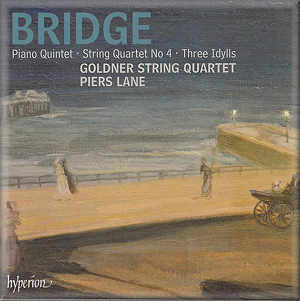

 Goldner String Quartet
(Dene Olding (violin); Dimity Hall (violin); Irina Morozova (viola);
Julian Smiles (cello)); Piers Lane (piano)
Goldner String Quartet
(Dene Olding (violin); Dimity Hall (violin); Irina Morozova (viola);
Julian Smiles (cello)); Piers Lane (piano) 
