Editorial Board
MusicWeb International
Founding Editor Rob Barnett Editor in Chief
John Quinn Contributing Editor Ralph Moore Webmaster
David Barker Postmaster
Jonathan Woolf MusicWeb Founder Len Mullenger
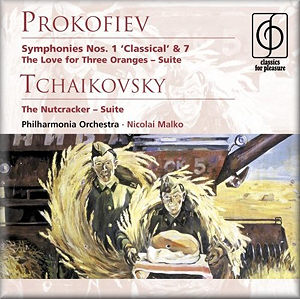
Sergei PROKOFIEV (1891-1953) The Love for Three Oranges Suite, Op. 33a (1919/24)
[13:15]
Symphony No. 1 in D, Op. 25 (Classical) (1916-7)
[13:50]
Symphony No. 7 in C sharp minor, Op. 131 (1951-2) [29:57] Pyotr Ilyich TCHAIKOVSKY (1840-1893) The Nutcracker Suite, Op. 71a (1892) [22:59] Philharmonia
Orchestra/Nicolai Malko
rec. Kingsway Hall, February 1955 CLASSICS
FOR PLEASURE 3822292 [80:29]
Prokofiev's Seventh Symphony ought to be
more popular, and more frequently played, than it is. It's
structurally concise,
melodically
expansive, and gently dissonant, without the brash, insistent
discords that some listeners, including me, can find off-putting.
The first movement, mostly comprising a succession of broad, arching
phrases, is dominated by the sweeping lyricism familiar
from Prokofiev's ballets. Nicolai Malko displays a good
feel for its expressive surge, aware of the ambivalence
arising from the themes' gravitation among various short-term
major and minor key-centers. He brings an infectious waltz-like
swing and uplift to the scherzo while acknowledging the
movement's brief pensive moments. Malko plays the Andante
espressivo slow movement as a real andante ("moving"),
a pleasing, songful intermezzo; keeping the movement in
proportion to the rest where other, slower performances
throw off the score's emotional balance. The finale's perky
vigor suggests Shostakovich - the good way - but a few
of the harmonic pivots are unmistakably Prokofiev's, as
is another of those surging themes, brought in by way of
contrast. Malko's touch is light and spirited, and, I'm
pleased to note, plays the composer's added up-tempo coda;
commentators are inclined to favor the original quiet ending,
but the brief return of the faster material rounds things
off nicely. Interpretively, Malko has succeeded in displacing
my cherished favourites from the 1970s, by Weller (Decca)
and Previn (EMI), although Weller's still offers more immediate
sound.
Malko's account of the ever-popular Classical Symphony is vivacious,
and he plays the Love for Three Oranges excerpts
with a balletic lightness. Rhythmic buoyancy keeps the
pounding, vaguely Age-of-Steel bits in Les Ridicules from
turning oppressive, while the contrasting lyrical passages
are shaped surely and musically. The March moves
along, shorn of fussy over-pointings - the quirky harmonies
provide sufficient characterization. Malko draws deep,
luminous expression from Le Prince et la Princesse,
though the movement peters out inconclusively.
The Nutcracker Suite, that holiday perennial, has gotten a
fair amount of recorded attention; since most symphony
orchestras don't play this music regularly, however, even
polished performances don't always avoid a whiff of routine.
Malko's take on it rises above that business-as-usual level,
not because the conductor does anything unusual or eccentric,
but simply by virtue of his care over detail. The wind
chords in the Miniature Overture don't just get
louder, they open out excitingly; the percussion punctuations
in the Russian Dance aren't indiscriminate, uniform
thumps, but build in volume and intensity. Tempi perhaps
marginally slower than the Pops-concert norm allow us better
to enjoy the "open" sound of three-part chords
in the Dance of the Reed-Flutes, the crispness and "lift" of
the Sugar-Plum Fairy's famous celesta solo, and the combination
of weight and airiness girding the Waltz of the Flowers.
It's nicely done.
It's good to have these recordings readily available, and in stereo
- Stateside, RCA issued the original Prokofiev LP in monaural
only. The sound is acceptable, but remember that this is very early
stereo: colors emerge vividly enough, but the range extremes
sound exaggerated - boomy bass, sometimes aggressive treble
- and a pervasive sonic glare produces a "canned" effect.
The ambience cuts off a bit abruptly at the end of several
tracks.
Stephen Francis Vasta
Please support our advertisers below by clicking on the logos for further information.

























 Philharmonia
Orchestra/Nicolai Malko
Philharmonia
Orchestra/Nicolai Malko 
