Editorial Board
MusicWeb International
Founding Editor Rob Barnett Editor in Chief
John Quinn Contributing Editor Ralph Moore Webmaster
David Barker Postmaster
Jonathan Woolf MusicWeb Founder Len Mullenger
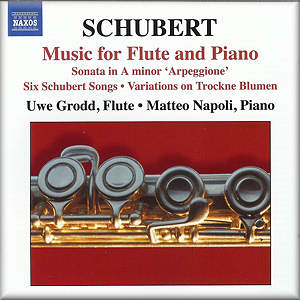
Franz SCHUBERT (1797-1828) Music for Flute and Piano
Sonata in A minor Arpeggione D821 (arr. Uwe Grodd) [23:53]
Six Schubert Songs (arr. Theobald Boehm): Gute Nacht, D 911/1 [4:39], Der
Lindenbaum, D911/5 [4:25], Das Fischermädchen, D957/10, Ständchen,
D 957/4 [5:25], Am Meer, D957/12 [3:52], Die Taubenpost, D957/12
[3:36]
Variations on Trockne Blumenfrom Die schöne Müllerin D802
Op. 160 [20:49] Uwe Grodd (flute); Matteo Napoli
(piano)
rec. 26-27 August 2007, WE Academy, Waikato University,
Hamilton, New Zealand. DDD NAXOS 8.570754 [69:23]
Following the Classical era, the flute
suffered something of a dwindling of repertoire by established
composers. There were many reasons for this, but perhaps
the most important was to do with the development of music
and of the instrument. Composers started to make greater
use of dissonance and chromaticism which were not particularly
suited to the simple system flute. Its intonation was in
any event problematic. Mozart’s apparent displeasure with
the flute was well documented, and the problems in the
early 1800s were important factors in the development of
the instrument, as many makers (most notably Theobald Boehm)
looked for ways of improving its reliability, intonation
and sound. The flute repertoire contains a number of works
by Schubert, although many of them are arrangements. His
flute writing in the symphonies is often quite soloistic
- particularly in the fifth symphony - and his music lends
itself well to the flute sound.
The Arpeggione sonata was originally
composed for an instrument of that name, a type of bowed
guitar which is now obsolete. The work lives on in several
arrangements, for viola, cello and also flute. Each of
the flute transcriptions - there are a few – is subtly
different. That by Uwe Grodd adds some further embellishment
in the slow movement. This performance is a good one – the
piano sound is clear and bright, and there is a good sense
of partnership between the players. At times I would have
liked a clearer flute sound to match that of the piano,
as the microphones sometimes pick up air in the sound.
The music is well phrased, and Grodd makes use of some
lovely tone colours. The music is allowed to sing without
being overly forced and the performers do not give in to
self-indulgence.
Schubert is perhaps best known for his
songs, and Theobald Boehm, developer of the modern flute,
made arrangements of six of these for flute - or later
for his newly invented alto flute - and piano. The first
two of these songs come from Winterreise while the
remaining four belong to Schwanengesang. These are
wonderful arrangements, which are mostly simple and include
some variation-like embellishment of the original theme.
The themes are lyrical and expressive, and are played here
with sensitivity. A particular favourite of mine is Ständchen,
with its dark harmonies, mournful theme and turbulent climax.
Schubert’s original flute work, the Variations
on Trockne Blumen is a substantial work, lasting
over twenty minutes. The breathtaking introduction takes
the dark harmonic mood of Ständchen and develops
the lines further. This is a truly stunning opening which
allows the flute an opportunity to show its rich, dark
sonorous qualities. The minor key theme ends in the major,
reflecting the poem (from Die schöne Müllerin), and
this pattern is maintained throughout the majority of
the variations. The work is a true duo, with complex
technical displays for both instruments. Unfortunately
there is a tendency for the flute to rush in the fast
passages, and the ensemble and intonation suffers slightly
as a result. The accuracy is not as good as we have
become used to in the modern recording age, and this
mars an otherwise reasonable recording. The piano moments
are more measured and are aggressive where required without
losing control.
Carla Rees
Please support our advertisers below by clicking on the logos for further information.
























 Uwe Grodd (flute); Matteo Napoli
(piano)
Uwe Grodd (flute); Matteo Napoli
(piano) 
