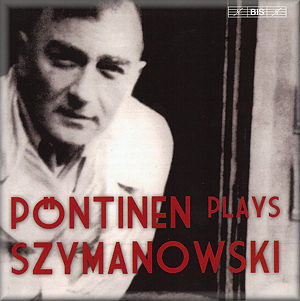
This is the second disc I have recently reviewed of Szymanowski’s
piano works. The other was by Eri Iwamoto on Acte Préalable (APO182).
The discs only duplicate one work but it’s a significant one,
‘Métopes’ a three-movement cycle inspired by Odysseus’s travels
as related by Homer. But before we discuss that, the booklet notes
by Jean-Pascal Vachon clearly pin-point for us the three stages
of the composer’s development and I will outline them for you.
The first is Romantic and lasts from his Op. 1
Preludes of c.1900 until the 1915 when ‘Métopes’ was composed.
This second period lasts up to c.1921 and it was one in which
a strong influence of Debussy, Impressionism, and Scriabin was
in the ascendant. Scriabin never seems to be too far away in
this music. Lastly comes the third period when Polish dances
and melodies became his passion. There he rested until his relatively
early death at the age of 55. It is the second and third periods
which are represented here and all three are on Iwamoto’s disc
mentioned above.
This is a very fine performance of ‘Métopes’ but
then so is that by Iwamoto. Overall duration is one minute more
than Pöntinen largely because of the more relaxed way she has
with the first section ‘L’île de Sirènes’ in which she is a
minute and a quarter slower; not that she loses the thread or
is less virtuoso. Pontinen finds the inner tension and keeps
the music going even through moments when it is in the calms.
It is a restless performance not emphasizing the “lugubrious”
as Vachon describes it but instead presenting us with the fantastical
nature of the music and the horror of the sailors “who have
succumbed” to the fateful songs of the ‘Sirènes’. The remaining
movements are ‘Calypso’ with its Debussian parallel chords and
the almost Berceuse-like ‘Nausicaa’. These are more conventionally
interpreted - incidentally the full story of Nausicaa was turned
into an extraordinary opera by Peggy Glanville-Hicks - and the
recorded quality makes this a beautiful experience to wallow
in. To be honest however I cannot find much that I dislike about
this rendition or that by Iwamoto.
In 1904 when Szymanowski was putting the finishing
touches to his First Sonata he was content with a fat romantic
statement in four distinct movements. By the time of the Third
Sonata he was under the spell of Scriabin – especially, it seems,
the 8th Sonata. He was concerned to write a sonata
in one movement. It was however to have the four distinct ‘moods’:
a sonata-form first with a semi-romantic second subject, a ponderous
and dark second, a quixotic and very short scherzo and then,
somewhat surprisingly, a fugal finale. This is broken by a contrasting
reflective section which ends, very oddly to my ears, in the
major key after so much near atonality. It’s a brave work but
not entirely successful I feel even in Pöntinen’s compelling
hands.
With the large-scale ‘Masques’ each part of the
triptych could be played as a separate piece. It is almost contemporaneous
with ‘Métopes’ but is - I think, and it seems Szymanowski did
too - a more successful work. The opening of ‘Shéhérazade’ reminded
me of Ravel’s ‘Le Gibet’ for a moment. The French influence
is strong. The booklet notes allude to the imitation of guitars
from ‘Alborada del Gracioso’ as an influence on the third masque
‘Sérénade de Don Juan’, which is, suitably, by turns, excitable
and calm. The middle masque ‘Tantris le bouffon’ has a quote
from Wagner’s ‘Tristan’ as the title here refers to a theatre
adaptation of the legend in which Tristan is disguised as a
jester, thus allowing the composer an opportunity for a scherzando
element in the overall composition. This is a fine work and
superbly handled by Pöntinen with no nuance it seems to my ear
overlooked; though I was without a score.
Two sets of Mazurkas are represented here, four
from the Twenty Op. 50 and the two Op. 62 which were practically
the composer’s last works. The latter, unusually for him, he
committed to shellac. There is little or no stylistic difference
between them despite the fact that there are four years between
them. These dances should not be heard as Chopinesque but as
inspired by Polish ethnic music, rather as if Szymanowski had
been on a field trip with Bartók twenty years earlier in the
Tartras or towards the eastern borders of the vast country.
He had heard the Górale people make music and had been entranced.
They do indeed live in the remoter areas of the mountains. The
booklet says that Szymanowski found a “much simpler style than
the one he had used in his earlier ‘impressionist’ period”.
Well, not simpler to play. These are bravura, passionate and
intense pieces especially in these almost neurotic performances
by Pöntinen. They have brought these works to life far more
than say Martin Roscoe in his complete cycle of Szymanowski’s
piano music recorded for Naxos in the mid-1990s.
There is no doubt that this is a fine disc in every
way and I especially appreciate the chosen repertoire. It is
a disc I shall come back to often.
Gary Higginson