This is the last in the series of six Viennese operettas that
Columbia recorded with the Philharmonia Chorus and Orchestra in
London in the mid-1950s, masterminded by producer Walter Legge,
with Elisabeth Schwarzkopf, Nicolai Gedda and Erich Kunz in leading
roles. They were conducted by Otto Ackermann – apart from Die
Fledermaus where Herbert von Karajan waved the baton. Recorded
in the autumn of 1954 Der Zigeunerbaron was for some reason
withheld for several years and wasn’t issued until the autumn
of 1958.
Ackermann had a
marvellous feeling for the Viennese music – he was a fine Mozartean
too. One of my first LPs was a coupling of Richard Strauss’s
two most popular symphonic poems, Till Eulenspiegel and
Don Juan. As in the rest of the series he moulds the
music with unerring taste and with alluring ritardandi and accelerandi.
The overture, albeit not as well known as the one for Die
Fledermaus, is still a very fine piece of music. With sparkling
playing from the Philharmonia it is a tempting opening to this
evening together with Strauss in great form and the fine cast
of singers in high spirits. The Philharmonia Chorus hardly ever
disappoints and during these sessions they were really in the
mood. The mono recording is fully acceptable even today, though
the opening chorus is a bit dim.
The music of Der
Zigeunerbaron is hardly inferior to Die Fledermaus
and the reason for its comparative neglect is primarily the
tricky libretto. Outside the German-speaking world it is rarely
staged nowadays. According to Malcolm Walker’s liner-notes it
hasn’t been performed in Britain since a Sadler’s Wells production
in 1964. The Metropolitan Opera in New York mounted a production
in 1959 that ran for only two seasons and a mere ten performances.
On record it has been more successful. Almost contemporaneous
with the Ackermann set was a production with Austrian Radio
forces under Robert Stolz with Hans Hopf as Sandor Barinkay.
EMI re-recorded it in stereo around 1970 with Chorus and Orchestra
from the Bavarian State Opera under Franz Allers. Nicolai Gedda
and Hermann Prey repeated their roles from the Ackermann set.
There was also Kurt Böhme as Zsupán, Grace Bumbry as Saffi and
Rita Streich a lovely Arsena. This is a wholly delightful recording.
In the mid-1990s Nikolaus Harnoncourt recorded the work for
Teldec – due for reissue – and there are also a couple of DVDs:
a 1975 set under Kurt Eichhorn with Siegfried Jerusalem as Barinkay
and a much later effort from the Seefestspiele Mörbisch under
Rudolf Bibl. The Allers set I have lived with for many years
and I am not going to part with it even though the LPs are worn
today. Hearing the Ackermann set in full for the first time
convinced me that it is at least as good as the Allers and in
several respects it goes one better.
I have already touched
on one such respect: the conducting of Otto Ackermann. For all
his deep experience in the field of operetta and musical, Franz
Allers doesn’t find that echt-Wienerisch lilt that obviously
is second nature to Ackermann. By his side Allers is a bit prosaic.
Viennese charm – though the action takes place in Hungary –
is what Ackermann radiates. Nicolai Gedda’s later self is more
outgoing and probably more in character than his more sleeked
down early reading. He is virile and springy and elegant, features
that characterize him all through his many fine operetta recordings.
Hermann Prey in what must be one of his earliest recordings
– he was 25 at the time – has tremendous ‘go’ in his entrance
song and he is youthful and sappy of voice – slightly less so
in his later incarnation. The third central male character,
the pig-breeder Zsupán, was sung by the boisterous Kurt Böhme
on the Allers set – a true buffo bass. Erich Kunz for Ackermann
is leaner and more insinuating and his Viennese dialect lends
his reading a charm that may not be quite in character with
the role, but who cares when he pulls so many strings in his
inimitable way?
Elisabeth Schwarzkopf
is another inimitable singer and her Saffi is a portrait to
set beside her Rosalinda and Hanna Glawari. Just listen to her
cajoling the phrases so seductively in the duet with Barinkay
Wer uns getraut?. It is slow, almost dangerously so,
but so exquisitely carried through. This is a magic moment when
time stands still. Grace Bumbry isn’t bad on the Allers set
but she isn’t quite as close to Heaven as Elisabeth Schwarzkopf.
Erika Köth is a glittering Arsena, comparable to Rita Streich
for Allers. The great surprise for me was the fruity contralto
of Gertrude Burgsthaler-Schuster, whom I can’t remember hearing
before, not even having heard of. She may not be the star of
the performance – with the names already mentioned in the cast
one really has to be someone to make one’s mark – but suffice
to say that she is more than worthy of the illustrious company.
Quirky story or
not, Der Zigeunerbaron is definitely an operetta worth
anyone’s attention. In this superb rendition it should adorn
any collection. It isn’t complete: Walter Legge made some quite
heavy excisions, but I can’t say that this is very damaging
and there is a fair amount of spoken dialogue to keep the story
together. Unlike a recent Lehár issue the dialogue is quite
closely recorded. With moderate knowledge of German it is rather
easy to follow the proceedings with Keith Anderson’s synopsis
at hand.
This recording has
claims to be a classic to the same extent as the other recordings
in this series. It should be in every true operetta lover’s
collection.
Göran Forsling
























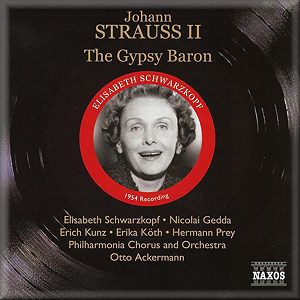
 Nicolai Gedda
(tenor) – Barinkay; Elisabeth Schwarzkopf (soprano) – Saffi; Erich
Kunz (baritone) – Zsupán; Erika Köth (soprano) – Arsena; Gertrude
Burgsthaler-Schuster (contralto) – Czipra; Willy Ferenz (bass; Karel
Stepanek (speaking role) – Carnero; Monica Sinclair (contralto)
& Lea Seidl (speaking role) – Mirabella; Josef Schmidinger (bass)
– Ottokar; Hermann Prey (baritone) – Count Homonay; Erich Paulik
(bass) – Pali; Philharmonia Orchestra and Chorus/Otto Ackermann
Nicolai Gedda
(tenor) – Barinkay; Elisabeth Schwarzkopf (soprano) – Saffi; Erich
Kunz (baritone) – Zsupán; Erika Köth (soprano) – Arsena; Gertrude
Burgsthaler-Schuster (contralto) – Czipra; Willy Ferenz (bass; Karel
Stepanek (speaking role) – Carnero; Monica Sinclair (contralto)
& Lea Seidl (speaking role) – Mirabella; Josef Schmidinger (bass)
– Ottokar; Hermann Prey (baritone) – Count Homonay; Erich Paulik
(bass) – Pali; Philharmonia Orchestra and Chorus/Otto Ackermann

