The first Schubert-Lied-Edition was published by Hyperion and
is still available separately but also issued in a chronologically
arranged box at budget price (see
review).
The second Edition - from Naxos - is now approaching its end
and, even though there have been more ups and downs than on the
Hyperion set, it is an appreciable achievement and well worth
the relatively modest outlay for the individual discs. This latest
instalment is no exception though I have some reservations.
It has to be conceded that the Sturm und Drang poets may not
always have brought out the best from Schubert. Even so, there
are almost everywhere in his oeuvre, irrespective of poets, things
to admire and marvel at, while others are attractive but still
of middling interest. Goethe and Schiller were the two most important
and influential authors of the Sturm und Drang period, which
lasted barely twenty years. They have been accounted for in earlier
volumes and the poets represented here are no doubt minor ones
but they certainly inspired Schubert to a couple of memorable
and major songs. Johann Georg Jacobi (1740 - 1814), responsible
for seven of the songs here, is hardly remembered today in his
own right and Christian Friedrich Daniel Schubart (1739 - 1791)
is likewise relegated to the shadows of the past. Both of them
have survived through Schubert’s setting of their poems
or, to be more specific, one poem each.
Jacobi’s
Am Tage Aller Seelen (tr. 6) is one of
Schubert’s most heartfelt songs and a great favourite with
many music lovers - and not only for the music but also for the
strings the poem pulls. Schubart will probably be remembered,
not only for the orthographic resemblance, but also through the
delightful
Die Forelle.
Those are also the songs on this disc that immediately draw attention
to themselves - first and foremost thanks to Schubert’s
settings. The Jacobi settings are in general professional but
not particularly absorbing. With one exception they are strophic
- which many Schubert songs are - but it is only
Am Tage Aller
Seelen that goes to the heart. The exception is
Lied des
Orpheus (tr. 9) which is dark and dramatic and built up as
an operatic scena, where there are even pre-echoes of the young
Verdi. The accompaniment is powerful and the song is a perfect
vehicle for Konstantin Wolff, since it provides him with ample
opportunities for dramatic declamation. He is also allotted
Am
Tage Aller Seelen which is sung with warmth and feeling.
There are some other songs that will also be of more than fleeting
interest. One is
Hagars Klage (tr. 10), which may not
be Schubert’s first essay as a song composer but it is
certainly his earliest completely preserved song. Considering
that he was only fourteen when he wrote it, it is an amazing
composition. It is long - more than fifteen minutes - and the
layout is brave, almost revolutionary, with long stretches of
recitative and a very active piano part. It has to be admitted,
however, that Schubert had a model. He had been shown ‘several
bundles of songs by Zumsteeg’, among them a setting of
Schücking’s
Hagars Klage. He then wanted to
set the same poem. No doubt he was influenced by the older composer
but Schubert developed his own style and it is instructive first
to listen to Zumsteeg’s setting (tr. 8) and then Schubert’s
(tr. 10). One finds that, however radical Zumsteeg was, Schubert
in his early teens was already very advanced and seems like an
old hand at writing for the theatre.
Among the other songs the setting of Schubart’s
Grablied is
gripping and
Lorma, the text from
Poems of Ossian (Ossian
= James MacPherson), is interesting insofar as the melodic material
is often presented in the piano accompaniment while the vocal
part is expressed in recitative. It should also be noted that
the song is listed immediately before
Der Erlkönig in
Deutsch’s catalogue.
The two singers on this disc were new to me and both are at the
very beginning of their careers. On this hearing the bass-baritone
Konstantin Wolff seems to be the most accomplished. His is a
vibrant, powerful and expressive voice, produced with fine legato
and excellent sense of nuance. He is darkly involving in some
of the dramatic and gloomy songs but his soft singing is also
enticing. His timbre has certain similarities with the great
Swedish baritone Ingvar Wixell - a leading Verdi and Mozart baritone
thirty to forty years ago - and this is high praise indeed. I
am less enamoured of Caroline Melzer, whose tone is too often
rather fluttery and edgy and when under pressure it adopts an
annoying vibrato, which seems alarming for so young a singer.
I have heard many better readings of
Die Forelle. Against
this must be adduced dramatic presence and - especially in the
Zumsteeg setting - delicious pianissimo singing.
Ulrich Eisenlohr has been a pillar of strength throughout this
comprehensive project - not only as the mastermind behind it
and the writer of the illuminating liner-notes but also as an
eminent accompanist on most of the issues. The recording, which
is a co-production with Swiss Radio DRS II, is a model of it
kind and the sung texts and English translations are available
on internet - which may be inconvenient to some readers.
Though not everything here is gold, collectors of this series
should invest in this issue for some deeply satisfying readings,
primarily by Konstantin Wolff, who is a major find.
Göran Forsling
Naxos Schubert Lieder review page
























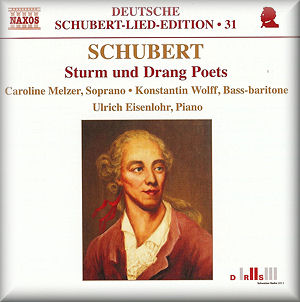

 Caroline Melzer (soprano); Konstantin
Wolff (bass-baritone); Ulrich Eisenlohr
(piano)
Caroline Melzer (soprano); Konstantin
Wolff (bass-baritone); Ulrich Eisenlohr
(piano) 
