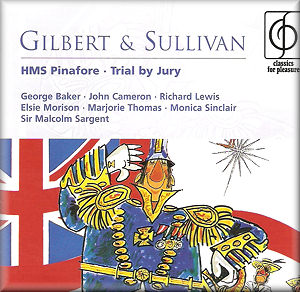
Since EMI's "Glyndebourne" G&S series of recordings
appeared at more or less the same time as the first D'Oyly Carte
stereo recordings for Decca, there's a tendency to think of them
as being somehow diametrical opposites. Historically this isn't
quite accurate: Sir Malcolm Sargent, EMI's conductor, did perform
and record with the D'Oyly Carte company back in 78 rpm days,
so his leadership does in fact represent a link, however distant,
with active D'Oyly Carte theater traditions. The point is important
to make, not just because of the unfair charge of untheatricality
sometimes levelled at these recordings, but also because of the
development of new "traditions" of G&S performance,
particularly Stateside, where directors and conductors adopt brisk
tempi, tending to scant nuance and phrasing that breathes in an
effort to "keep the show moving".
Sargent's
account of the Pinafore Overture lets us in on what we're
missing. Listen to the heft and swing of the rhythm in the 6/8
dance; the expansive tone when the strings briefly take over
the plaintive lyrical theme; the charm and lilt of the "Bell
Trio" tunes. In the opening number, the men's chorus is
clear, crisp, and perfectly balanced. All this is typical of
the performance's success at realizing uniquely musical values
in the score. I suppose enthusiasts may carp at one or another
of the conductor's choices, in particular the untraditional,
quasi a tempo rendering of the coda of Refrain, audacious
tar; but the più lento marking isn't a primary tempo
change, after all, and I like the idea of retaining the momentum
through this final aside, rather than "milking" it.
The end of the first Finale, however, strikes me as rather
measured; I realize this tempo is more or less standard, but
at this speed it's hard for the principals' phrases to become
airborne.
Whether
you like a G&S performance depends largely on how you like
the singers. This cast includes many of the Sargent regulars;
they may not be ideal, but then the D'Oyly Carte soloists weren't
always the strongest singers, either. Here, the chief stumbling
block for me is Richard Lewis, an estimable artist, but wrong
for this material. His fussy, puckered enunciation and stiff,
"correct" phrasing leave him an old-sounding Ralph
Rackstraw, who misses the role's sense of youthful ardor: listen
to his cautious way with the vaulting arpeggio at "When
we have pain" in Act I. Where Lewis does "let go,"
it's the wrong thing, as in the shouty rendition of the Act
I Glee.
His
soprano counterpart, Elsie Morison, has been subject to similar
strictures elsewhere in the series, but Josephine actually suits
her reasonably well. The character may be another ingenue, but
she's a high-class one, and Morison's concert-soprano manner,
which can make her other G&S heroines sound stuck-up, gives
Josephine some welcome authority. The voice as such is mostly
full and round - note the curve through the top A in Refrain,
audacious tar - until it reaches the uppermost notes. The
top C at the end of the Act II Scena is thin and very, very
careful, while the high B capping the Bell Trio doesn't
quite get there.
John
Cameron's performance as Captain Corcoran is puzzling. The way
he "sits on" the legato makes him sound gummy - though
his words are mostly clear - and his soft dynamics are simply
too soft: he almost croons the proclamatory "Now give three
cheers" before Sir Joseph's Act I entrance, and his final
aside in the Buttercup recitative, intimately played to begin
with, is practically in mike voice. Cameron sings out more in
Fair moon, to thee I sing, with a clear, secure top G.
The Buttercup, Monica Sinclair, is solid, as always - but what's
with all the glottal separations in her first recitative? Fortunately,
she drops them soon enough.
Owen
Brannigan is a vivid presence as Dick Deadeye, though, surprisingly,
he fudges a few of the trickier pitches - some of Deadeye's
vocal lines are surprisingly disjunct. Marjorie Thomas doesn't
do much with Cousin Hebe - the music by itself doesn't allow
for it, though I've seen some strong comedic performances on
stage - but she's a strong presence in the ensembles of the
first Finale.
I've
not mentioned the Sir Joseph of George Baker simply because
it's very much the usual George Baker performance. He was an
actor rather than a singer, but he's secure with the notes,
bringing in a touch of decorous parlando where appropriate
- I appreciate his restraint.
Trial
by Jury was also the filler for the original 2-LP set, and
in some ways it seems like a "filler", with signs
of hasty preparation. Some of the simpler chorus responses sound
under-rehearsed -- the more intricate passages, in numbers like
A nice dilemma, are rendered as precisely and brilliantly
as ever -- and there are a few unexpected word bobbles. For
the Plaintiff's rhyme of "unceasing and "increasing,"
Morison sings "increasing" both times; and Cameron
sings, "Where is the Plaintiff? Let her now be bought"
for "brought," as if the trial had been moved to Chicago.
I'd always thought the recording might have been made quickly,
perhaps in a session left over from something else, but the
booklet indicates a full three-day recording period. So much
for that idea.
At
any rate, the results are still lively and enjoyable. It sounds
like the producers were reacting to the charge of "untheatricality":
Baker indulges in broader and more frequent parlando than
elsewhere in the series; Morison adds a few unscripted swoons;
and we hear the sound of splashing water in That she is reeling,
though a few lines too early. Everyone participating is in representative
form, with Lewis, fortunately, a bit better than that. It's fun.
Stephen Francis Vasta
see also Review
by Jonathan Woolf
























 George Baker
(baritone) - Sir Joseph Porter
George Baker
(baritone) - Sir Joseph Porter 
