Editorial Board
MusicWeb International
Founding Editor Rob Barnett Editor in Chief
John Quinn Contributing Editor Ralph Moore Webmaster
David Barker Postmaster
Jonathan Woolf MusicWeb Founder Len Mullenger
Gustav MAHLER (1860-1911)
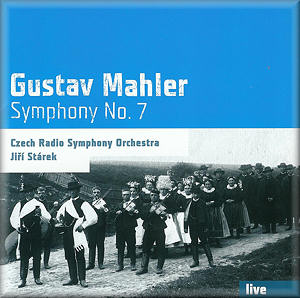
Symphony No.7 in E minor (1906) [79:17] Czech Radio Symphony
Orchestra/Jiří Stárek
rec. live performance, DKO Jihlava, Czech Republic, 19 September
2008 ARCODIVA UP 0112
- 2 131 [79:17]
Small print is usually something of which you should be very wary. It can invalidate your insurance claim or commit you to receiving unwanted books every month for the next five years.
But, just once in a while, small print can be very useful. And, were it not for the very small print on the back of this CD's case, I wouldn't have appreciated the significance of this performance - for it is certainly not mentioned anywhere else at all in the accompanying booklet notes.
This recorded live concert was, in fact, given on the 100th anniversary to the day of the seventh symphony's world premiere. And, although that event had actually taken place in Prague, this recording was made in the appropriate surroundings of the Czech city of Jihlava, just 70 miles to the south-east and on the border of Bohemia and Moravia, where Mahler had grown up.
So this was clearly something of a special occasion to all concerned and the outcome was, thankfully, a generally positive one. Veteran conductor Jiří Stárek, a pupil of Talich and Ančerl, had passed his 80th birthday earlier that year but clearly felt quite at home both in this repertoire and leading the orchestra that he had first conducted more than 50 years earlier in 1953: he actually went on to become their chief conductor between 1964 and 1968 before moving west to concentrate on a busy international career.
The orchestra, too, is generally well up to the mark, although there are a couple of those minor glitches often found in recordings of live performances. Thus, the players sound rather exhausted and ragged at about 21:34 towards the very end of the long opening movement, while at 11:20 in the finale an over-enthusiastic percussionist seems to momentarily divert his colleagues' concentration by an early entry. Modern practice is often, of course, to record a piece several times and to eliminate infelicities by patching the most effective passages together - but I suppose that, as an 'historic' event, this centenary performance has been left unretouched; it also includes a couple of discreet audience coughs as well as their final applause.
The very opening of the first movement establishes a realistic, quite dry acoustic that I personally find most attractive; I often think that I must be the only fan of Toscanini's much-derided resonance-free Studio 8H. There is, throughout the whole recording, a welcome absence of the somewhat artificial surface sheen that smoothes away the rough surfaces on so many Mahler recordings from better-known bands. All sections of the well-balanced Czech Radio Symphony Orchestra can be heard clearly, contributing to an especially idiomatic overall sound. Atmospherically plangent woodwinds make a particularly strong impression, as do the strings - although the violins, it is true, are challenged in the highest registers where they can occasionally sound thin and a little shrill. In general, the opening movement is at its best in its more forceful, driven passages: when Mahler's writing becomes more contemplative the players appear to lose some of their focus and direction, regaining it, however, as soon as a weightier, more propulsive atmosphere returns.
Given that last point, it was a surprise to find that the second movement - the first of two in this symphony designated as Nachtmusik - is such a success. Perhaps because it is, quite frankly, less musically ambitious, the Czech players immediately sound more focussed and purposeful. While the brass and strings are warmly incisive, the contrasting passages of flowing melody given to the strings are also especially successful. It is a shame that the cowbells are rather 'in your face' and lack subtlety - what should surely be an atmospheric sound heard faintly across the Moravian meadows unfortunately sounds here more like the dustman sorting through your tin cans for recycling. The cowbells' return in the final movement is, thankfully, far more effectively integrated into the overall sound mix.
Stárek immediately and successfully creates the requisite demonic feel to the third movement and the tension is well maintained. The general effect is satisfyingly spiky, once again avoiding any temptation to smooth the music out. The playing is idiomatically 'rustic', with that dry acoustic helping to create something of a 'village band' sound - the violinists, in particular, must surely have enjoyed all that sliding and skittering among the notes.
The second Nachtmusik is just as successful - free-flowing, relaxed and highly atmospheric, all in all very much of a piece with the two preceding movements. The Czech players seem to have this music in their blood and acquit themselves far more than merely competently.
The finale is a long movement - but it is especially so here as Stárek draws it out to 18:34. For comparisons taken from my shelves, Rafael Kubelik and his Bavarian Radio Symphony Orchestra dash it off in just 16:42, Edo de Waart and the Netherlands Radio Philharmonic Orchestra come in at 17:24, while even Leonard Bernstein can wrap things up in just 17:56 in his 1965 New York Philharmonic recording - though he'd extended that to 18:57 by the time of his 1974 video recording with the Vienna Philharmonic. Stárek's tempi are, nevertheless, eminently sensible and sound, to my own ears, innately right. He keeps the whole movement flowing well, minimising any charge of it sounding episodic and disjointed, though he is forceful and emphatic - as opposed to melodramatic - when required. The strings and woodwinds exhibit an attractive glow in the more intimate passages, while a firm hand effectively restrains the brass. Holding his full power in reserve, the conductor consistently refuses the opportunity to go for broke, so that, while this may not be the most exciting finale to a Mahler 7, it is musically enlightening and effective.
Apart, then, from a brief moment or two in the opening movement, this is a worthwhile performance that held my concentration and one that I certainly enjoyed rather more than others from much starrier forces. Perhaps it is rather fanciful, but it ultimately seemed to me to be something of a provincial, Moravian version of Mahler - meant not in the slightest sense pejoratively but so as to stress its distance of that glossy, high-powered, exaggerated neuroticism so frequently encountered - did anyone mention Bernstein? It is good to encounter, just once in a while, a performance like this one that takes the composer very much back to his roots.
Rob Maynard
Please support our advertisers below by clicking on the logos for further information.
























 Czech Radio Symphony
Orchestra/Jiří Stárek
Czech Radio Symphony
Orchestra/Jiří Stárek 
