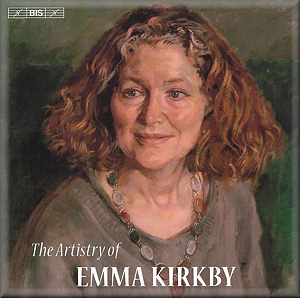
This set seems to have been assembled to celebrate Emma Kirkby’s
60th birthday, though you have to read through the
CD liner-notes to discover this fact. The set consists of selections
from the CDs that she has made for BIS since she started releasing
records with the company in 2000. The result is an attractive
set which covers quite a range of ground and gives a clear picture
of Dame Emma’s current artistry and voice.
It may seem impolite
to harp upon the soprano’s age, but the remarkable condition
of her voice means that when you first play these discs you
rather do a double take. It is not many sopranos of Dame Emma’s
vintage who have preserved so much of their vocal prime. Not
that everything is perfect, there is now a tendency to shade
off high notes and the upper register generally lacks the freedom
which it once had. The vocal tone is still clear, pure, cool
and limpid but with hints that the flexibility is rather harder
won than it used to be. All this must be balanced by a sense
of warmth and character which is relatively new in the voice.
As ever when singers age, you have to balance the reduction
in vocal resources with the greater gains in depth, artistry
and character.
The first disc is
entirely devoted to Handel, starting with the recording of Handel’s
Gloria which she made with the Royal Academy of Music
Baroque Orchestra. This was the work’s first recording after
having been re-attributed to Handel. Handel’s writing hints
at Vivaldi and other baroque contemporaries. Kirkby’s account
of the solo line is accomplished, beautiful but rather cool.
What she can do
is indicated in the remaining tracks of the disc where she performs
Handel Italian solo sacred music with Charles Medlam and London
Baroque. On these tracks she adds a new warmth and depth to
her technical ability. This makes the antiphon Salve Regina
a moving little gem. This piece was written in Rome in 1707
as were the following two motets, O Qualis de Coelo Sonus
(probably for Whitsun) and Coelestis dum spirat aura
(for the feast of St. Anthony of Padua). Kirkby’s tones
are not naturally Italianate, instead she brings intelligence,
technical ability and a feeling of authority to this repertoire.
This is especially seen in Laudate Pueri, Handel’s version
in F major from 1706 (his earliest surviving manuscript); here
Kirkby gives us some beautifully clear, clean runs and sing
the slower movements with superb poise.
For the second disc
we discover on of the set’s weaknesses. Though the liner notes
provide excellent background information on Kirkby and we do
get full texts and translations, but there are no notes about
the composers. This is something of a problem on a disc which
includes music by Böddecker and Graupner!
Böddecker was a
composer and organist from a family of musicians; born in Alsace
he went on to work at the court in Darmstadt before working
in as organist in Frankfurt and at Strasbourg Cathedral. His
motet, Natus est Jesus is charming, with its mixture
of German and Latin texts. As with other South German composers
there are Italianate hints in the music.
The two Bach cantata
arias are near ideal, with only hints of strain at the top marring
the sheer perfection. Kirkby is complemented by some fine solo
violin playing. I couldn’t help wishing that we’d been able
to hear the cantatas complete.
Christoph Graupner
was born in Saxony and was taught at the Thomasschule in Leipzig.
He worked at the Hamburg Opera under Keiser before moving to
the court at Darmstadt. He seems to have composed nearly 1500
church cantatas. Ach Gott und Herr is for the 3rd
Sunday after Trinity. Graupner opens the cantata with the solo
voice singing the chorale melody, beautifully decorated by instrumental
obbligato. In both the arias, Graupner complements the voice
with some lovely inventive instrumental textures. This is the
recording’s first appearance on disc.
Finally on the second
disc we have Couperin’s 1st and 3rd Leçon
de Tenèbre pour Mercredi Saint and De Lalande’s 3rd
Leçon de Tenèbre pour Mercredi Saint. Kirkby’s response to this
music is quite dramatic, passionate and declamatory, rather
than the rather cool perfection of her recordings of this repertoire
from the 1970s. She is joined by Agnes Mellon for Couperin’s
3rd Leçon. Whilst there was much to enjoy in these
recordings of two mature artists in great music, I found them
slightly disappointing counting the losses as well as the gains.
Disc 3 opens with
a pair of cantatas by Alessandro Scarlatti. As with much of
Scarlatti’s repertoire apart from the harpsichord sonatas, his
music seems to live under the shadow of his father. These two
are lovely nonetheless. Non so qual piu m’infomra is
a charming, rather low-key pastoral cantata but it’s subject
is actually sacred and the cantata celebrates the birth of the
Messiah, as does O di Betlemme, altera poverta venturosa.
The second cantata in particular benefits from some fine
instrumental playing from London Baroque and the aria L’autor
d’oni mio bene (The author of all my joys) is especially
lovely.
Ariosti was an Italian
composer who may have been a priest and served in Bologna until
he eventually entered the service of the Duke of Mantua before
spending time in Berlin, Vienna and England. His cantata Pur
alfin gentil viola comes from a manuscript from Berlin,
in it the poet compares the gentle beauty of the viola with
the arrogant beauty of the rose. Kirkby is ably accompanied
here by a delightful viola d’amore solo from Thomas Georgi.
Finally on disc
3 a group of cantatas by the Sicilian-born, Neapolitan-trained
Cataldo Amodei. They are all highly characterful pieces and
Kirkby brings out the variety in them, her delight in the writing
radiant in her voice.
For the final disc
we move to lute songs. In addition to the delight of hearing
Kirkby singing in her pure, clear English, I feel that this
style of song suits her voice best. She opens with a group of
Dowland songs accompanied by her long term partner Anthony Rooley.
They are all generally sad, beautifully and poignantly sung.
But I did wonder if the speeds were a little too slow, a little
too self-indulgent.
Next follows a group
of songs accompanied by Jakob Lindberg, with Dowland being followed
by Danyel and Johnson. This calm melancholy of this latter’s
Full fathom five they father lies is beautifully caught
by Kirkby and Lindberg. Kirkby’s tones in Sigismondo D’India’s
Dal l’ondel del mio piano are rather too English for
my taste, but there is not doubting the artistry and she is
technically brilliant. Schütz’s Eile mich, Gott, su erretten
is fascinatingly declamatory with echoes of Monteverdi.
The set ends with
a fascinating group of songs recorded by Kirkby and Rooley at
York Early Music Centre. Kirkby, a former Oxford Classics scholar,
was invited to become President of the Classical Association.
In lieu of an inaugural lecture she sang and the recital, all
songs to classical texts or on classical themes, made its way
to disc. Here we hear Henry Lawes setting Anacreon in the original
Greek, along with an English’d version as well and John Wilson
sets one of Horace’s odes. Lawes Tale out of Anacreon (At
Dead low ebb of night) is inspired by the classics as is
the cantata to Sapho by John Blow. Both are vividly performed
by Kirkby and the Blow is fascinatingly free in form, with some
fine flurries of technical brilliance.
This box is excellent
value as you get 4 well filled CDs for the price of 2 (nearly
5 hours of music). The booklet includes articles about Kirkby
and full texts and translations
This is a fine survey
of Kirkby’s late career, giving plenty of idea of her musicianship
and the brilliance of her technique. Whilst it must be admitted
that her voice does not quite have the free and evenness it
used to have, this is compensated for by warmth and keen intelligence.
At her best on these discs she manages to balance the cool perfection
of her younger self with a darker more compelling older version.
Essential listening for all lovers of vocal music.
Robert Hugill

























 Emma Kirkby
(soprano); Agnes Mellon (soprano) (6); Charles Medlam (bass viol)
(5, 6); Terence Charlston (organ) (5, 6); Thomas Georgi (viola d’amore)
(8); Lucas Harris (archlute) (8);
Emma Kirkby
(soprano); Agnes Mellon (soprano) (6); Charles Medlam (bass viol)
(5, 6); Terence Charlston (organ) (5, 6); Thomas Georgi (viola d’amore)
(8); Lucas Harris (archlute) (8); 
