Sir Mark Elder, deservedly knighted since this recording was
made, continues
his Elgar series with the Hallé. In the two principal works he follows
in the footsteps of his illustrious Elgarian predecessor, Sir John Barbirolli.
JB made a splendid recording of
Falstaff with the Hallé in 1964
and a legendary recording of the Cello Concerto with Jacqueline Du Pré in
the following year, although on that occasion the orchestra was the LSO. Both
of these recordings are included in EMI’s box of Barbirolli recordings
of Elgar that was warmly
welcomed by
Rob Barnett in 2006. I’m sure that the concerto recording, at least, continues
to be available separately as well in EMI’s Great Recordings of the Century
series. But there’s another Barbirolli recording of the Cello Concerto,
perhaps less celebrated but excellent nonetheless, that forms an interesting
link with this present CD. In 1957 he recorded the work for Pye with the Hallé and
cellist André Navarra. I acquired the performance when EMI issued it on
its Phoenixa imprint. However, it’s more recently been issued by Testament (SBT
1204). The link between the recordings is that Heinrich Schiff was a pupil of
André Navarra.
Those seeking a big, emotional performance of the concerto in the manner of Du
Pré should probably look elsewhere for Schiff takes a more objective view
of the work. In this he’s not unlike his teacher, I think, and it’s
interesting to note that Schiff’s timing for the work as a whole is pretty
close to the 27:09 that Navarra takes. Du Pré, by contrast, spreads the
work out to 29:56, the main point of difference being the finale, which lasts
12:15 in her performance, where Navarra takes 10:52 and Schiff 10:04. The discrepancy
is almost wholly explained by the deeply emotional - some would say indulgent
- way in which Du Pré treats the extended slow episode in that movement.
I still admire her performance of the concerto greatly but I’ve come to
think that perhaps a slightly “straighter” way with the finale is
preferable.
In his characteristically perceptive notes for this Hallé disc Michael
Kennedy reminds us that Elgar himself described the concerto as “
good and
alive” and writes that though there is “an autumnal world-weariness
about the concerto, one should not overlook the ‘alive’ quality.” I’d
say that Schiff and Elder get the balance about right. So, though the first movement
is properly reflective one never senses that there’s a danger of the music
becoming overcooked through sentiment. The lovely third movement is gently poignant.
It’s not as overtly expressive as Du Pré’s reading but I like
the comparative restraint of Schiff and Elgar is never short changed. The outer
episodes of the finale are indeed “alive” and full of vigour. In
the central section Schiff is more clear-eyed than is Du Pré but there’s
a sufficient degree of introspection.
I enjoyed Elder’s account of
Falstaff very much. It may not be quite
as ripe as Barbirolli’s account but it’s a keenly observed reading
and the teeming detail of Elgar’s score registers well with the listener.
My colleague, Tony Haywood, pointed out that Sir Mark’s considerable operatic
experience pays dividends in a score such as this and I concur with that view.
Elgar was at the height of his powers as both a composer and an orchestrator
when he penned this masterpiece and Elder has the skill to lay out this fascinating
character study with conviction and narrative aplomb. Incidentally, listeners
who are new to the work will find it a huge help that the performance is divided
into ten separate tracks, all linked back to Michael Kennedy’s note.
The performance is launched with a confident gait. Elder and his fine orchestra,
which is on top form, bring out all the opulence and swagger of Elgar’s
writing. However, pretty soon I realised that the real strength of this performance
lies in the way the more subtle passages are delivered. Thus the needlepoint
accuracy of the playing at the start of the Gadshill robbery episode (track 3)
is noteworthy, as is the way in which Falstaff’s subsequent sack-induced
torpor, snores and all, is realised (track 4). On the other side of the coin,
the passage where the Fat Knight learns of Prince Hal’s accession to the
throne (track 9) is bustling and exciting. The excellence of the playing means
that you can palpably sense Falstaff’s pride and eagerness at the news
as he hastens to join the coronation revels as fast as his girth will allow.
Elgar’s brilliant portrayal of the coronation pageantry is delivered with
swagger by Elder and his players. The pathos of Falstaff’s rejection by
his erstwhile drinking partner is eloquently conveyed - the playing really engages
our sympathies at Falstaff’s plight. I won’t lightly give up my Barbirolli
recording of this work but Elder’s version is a worthy successor.
The
Romance for bassoon is, I suppose, an example of the lighter side
of Elgar. But is it? Michael Kennedy points out that its composition was contemporaneous
with the Violin Concerto and that it is a “thematic offshoot” of
that great work. Do we see Elgar here letting the instrument that he himself
played in his younger days muse briefly on some of the great matters addressed
in the Violin Concerto? The Hallé’s principal bassoonist, Graham
Salvage, treats us to a lovely performance of this delightful miniature.
The
Smoking Cantata is a curiosity and nothing more. It’s a fragment
of a mere nine bars in which Elgar indulges himself in a musical jest, scored
in a grandiose way. I doubt I shall listen a second time.
The sound quality of this issue is first rate, reporting with great clarity and
fidelity the superb playing of the Hallé. Sir Mark Elder proves himself
yet again to be a perceptive and committed guide to Elgar’s music and collectors
who have acquired other issues in this series need not hesitate. Elder’s
forthcoming recording of the Violin Concerto is eagerly awaited.
John Quinn
see also review by Tony
Haywood
























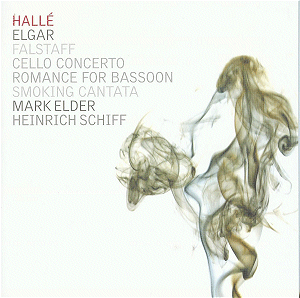
 Andrew Shore (baritone); Graham
Salvage (bassoon); Heinrich Schiff (cello)
Andrew Shore (baritone); Graham
Salvage (bassoon); Heinrich Schiff (cello) 
