The first decades of the 17th century in Italy were an exciting
time: the new 'stile concertato' offered composers all kind of
opportunities to experiment with new instrumental colours and
compositional forms. The regularity of the canzona, based on vocal
models, made way for the sonata, which allowed scope to explore
the individual characteristics of the various instruments.
This disc sheds light on one of the main representatives of the new
style, Dario Castello. In addition pieces by some of his contemporaries
are played. Most are rather well-known, but there is also
music by two hardly-known composers, Giovanni Antonio Bertoli
and Giovanni Battista Spadi da Faenza.
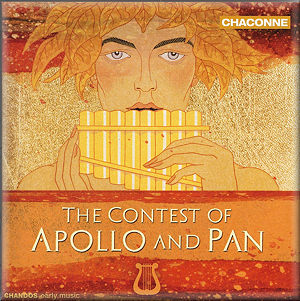
The title of this disc refers to the name of the ensemble. In the booklet
this name is explained thus: "In Greek mythology, Pan
famously challenged Apollo to a musical contest. In the Renaissance,
Pan, often pictured holding a wind instrument, represented
the wild and untamed, whereas Apollo, normally shown with
a stringed instrument, embodied the sublime and refined. These
contrasting qualities are united in the ensemble of violin
and bassoon which in the seventeenth century, with the development
of mixed ensembles, symbolised the opposing forces of Apollo
and Pan".
In a way it is a bit disappointing that the music of Castello has been
chosen, as his music is frequently played and recorded. In
fact, the very first item on this disc, Castello's Sonata
X, is probably his most famous piece. The amount of repertoire
from this time is huge, and I am sure many far lesser-known
compositions could have been chosen. Having said that this
disc gives a nice impression of what was going on at the time
in Northern Italy.
Very little is known about Castello. Here the tracklist gives the dates
of his birth and death, but I don't know where this information
comes from: New Grove, for instance, only says that he flowered
in Venice in the first half of the 17th century. Here he was
the leader of the wind section of the chapel of San Marco.
The fact that he wasn't a violinist is reflected by his 29
sonatas, whose string parts are not overly virtuosic. They
were published in two collections in 1621 and 1629 respectively.
The sonatas on this disc are all from the second book. Considering
his position in San Marco it is not surprising that in his
sonatas he fully explores the possibilities of the dulcian,
often to astounding effect. The Sonata X contains several
highly virtuosic passages for the instrument.
The exploration of the particular qualities of the instruments is not
the only feature of the sonata. Unlike the canzona it consists
of a sequence of passages which contrast strongly in tempo,
metre, scoring and texture. The sonatas here are either for
two or three instruments with basso continuo. The Sonatas
IX and X are for two violins, dulcian and bc, the Sonata IV
for two violins and bc (the tracklist is incorrect in mentioning
the dulcian here) and the Sonatas VII and VIII for violin,
dulcian and bc. The sonatas for three instruments are in fact
very early forms of the trio-sonata which was to become one
of the most popular forms of instrumental music in the second
half of the 17th century. In all sonatas the instruments have
solo passages. The texture also varies: sometimes the instruments
imitate each other, sometimes they speak in parallel. A typical
feature of Castello's sonatas is the repetition of the last
passage of a phrase, like a kind of echo - very popular in
theatrical music at the time.
The programme also contains sonatas by others. One of the least-known
is Giovanni Antonio Bertoli. He was a bassoonist by profession,
and only one collection of instrumental music has been published.
It contains nine sonatas for the bassoon, or dulcian, as played
here, and the sonata VII gives a good impression of his great
skills as a player. It is a sequence of more introverted and
very virtuosic episodes, with frequent leaps and fast passage
work. Bertoli should not be confused with Antonio Bertali,
who at the same time was working at the imperial court in
Vienna. But these two knew each other well, and Bertali was
even one of those who encouraged Bertoli to publish his sonatas.
So did Francesco Turini, who was organist in Brescia. He is
represented here by one of his best-known works, a sonata
on a popular tune at the time, also known as 'La Monica'.
Salamone (or Salomone) Rossi was a composer of Jewish origin. He is
mainly known for his madrigals and his psalms on Hebrew texts.
Here he is represented by a sonata consisting of variations
on an unknown tune. These variations are called 'sonata',
and that shows that there is no watershed between the two
main genres represented on this disc.
Apart from the sonatas the ensemble plays variations in various forms.
For instance divisions on a through-composed piece of music,
like those on Cipriano de Rore's most popular madrigal, Ancor
che col partire, by Giovanni Battista Spadi da Faenza, a composer
about whom nothing is known. Writing divisions over an ostinato
bass pattern was another form. The bass pattern could be a
chaconne or a passacaglia. The latter is represented here
by the above-mentioned sonata by Bertoli, the former by the
Chiacona by Tarquinio Merula. The pieces by Turini and Rossi
belong to a third category: variations on a melodic line.
In the programme notes the Balletto by Biagio Marini is also
counted as belonging to this category. Whereas this piece
shows some inner coherence, the four dances by Buonamente
are much more loosely connected.
Lastly, two keyboard works by Girolamo Frescobaldi, one of the greatest
composers of keyboard music in history. The Capriccio Ruggiero
combines several variation techniques. The toccata could be
compared to the sonata: it also consists of contrasting sections
and finds its origin in improvisation.
The programme played here is entertaining enough in itself, but I would
have preferred the ensemble to be a bit more adventurous in their
choice of repertoire. Some sonatas by Castello have almost cult
status among interpreters of baroque music, and Turini's sonata
is also very well-known. The interpretations could have been a
little more adventurous too. Don't misunderstand me: the players
are all very competent and give fine performances. Sally Holman
deserves to be specially mentioned for her impressive playing
of the dulcian. But in my view these performances are too introverted.
At the time this music was composed we see the rise of the opera,
and there is a general preference for musical drama, not only
in vocal, but also in instrumental music. And that is where this
recording falls a little short. The performances could have been
more exciting, more engaging and more daring. The players keep
it too much on the safe side. But maybe it is just that the contest
of Apollo and Pan has been won by Apollo.
I am sure there are people who will be very happy with these performances.
And I don't want to discourage anyone from purchasing this
disc. It is just that I think this repertoire has more to
offer than is delivered here.
Johan van Veen