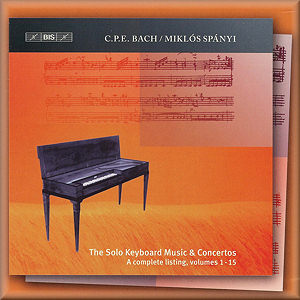
It was an eminently sensible idea of BIS to combine into a double
album
these two discs in the complete edition of C.P.E.
Bach’s keyboard works. If you started with Volume 1, as I did,
you have been collecting since 1995. At that time Miklós Spányi
worked with Concerto Armonico and used a harpsichord. Volume 6
introduced the fortepiano and Volume 8 the tangent piano which
has been a continuing thread. It is a beautiful instrument which
sounds midway between a harpsichord and a fortepiano and can therefore
be quite expressive.
They have saved one of the finest of Bach’s concertos
until this volume: that is the D minor Wq 23 not to be
confused with another fine D minor concerto H425 recorded on
volume 13.
Volume 14 used the Ensemble Opus X and so does
volume 15. This change from using Concerto Armonico was brought
about when the series production moved from Hungary to Finland. Ensemble Opus
X has a somewhat different, arguably more brittle sound, which
oddly enough, seems to work especially well with the tangent
piano.
I have known and loved the wiry D minor work for
many years ever since I first heard it on an LP on the old
Concert Hall label; I suspect many of you ‘of a certain age’
remember them. It was the only concerto in print until quite
recently. Although the instruments were modern it was played
with considerable passion and attack as it is here except possibly
in the third movement where I was quite surprised at the amount
of legato phrasing. Whilst this made a contrast with the spiky,
typically wild and disjunct lines of the rest of the music it
does seem to be slightly out of place. I would love to see in
the score whether C.P.E. has left us any phrasing marks, and
find out how much comes down to the performers from the composer?
Anyway the fingerprints of this great composer are all there.
These comments do not apply to the elegant Bb major
concerto (Wq39).This is a reconstruction of an earlier oboe
concerto, one of two; the other in Eb major can be heard on
volume 14. The style here is ‘galante’ - at times I thought
I was listening to J.C. Bach. However the middle movement is
too long and intense for J.C. and again certain C.P.E. traits
are audible. The outer movements, an Allegretto and an
Allegro Moderato are especially charming. The tangent
piano, now no longer in its infancy but used and developed fully
in recent times, seems ideally suited to these movements. That
said, I feel that I want something a little more expressive
in the slow one.
The concertos are divided by a curious work for
keyboard, strings and some wind doubling with horns especially
notable in the third movement. It is entitled ‘Sonatina’. The
other two of these Sonatina works have appeared in earlier volumes.
They are shorter and lighter than the concertos; more friendly
and far less virtuoso. Falling into three movements the present
Sonatina is a most engaging work, beginning with a fairly slow
movement followed by an Allegro and finally a Minuetto
in which the material given to the strings is often answered
by an ornamented keyboard line.
I have not been collecting discs in this part of
the series so cannot make direct comparisons.
So let’s take it as it is.
The instrument used here is a clavichord - the
same one used in the recording of volumes 10, 12 and 14. In
the interim the pitch has now settled to be a little sharper
than earlier. The instrument is a copy made in 1999 by Joris
Potvlieghe of a clavichord made by Gottfried Horn of Dresden in the 1780s.
CPE especially liked Horn’s instruments. It has a particularly
fine resonance and some dynamic contrast which is unusual in
a clavichord. The two Sonatas, which are of about the same length,
were aimed at the amateur market. They are attractive and elegant
three movement works. The D minor ends with a graceful Allegretto
and the A minor with a spiky Minuet in rondo form. Both
first movements are in binary form alla Scarlatti. In
his booklet notes Darrell Berg tells us that “movements 2 and
3 of the A minor may well originally have been character pieces”
as they have titles of ‘La Guillelmine’ and ‘La Coorl’ for reasons
he explains. Talking of character pieces, there are nine of
them recorded, for example the last track on the CD ‘La Louise’
is a little Rondo which C.P.E. used in other contexts. The identity
of this Louise remains elusive.
Of the remaining ‘character pieces’ but equally
elusive in identity and especially interesting it seems to me
is ‘La Xenophon and La Sybille’ played as da capo pair. As Miklos
Spányi points out in his fascinating ‘Performers Remarks’, these
character pieces were, in Bach’s mind, interchangeable with Sonata
movements. The rather serious ‘La Philippine’ finds itself as
the opening movement of a Sonatina in C major (Wq 103). Equally
fascinating is that some pieces, for instance ‘La Sophie’, also
served as songs because a text is supplied which works for the
right-hand melody of the keyboard part. Spányi describes this
as “an exciting example of cross-over”. To add to the confusion,
the three movements listed with Italian speed indications, were
probably intended to be character pieces. I first heard them one
after the other as little sonata in three differing keys - quite
fun. Probably composed, again, for didactic reasons, these are
binary-form structures and Spányi has composed the ornamentation
for the repeated sections.
In truth some of these pieces are a little trivial
but if you like the C.P.E. of the ‘sturm und drang’ mood then
‘La Gabriel’ and ‘La Caroline’ - who might have been a moody
daughter – like father like daughter perhaps - will excite you.
I cannot speak too highly of this double album
and also of this mammoth series as a whole. Many of the musicians
listed here have been almost constantly engaged in this grand
endeavour for almost two decades. They have given
extraordinarily wonderful performances. The performance
practice is richly informed by academic research that has quietly
gone on in the background. This work, by Peter Wollny, amongst
others is credited by Spányi. It was very much needed, not only because
we have now reached a point in the ‘Early Music’ movement when
an in-depth study of a great individual creative mind was necessary
but also because so much has been learned along the way about
suitable instruments and performing techniques appropriate for
the time and place in which C.P.E. lived. I suspect however
that only those of you with a large library space will have
bought every volume to date, however a random dipping into a just a
few of the CDs as spur of the moment purchases, would, I am
sure, never disappoint.
Gary Higginson