Editorial Board
MusicWeb International
Founding Editor Rob Barnett Editor in Chief
John Quinn Contributing Editor Ralph Moore Webmaster
David Barker Postmaster
Jonathan Woolf MusicWeb Founder Len Mullenger
Ludwig van BEETHOVEN
(1770-1827) Early String Quartets (1798-1800)
CD 1
String Quartet in F, Op.18/1 [28:59]
String Quartet in G, Op.18/2 [23:59]
String Quartet in D, Op.18/3 [24:39]
CD 2
String Quartet in c minor, Op.18/4 [23:28]
String Quartet in A, Op.18/5 [28:47]
String Quartet in B-flat, Op.18/6 [24:33]
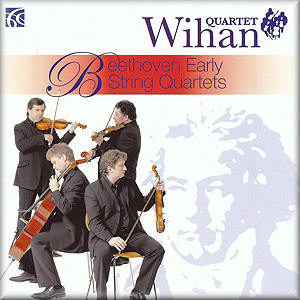
Wihan Quartet
rec. live, Convent of St Agnes, Prague, 18 October, 8 November,
6 December, 2007, 17 January, 7 February, 13 March 2008. DDD NIMBUS ALLIANCE NI6105 [77:43 + 76:44]
It must be noted that these are different recordings from those
available CDs previously on the Lotos label, LT0085-2-131, LT0112-2-131
and LT0052-2-131. Having signed an arrangement with Nimbus, inaugurating
the Nimbus Alliance, their recordings of the late Beethoven Quartets
have already appeared under that new imprint (NI6100). Patrick
Waller found that earlier release something of a mixed blessing,
but thought that 'it should be well worth investigating this
modestly priced set' - see review.
It's clear from the recording dates that these early quartets
were performed in tandem with the late quartets - one of each
per concert, presumably. It's not surprising, therefore, that
my reactions are similar to PW's, namely that these are good
performances which I have been pleased to hear, but they wouldn't
be my first choice.
Even the Op.18 quartets were regarded in their day as unconventional.
Much as Beethoven refused to acknowledge what he had learned from
Haydn, perversely maintaining that he had learned more from Salieri,
his symphonies and quartets show repeated signs of his trying
to outdo Haydn's later works in these genres and the Op.18
quartets are no exception. They are 'early' only in the
sense that the other quartets came later; Beethoven had already
found his voice in the Op.9 String Trios.
Very well played as these Wihan Quartet performances are, I just
miss the last degree of that out-Haydning of Haydn, as, for example,
where a moment of great stillness is followed by a loud exclamation
of the sort that Haydn made something of a trade-mark. The best-known
examples are in the Surprise Symphony, immediately after
the slow introduction, and The Creation, on the word es
werdeLicht, let there be light. When Beethoven
plays the same card, the Wihan Quartet take the edge off it a
little.
From these Wihan performances the young Beethoven emerges as a
very gifted and rather polite composer. The first epithet is certainly
justified, the latter not really. Listen to the very opening of
the first quartet from the Wihans and then from the Takács
Quartet and you'll hear the difference; the Decca performance
(470 8482) makes the connection between Op.18 and the middle-period
works much more apparent. This is even more the case in the slow
movements of this and several of the other quartets. Michael Cookson,
reviewing Op.18/5 on a super-budget compilation of Takács
recordings available only from Buywell, though preferring the
Quartetto Italiano, put his finger on the qualities which the
Takács bring to this music when he wrote '[they] are
thoroughly at home here and play as a single voice' - see
review.
Tempi are part of the difference between the Wihan and Takács
performances, though not, of course, the whole story. In Op.18/1
the Takács are very slightly faster throughout and this
makes their performance just that little more urgent, especially
in the finale. The same is true of most of the rest of the set;
when the Takács give themselves a little more space, as
in the slow movement of Op.18/2, their 6:30 against the Wihan
5:54 gives their andante just that little extra room to
sound truly cantabile. Conversely, in the slow movement
of Op.18/3, their tempo, six seconds faster, allows them to emphasise
the second part of the direction andante con moto.
Taken on its own, the Wihan Quartet performance of Op.18/6 is
very impressive, with powerful playing in the finale. The opening
section of this finale, entitled la Malinconia, depicts
melancholy before the mood in the main body of the movement changes
to one of joy. The depiction of a mood or state of mind in music
was not new - Jan Dismas Zelenka had composed a whole suite depicting
hypochondria and Haydn had explored a number of moods in his Sturm
und Drang symphonies, but Beethoven's manner here anticipates
many aspects of his later quartets, with joyful and mellifluous
passages interrupted in mid flight by ominous chords before being
allowed to resume.
The Wihans cope well with the drama of this movement until one
compares them with the Takács performance. In the latter
hands the movement opens almost inaudibly and at a slower tempo,
as if wisps of thought are curling around in the atmosphere before
settling into an altogether firmer sense of thoughts that lie
to deep for tears - certainly too deep to be put into words. When
the first strands of joyfulness creep in, they, too, begin tentatively
before being allowed full rein. Paradoxically, though they take
longer than the Wihan Quartet (8:20 against 7:39) their version
of this movement actually sounds shorter.
Though these are live performances, the audience remains incredibly
quiet. I'm not sure whether the applause at the end of each
work sounds polite rather than enthusiastic because the audience
shared some of my reservations or because they were so incredibly
well behaved.
On first impression the recording is very clear. It sounds fine
on the beefier of my systems, but a little thin on the other.
I hear the first violin a little too clearly, the cellist slightly
less prominently, and the inner parts get a little lost - but
that's a common problem with string quartet recordings and
I don't want to make too much of it. The Decca recording for
the Takács Quartet is much more truthful in presenting
all the parts without making the first violin too prominent.
The notes in the Nimbus booklet are extremely detailed and informative.
The significance of Haydn's last completed quartets, Op.77,
and Beethoven's first set, Op.18, being dedicated to the same
Prince Lobkowitz had passed me by before reading Misha Donat's
notes. I noted just one typo: the track listing gives the opening
of the finale of Op.18/6 as La Malincolia, correctly given
as La Malinconia (melancholy) in the notes.
I've been making recommendations for the middle and late quartets
in recent Download Roundups, but haven't yet got round to
the Op.18 set. This new set from the Wihan Quartet enters a strongly
competitive market in which, for example, even such good performances
as those of the New Budapest Quartet (Hyperion CDA66401-3) are
not among the front runners and are now available only from the
Archive service. Similarly, though these Wihan Quartet performances
would shine in a less competitive field, there are better versions
to be had.
The Italian Quartet recordings seem not to be available at present,
so I think it has to be the Takács recording, on a 2-CD
set for around £20 or available for download for £15.99
from passionato.com
in very acceptable 320kbps mp3 sound. I haven't heard the
Tokyo Quartet versions but I very much liked their middle quartets;
they are also economically presented on 2 CDs (Harmonia Mundi
HMU90 7436.37), or available to download in 256kbps sound from
Amazon.co.uk; be warned, however, that at least one online dealer
has them for just over £12, over £1 less than the
cost of the download. For all the virtues of the Borodin Quartet,
they run to a less economical three CDs (CHAN10381, downloadable
from theclassicalshop.net - see Paul Shoemaker's review
of the whole Borodin series).
Brian Wilson
Footnote July 2007
NB: I was in error when I reported that the Quartetto Italiano
set of the Beethoven Quartets was no longer available. The separate
set of the Early Quartets does seem to have disappeared from general
availability but our partners at Arkivmusic.com have the complete
Quartetto
Italiano set of all Beethoven’s Quartets for $77.99,
though they report that stock is low. Our other partners at Crotchet.co.uk
and Amazon.co.uk
also have the complete set for £56.72 and £55.79 respectively.
Please support our advertisers below by clicking on the logos for further information.