Editorial Board
MusicWeb International
Founding Editor Rob Barnett Editor in Chief
John Quinn Contributing Editor Ralph Moore Webmaster
David Barker Postmaster
Jonathan Woolf MusicWeb Founder Len Mullenger
Buy
through MusicWeb for £14.99 postage
paid World-Wide.
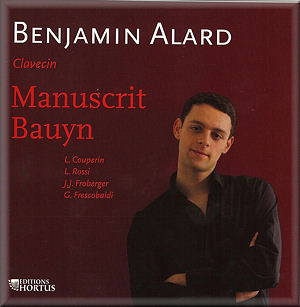
Manuscrit Bauyn Louis COUPERIN (c.1626 - 1661) Pièces en la [16:36] Luigi ROSSI(1598 - 1653) Passacaille [02:57] Johann Jakob FROBERGER (1616 - 1667) Toccata in D [04:19] Girolamo FRESCOBALDI (1583 - 1643) Capriccio in G [02:54] Johann Jakob FROBERGER Allemande (faite à Paris) [04:22] Gigue (nommée la Rusée Mazarinique) [02:18]
Toccata in F [03:49] Louis COUPERIN Pièces en fa [19:00] Benjamin Alard (harpsichord)
rec. 6-8 April 2008, Church Saint-Martin of Arossa, Pyrénées
Atlantique, France. DDD HORTUS 065
[56:24]
The Bibliothèque Nationale de France contains a manuscript
of a little more than 350 compositions written in the 1640s and
1650s, mostly for keyboard. It is named 'Manuscrit Bauyn', after
André Bauyn de Bersan, the first owner of the manuscript.
The largest part contains French music, by Jacques Champion de
Chambonnières (1601/02-1672) who may be considered the
father of the French harpsichord school, and Louis Couperin, whose
career as a musician was decisively influenced by Chambonnières.
The third section contains 15 pieces by French, German, Italian
and English composers. Thus the manuscript sheds an interesting
light on the connection between French and in particular Italian
keyboard music. Froberger was German but through his training
by Frescobaldi his compositions were strongly influenced by the
Italian style.
It was in particular after the middle of the 17th century that
an antagonism between French and Italian music emerged. But in
the first half of the century many music lovers in France greatly
appeciated Italian music. In 1605 Giulio Caccini and his family
visited Paris and in particular the singing of his daughter Francesca
was widely admired. Later on operas by Francesco Cavalli and Luigi
Rossi were performed. One of the advocates of Italian music was
Cardinal Mazarin, himself of Italian birth. And even when the
French started to emphasize the importance of keeping the pure
French taste alive there was always an undercurrent of support
for Italian music.
One of the main composers of keyboard music after Chambonnières
was Louis Couperin. In 1652 Johann Jakob Froberger paid a visit
to Paris. He was then at the service of the Imperial chapel in
Vienna, but in 1649 the empress died and as a result the musical
activities at the court were limited. This could well have been
the reason Froberger made a journey through Europe, which brought
him as far as London. The contact with Froberger had a considerable
influence on Louis Couperin. His 'préludes non mesurées'
- which belong to his most famous compositions - are modelled
after the toccatas by Froberger. The disc opens with a Suite in
A which begins with a 'prélude à l'imitation de
M. Froberger'. This superior piece as well as the much shorter
prelude of the Suite in F show great similarity to the two Toccatas
by Froberger which are also recorded here. They all reflect the
stylus phantasticus with its juxtaposition of free, improvisatory
and more imitative sections.
The two suites by Louis Couperin don't appear as such in the manuscript.
It is up to the interpreter to choose pieces to play in the form
of a suite. At the time the form of the suite wasn't fully fixed,
but there was a development into a structure which contained the
sequence of allemande, courante and sarabande. Those are the heart
of the two suites on this disc. Both are introduced by a prelude
and in both suite a lighter dance is added: la Piémontoise
and Branle de Basque respectively. The Suite in F also contains
a chaconne: one of Couperin's best-known pieces, and in my view
one of the most beautiful chaconnes ever written.
We also get here two pieces which Froberger has written while
in Paris: the Allemande 'faite à Paris' and a gigue which
is sometimes called 'la Rusée Mazarinique' - referring
to the slyness of Cardinal Mazarin and the ups and downs in his
career. The gigue's beginning is remarkable because of the irregular
rhythm. As Froberger introduced the music of his teacher Frescobaldi
in France it is nice that his Capriccio in G is also included.
With its many twists and turns it is a capricious piece indeed,
another example of the stylus phantasticus. The Passacaille by
Luigi Rossi is the only keyboard work by this Italian composer
which has been preserved. He was mainly famous for his operas
and cantatas.
The disc ends with another famous work: the Tombeau de M. de Blancrocher
by Louis Couperin, here played as the last movement in the Suite
in F. Charles Fleury, sieur de Blancrocher, was a lutenist, and
he became a close friend of Froberger. But the friendship didn't
last long: Blancrocher fell down the stairs and died during Froberger's
stay in Paris. Both Louis Couperin and Froberger wrote Tombeaus
for Blancrocher. Couperins piece is a superior work in which the
ringing of death bells is repeated several times.
This is also one of the highlights of this recording. It is superbly
played by Benjamin Alard whose performance is absorbing and highly
expressive and profits from the sonorous bass of the harpsichord.
The tension never decreases despite the moderate tempo. That is
a feature of this whole recording: the tempi are mostly moderate,
even in a piece like the Branle de Basque which is often played
very fast. In his performance Alard adds some nice ornamentation.
The Prélude à l'imitation de Froberger which opens
this disc is also brilliantly played, with an excellent realisation
of the contrast between the various sections. The more light-weight
pieces, like the courantes in both suites, are played with flamboyance
and playfulness.
The programme has been well put together: there is a clear coherence
despite the variety in genres and styles. The playing by Benjamin
Alard is most impressive, both technically and in regard to interpretation.
He uses a splendid harpsichord and the programme has been well
recorded. The booklet contains informative programme notes in
French and English and information about the instrument. In short,
this is a superior disc and not to be missed.
Johan van Veen
Please support our advertisers below by clicking on the logos for further information.
























 Benjamin Alard (harpsichord)

