The recording of this second volume in the Gothic Voices’ series, The
Spirits of England and France, followed hard on the heels
of the first, recorded in March 1994 and now also on the budget-price
Helios label (CDH55281). Three further volumes were to follow
and it is to be hoped that these, too, will be reissued on Helios
in the near future; the reissue of all five volumes on CDH55281-5
was announced as long ago as the 2006/7 Penguin Guide Yearbook.
Let me direct you to that earlier review in
order to reinforce my recommendation of Volume 1.
Whereas the first volume cast its net widely from the twelfth
to the fifteenth century, volume 2 concentrates on the music
of the trouvères, the Northern French equivalent
of the Provençal troubadours, writing in the language
which was the precursor of modern French. Though there are similarities
between the troubadours and trouvères, the
two should not be confused as, unfortunately, that review in
the Penguin Guide Yearbook seems to do. You might wish
to acquaint yourself with their troubadour precursors
first, in which case you could do much worse than to try various
recordings by the Martin Best Consort and Ensemble on Nimbus: Forgotten
Provence (NI5445 - see review), Amor
de lonh - The Distant Love of the Troubadours (NI5544 - see review)
and The Last of the Troubadours (NI5261 - see review).
The themes will be familiar to anyone with the slightest acquaintance
with medieval poetry of fin’amors or Courtly Love.
It may have been a game - most scholars now think that CS Lewis
took it too seriously in his seminal work on the subject, The
Allegory of Love - but it was a serious literary and musical
game. The fin’amors of Lancelot and Guinevere destroyed
King Arthur and his entourage and Gawain’s dalliance with
the Lady of the Castle of Hautdesert almost cost him his life
at the hands of the Green Knight and led to his eternal shame:
Þ
is is þe token of vntrawþe þat I am tan inne
and I mot nedez hit were wyle I may last ...
for þer hit onez is tachched twynne wil hit neuer
[This is the token of the unfaithfulness that I was caught in
and I must needs wear it while I live; the stain never departs. Sir
Gawain and the Green Knight, ll.2509-12)
The courtly lover’s lot was hard: the first of the Grand
Chants on the CD, Gace Brulé’s Desconfortez,
plains de dolor (‘Disconsolate, full of sadness’,
track 2) has all the ingredients: ‘she whom my heart most
desires is killing me.’ Six of the tracks belong to this,
the purest form of trouvère music.
If you know the Middle English Harley Lyrics, you’ll
know that, while many of them belong to this purer type, there
are also some of a more down-to-earth nature, such as The
Wild Women of Ribblesdale:
Mosti ryden by Rybbesdale,
Wilde wymmen forte wale,
And welde whuch ich wolde,
founde were þe feyrest on
þ at euer was mad of blod ant bone,
in boure best with bolde.
[‘As I rode by Ribblesdale to choose wanton women and master
any that I wished, I found the fairest one that ever was made
of flesh and blood, one of the most valiant in her bower.’ No.7,
ed. Brook, ll.1-5]
On this CD, the Pastourelles belong to this earthier type,
as on track 1, Richart de Semilli’s Je chevauchai.
This takes the form of a Chanson d’aventure: the
singer rides out, finds a shepherdess who is waiting for her
lover - almost inevitably named Robin - has his will of her,
kisses her and leaves her to defend herself from Robin’s
censure on the grounds that his delay was to blame. The blunt
statement Quant j’oi tout fet de li quan’il m’agree -
when I had done everything that I wanted with her - leaves even
less to the imagination than one of the Harley chansons d’aventure - In
a fryth as y con fare fremede: ‘As I was passing through
an unfamiliar wood’ - where, after token resistance, the
girl suddenly yields:
Þ
e beste red þat y con to vs boþe
þ
at þou me take ant y þe toward huppe
[‘The best thing for both of us would be for you to take
me and for me to move towards you.’ No.8, ed. Brook, ll.41-2]
In Quant voi la fleur nouvele (tr.7) the girl is less
willing but the result is the same - the singer, smitten by unendurable
pain when the flowers appear in the Spring, takes the girl
by force :
Pris la par la main nue,
Mis la seur l’erbe dure;
[‘I took her by the bare hand and laid her on the hard
grass.’]
Because the Pastourelle represents a ‘lower’ tradition
than the Grand chant, two of the three examples here are
accompanied.
The balade, a word derived from Provençal, is represented
by track 9, Un chant novel. Because of the dance associations
- the word is the ancestor of both our modern English words ballad and ballet -
percussion is employed here, too, to support the voice.
The Descort, or discordant style is also represented by
just one example, Gautier de Dargies’ La doce pensee (tr.12).
The discord lies in the fact that the stanzas are different from
each other, the lines of the second stanza being notably different
in length from the others.
Track 14, Adam de la Halle’s Assenés chi, Grievillier,
is a Jeu parti, or debate song, in which Adam himself
and Grievillier cosnsider how best to exalt love.
The final vocal item, Audefroi’s Au nouvel tens pascor (tr.18),
a Chanson de toile, literally embroidery song, tells the
story of Argente, the wife of Count Gui, abandoned by her husband
for his mistress Sabine and sent into exile. The song’s
burden, that whoever is wed to a bad husband often has a sad
heart, switches the genders of the usual medieval version of
that saying.
To modern ears the monophonic song of this period may seem to
lack variety, but there is a degree of variety in the programme,
as will be seen from the descriptions of the various forms briefly
outlined above. It might be useful for the listener to know a
little of medieval literature - most could probably place Tristan
and Iseult, named in Donna pos vos ay chausida (tr.5)
but fewer would probably recognise Erec and Enide, from Chrestien
de Troyes’ Erec, among the lovers whom the singer
claims to excel.
In accordance with Christopher Page’s normal practice,
most of the vocal items, including all the Grands Chants,
are performed unaccompanied, but there is more variety than on
many of his recordings: tracks 1, 5, 7, 9 and 13 are accompanied
by percussion, fiddle or lute. I can honestly report that my
ear did not crave an accompaniment in the other items. All the
singing is excellent; though a great admirer of Emma Kirkby,
I have to admit that her performances here (trs. 5 and 9), excellent
as they are, are equalled by the other contributors. It would
be invidious to single out any one performer.
It goes without saying, with Christopher Page at the helm, that
the scholarship of these performances, including the Old French
pronunciation, is impeccable. That doesn’t mean, however,
that everything is boringly proper. Some of the singing, as from
Margaret Philpot on tr.13, is appropriately forthright, though
none of it ever approaches the gloriously OTT style which used
to be associated with Jantina Noorman and Musica Reservata.
Two other instrumental forms, both probably originating as dances,
are included here as interludes between the vocal items, the Dansa and
the Estampie. The Dansa originated in Provence
- it is, indeed, an Occitan word, the language of that area -
but the examples included here are late and modified by Northern
French practice. The Estampie or Istampita probably
also originated as a dance but figures in medieval manuscripts
as an instrumental interlude, often intended for fiddle players
to show off their technique.
The performances are all that we have come to expect from Gothic
Voices, contriving to be scholarly and entertaining at the same
time. The recording, too, is fully up to Hyperion’s usual
high standards.
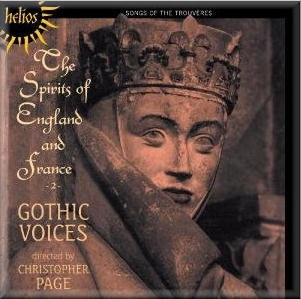
The presentation, too, is of the usual high quality, though the
photograph of a statue of Countess Uta is much less colourful
than the manuscript illustration on the cover of the first volume.
The booklet is a straight reprint of that for the original full-price
issue, with Christopher Page’s notes - scholarly but accessible
- full texts and translations. Just occasionally I thought that
the translation could be improved, as when sans retor (tr.12)
is translated as ‘without renunciation’, when I should
have thought ‘without respite’ more to the point.
As usual, prospective purchasers may sample excerpts and read
the booklet on the Hyperion
website.
Otherwise, lovers of medieval music may order with confidence
- and don’t forget the first volume (CDH55281).
Brian Wilson
Details
Richart de SEMILLI (fl.1200-1200) Je chevauchai1,6 [2:37]
Gace BRULÉ (c.1160-after 1213) Desconfortez,
plains de dolor [5:11]
ANONYMOUS - Medieval Estampie I7 [1:12]
Gace BRULÉ Quant define feuille et flor4 [3:20]
ANONYMOUS - Medieval Donna pos vos ay chausida 3,6 [1:31]
Gace BRULÉ De bien amer grant joie atent1 [4:41]
ANONYMOUS - Medieval Quant voi la fleur nouvele1,8 [2:38]
Gontier de SOIGNIES (fl. before 1220) Dolerousement
comence2 [4:12]
Guibert KAUKESEL (fl. c.1230-1255) Un chant
novel3, 10 [2:04]
Gace BRULÉ Cil qui d’amours4 [4:20]
ANONYMOUS - Medieval Estampie II7 [1:18]
Gautier de DARGIES (c.1165-after 1236) La doce
pensee2 [4:40]
ANONYMOUS - Medieval Amors m’art con fuoc
am flama1,8 [1:48]
Adam de la HALLE (1245/50-1285/8) Assenés
chi, Grievilier4 [3:35]
Ernoul le vielle de GASTINOIS (fl. c.1280-1280) Por
conforter mon corage5 [3:22]
ANONYMOUS - Medieval Estampie III9 [3:20]
Guibert KAUKESEL Fins cuers enamourés2 [3:44]
AUDEFROI le bastart (fl.1190-1230) Au novel
tens pascor1 [7:25]
Margaret Philpot (alto)1; Rogers Covey-Crump (tenor)2;
Emma Kirkby (soprano)3; Henry Wickham (bass)4;
Leigh Nixon
(tenor)5); Pavlo Beznosiuk (fiddle)7; Robert White (bagpipes)8;
Pavlo Beznosiuk (fiddle)9; Nick Bicat (percussion)10/Christopher
Page (lute6)


























 Gothic Voices/Christopher
Page
Gothic Voices/Christopher
Page
