Here is an early entrant for best new composition of the year
- Roberto Sierra’s Missa Latina, or Latin Mass, written
in 2008 for the National Symphony Orchestra and Leonard Slatkin
and here receiving its world-premiere recording. Sierra, originally
from Puerto Rico, has a great deal of style-hopping music to
his credit; he studied with Ligeti in Europe and has composed
works which range in tone from Ligeti’s own experimental
sensibilities to folk rhythms and styles of Sierra’s Caribbean
homeland. His populist side was previously best illustrated by
the Symphony No. 3, appealingly entitled the “Salsa Symphony” -
and, indeed, this new mass could be considered the Salsa Mass.
The merger of the salsa and the sacred is signaled by the work’s
title, which, as Sierra explains in his helpful but rather terse
liner notes, has a double meaning. Missa Latina refers to both
Latin - the language of the text - and Latino - the composer’s
heritage. Thus much of the work has a strong Caribbean undertow,
and the “Latino” side of the work often becomes overt
in marvelous salsa-influenced passages with dancing percussion
and swinging vocal lines.
The Missa Latina is a big, grand, complex work for soprano, baritone,
full chorus, and an orchestra equipped with a large Latino percussion
battery. But, despite its length of nearly seventy minutes, this
piece is almost never intimidating. The style is eminently approachable,
the music is consistently tonal, and generally the work sounds
quite attractive. There is a tendency toward the serious and
ominous, however, which is sometimes incongruous alongside the
salsa elements of this mass - as if Sierra had written two works,
one a jubilant hymn to his homeland and the other a troubled
work of introspection, and woven them together. It is likely
that most listeners will prefer one of the work’s atmospheres
to the other; I prefer the down-home joy.
The opening Introitus actually betrays little of the outgoing
style of the movements to come; it begins tentatively, the soprano
singing with sparse accompaniment. The chorus only joins in halfway
through the movement, and, although some of the Latino percussion
slithers in near the end, the general mood is dark and uncertain.
Heidi Grant Murphy, who sang in the world premiere performance
of the Missa Latina, sings with conviction and beautiful tone.
Kyrie is an even more troubled movement, but it also offers a
fine example of Sierra’s mixture of the two meanings of “Latina,” since
the foreboding, resolutely tune-free atmosphere regularly does
battle with spots of folk color - like the delightfully jazzy
clarinet line which wends its way through the midsection. At
the beginning of Gloria, Sierra finally strikes gold. The newly
hopeful - and decidedly nationalistic - atmosphere builds amid
Latino percussion and syncopated tunes, up to a truly marvelous
passage (“Laudamus te”) for baritone Nathaniel Webster,
backed up by a swinging choir and some fantastic orchestral detail
(great trumpet licks!). The soprano then answers with a more
lyrical interlude, magical in its own right, and the two moods
alternate for the rest of this passage, building to a sumptuous
close.
The following Credo, however, is the work’s most problematic
section. It is, to put things mildly, far too long: frankly,
in the twenty-one-minute-long movement I found myself looking
at the CD player’s timer to see how much longer it would
go on. It could have done with a serious trim, and the Introitus
and Offertorium are rather flabby as well. The Credo is the worst
offender, though, and when you hear the excessive repetition
of the final “Amen,” you will surely agree. That
single word is sung, by my count, 26 times!
After a rather undistinguished Offertorium, the Sanctus bursts
onto the scene as a triumphant answer to the troubles of earlier
movements. This is the heart of the work, a triumphant mix of “Latin” and “Latino” with
a dash of Leonard Bernstein for good measure; the final Agnus
Dei extends this delight in building to a marvelously affirmative
conclusion.
I would hesitate to call the Missa Latina a masterwork. Unlike
the best works of its kind - and I am thinking in particular
of another distinctively modern, fervently nationalistic approach
to the old-fashioned mass genre: Janáček’s
Glagolitic Mass - Sierra’s ideas do not always flow organically
from each other - they sometimes seem more like one thing after
another than a logical development of a central argument. I often
yearned to hear ideas elaborated further, only to discover that
they never appeared again at all, like Webster’s irresistible
melodic line in Gloria or, later in that movement (at 8:02),
a truly marvelous oboe solo, which as far as thematic material
goes must be counted a red herring. Janáček was not
one to give us obvious melodies or a rigidly formal structure,
either, but the flow of his music, and the feeling that each
event in the score is a necessary consequence of the last, is
something lacking in a great deal of the Missa Latina. Take Sierra’s
Offertorium: the movement is structured as a gradual transition
from darkness to light, just like the Sanctus (“Svet”)
in Janáček’s Mass. But, whereas in the Czech
work the arrival of light signifies an absolute triumph, in Sierra’s
it makes absolutely no narrative sense. It is almost as if a
mariachi band has mistakenly barged into a funeral.
That said, some sections of this work are unquestionably great,
and I do not want you to get the wrong idea. Nearly all of the
Missa Latina is thoroughly enjoyable, and much of it is fantastically
written music. The Sanctus in particular is an absolute marvel,
and the Gloria and Agnus Dei are not far behind. Murphy and Webster
are superb soloists and their parts are consistent delights,
the Milwaukee Symphony Chorus and Orchestra are superb (especially
the terrific brass section), and conductor Andreas Delfs, a longtime
collaborator with Sierra, gives us an interpretation which is
unlikely to be bettered anytime soon. Nearly everyone will be
able to enjoy this work, and Sierra, though not yet expert in
creating a strong narrative, has put together some brilliant
orchestration here. At Naxos’ price, trying this work out
is a simple matter, and unless you are expecting a masterpiece
I do not think you will be disappointed. There is much to love
about the Missa Latina. If it were twenty minutes shorter, this
work would be an instant classic; as is, it is still very much
worth anyone’s time.
If I may make a suggestion, however: if Sierra does revise this
work for further performance, Deutsche Grammophon would be wise
to convince conductor Gustavo Dudamel to present this work with
the Los Angeles Philharmonic Orchestra. (They should retain the
vocal talents of Murphy and Webster.) This music seems tailor-made
for Dudamel and his new band, as is Sierra’s “Salsa
Symphony,” which deserves a far wider audience too. Now
there is a disc I would love to hear - but until then, this one
is very strongly recommended. Fine new music in a truly dedicated
performance. The Missa Latina is too long and disorganized to
achieve greatness, but that does not stop it from having a marvelous
good time.
Brian Reinhart
Naxos American Classics review pages
























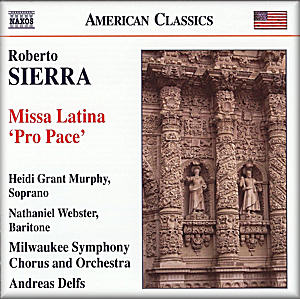

 Heidi Grant Murphy
(soprano); Nathaniel Webster (baritone)
Heidi Grant Murphy
(soprano); Nathaniel Webster (baritone) 
