Editorial Board
MusicWeb International
Founding Editor Rob Barnett Editor in Chief
John Quinn Contributing Editor Ralph Moore Webmaster
David Barker Postmaster
Jonathan Woolf MusicWeb Founder Len Mullenger
Sergey
RACHMANINOV (1873-1943)
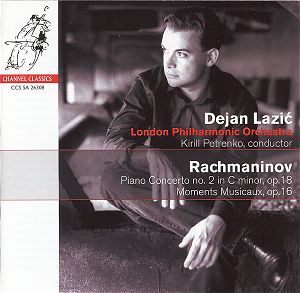
Piano Concerto No. 2 in C minor, Op. 18 (1900-01) [34.34] Moments Musicaux, Op. 16 (1896) [30.21] Dejan Lazić (piano)
London Philharmonic Orchestra/Kirill Petrenko
rec. live, Royal Festival Hall, London, England, May 2008
(op. 18); Muziekcentrum Frits Philips, Eindhoven, The
Netherlands, May 2008 (op. 16), SACD
Booklet notes and artists’ biographies in English, German
and French CHANNEL
CLASSICS CCSSA26308 [64.15]
The Piano
Concerto No. 2 was composed after the deep depression
that followed the failure of the First Symphony. According
to historical sources, Rachmaninov was not appreciated
in St. Petersburg, where the symphony was premiered in
1897. He had been expelled in 1885 from the local conservatory
and had then completed his studies in Moscow. The premiere
of the First Symphony was conducted by Alexander Glazunov
(1865-1936) who reportedly was drunk and trashed the
work. The critics relished the opportunity and completely
destroyed the composer and the composition. Rachmaninov
believed that he was unfit for composition and began
drinking immoderately while attempting other career paths,
namely as a concert pianist and a conductor. By the end
of 1899 he was an alcoholic, whose hands shook heavily,
stopping him from playing the piano. From January to
April 1900, Rachmaninov had then the good sense of visiting
daily a Dr Dahl, a Moscow specialist in “neuro-psychotherapy” or,
in other words, hypnosis and was urged during these sessions
to compose a new piano concerto that had been commissioned
by a London impresario. The trance therapy brought Rachmaninov
back from the dead and shook him out of his lethargy.
He composed with great ease this new and wonderful piano
concerto: The No. 2 in C minor, which he dedicated
to Dr Dahl, as a token of his gratitude for the therapy.
Rachmaninov was never again impaired by depression in
spite of some bad turns of fortune in his life.
The Piano
Concerto No. 2 is formed of three movements and is
classic in its structure. It is also possibly the best
known and most widely recorded of Rachmaninov’s piano
pieces, perhaps with the exception of his Variations
on a Theme by Paganini. One may be forgiven for wondering
why it might be necessary to record it again but this
is the kind of situation that continuously happens with
popular pieces. It is always an enriching experience
to listen to a new interpretation. This performance was
recorded live at the Royal Festival Hall in May 2008
and although the various reviews, which I read at the
time, were complimentary of the pianist, several complained
that he could not be heard during the parts of the first
and last movements when the orchestra joins in. I was
therefore eager to listen to it and judge for myself.
Dejan
Lazić is a fine pianist but I am sorry to have to
say that his performance failed to impress me. Although
the piano is heard in this recording much clearer than
it must have been live, one still gets the impression that
it is not completely there. The opening chords of the first
movement, Moderato; Allegro, are perfectly played,
leading the way for the powerful entrance of the orchestra.
After that the piano fades into the background, almost
as if the pianist was hitting the keys with a surprising
lack of strength. This concerto and particularly, the first
movement are dominated by a dark, expressive mood that
requires a pianist that understands the emotions within
the composer’s mind and narrates the story contained in
the music with passion and drama. Personally, I think that
Lazić’s playing lacks these qualities; he is too soft
and that is why when the orchestra is present, he no longer
takes centre-stage. This situation is completely reversed
when we get to the second movement, Adagio sostenuto.
Here, Lazić is definitely in his element and he excels.
His interpretation is beautifully evocative, almost poetic
and he approaches the instrument in a sensitive manner;
his playing is very delicate, nearly feminine in style.
It is a wonderful rendition of the second movement and
one that I found myself playing over and over again. However,
once one gets to the third and final movement, Allegro
scherzando, the piano does not disappear as such but
one forgets that it is actually there. This is a piano
concerto and not an orchestral piece as such. Therefore,
hearing mostly the orchestra and hardly noticing the pianist
is obviously not the objective. There were moments, during
the third movement where Lazić appeared hesitant,
as if his fingers lacked the dexterity or the strength
to play. The London Philharmonic, on the other hand, under
the excellent leadership of Kirill Petrenko, gives a magnificent
performance. The orchestra is in perfect tune with the
conductor and dramatically very expressive, in particular
during the darker C minor mood of the first movement and
the glorious contrasting C major of the final one. Petrenko
is undoubtedly a fabulous conductor: passionate, insightful
and inspiring. I can hardly wait to watch him live.
The
second work, Moments Musicaux,
is an earlier piece that Rachmaninov composed in 1896,
before his breakdown. It is a set of six precious little
gems for solo piano, imposing and difficult, but that complement
each other harmoniously, which renders them perfect for
a complete performance. With his interpretation of these
pieces, my confidence and belief in Lazić’s attributes
as a pianist were fully restored. He really comes into
his own without the orchestra’s presence and this demonstrates
why he is such a fabulous chamber musician. His performance
is engaging and virtuosic, beautifully expressive and emotional
but he does not allow himself to indulge in romantic sentiment.
His rendition remains sober yet deeply felt, moving and
personal. His playing is precise and his technique impeccable
and pure. A real treat and a joy to listen to.
The
sound quality of the recording is, like with all hybrid
CDs, excellent however one listens to it, however it is
really superior when played on the appropriate SACD equipment.
The sound is crystal clear; every note is noticed, every
little nuance is present and does not disappear. I derive
great pleasure from this brilliance of sound and in some
instances, as with the best orchestral parts, I found myself
with my eyes closed, thinking I was in a real concert hall.
Dejan
Lazić’s interpretation of Rachmaninov’s Piano Concerto
No. 2 is perhaps a little disappointing and definitely
not one of the best I have ever heard, however his is a
solid performance, with a wonderfully played second movement.
If you are not bothered that the piano fades during the
orchestra’s passages, then stick to it because you are
in for a treat when you get to the interpretation of Moments
Musicaux.
Margarida
Mota-Bull
Please support our advertisers below by clicking on the logos for further information.

























 Dejan Lazić (piano)
  [64.15]
