It is a fairly established “rule” that, while opera and oratorio
arias are written for specific voice-types and are sung only by
those voice-types, music for voice and piano – lieder, mélodies
and so on – may be transposed up or down to suit the singer. Most
of Brahms’s songs were issued in two or three keys during his
lifetime as a matter of course. Just occasionally a composer felt
more strongly about the matter. In Brahms’s case, op. 121 was
described in the title as “Four Serious Songs for Low Voice and
Piano”. By and large his wishes have been respected. In this performance
the songs are put up a minor third.
Oddly
enough, this affects the piano more than the voice. By this
time in her career Flagstad was no longer young and had retired
from the operatic stage. Her voice, always powerful and solid,
had a dark quality, something like a contralto but with a
soprano range. As a result the voice does not sound “wrong”
the way a more typical soprano lieder singer – such as Schwarzkopf
or Seefried – would. We can still appreciate her fail-safe
intonation and generally rock-steady delivery. Just occasionally
the notes of her passaggio – Fs and Gs – seem a tad
queasy, but above there the As and the one B flat are still
splendidly firm. If she doesn’t convey to me quite the frisson
I get from Kathleen Ferrier in these songs, I think it
is the old story of the prevalently operatic singer being
a bit generalized in her expression when it comes to lieder.
And
so to the piano. The problem is admittedly endemic to vocal
chamber music. Imagine playing your favourite Brahms piano
pieces a third higher than written and trying to give them
the same body of sound they have in the original key. Or playing
them a third down and trying not to make them sound any grumpier
than they do as written. The pianist working in the lieder
field is continually up against this problem. But somehow,
maybe because we’re not used to hearing these particular songs
in a range of keys, maybe because Brahms himself gave freer
rein to his pianistic fantasy than usual under the assumption
that the music would not be transposed, these particular songs
emerge with reduced impact. It doesn’t help that the piano
is a little backwardly placed, as mono recordings tended to
be in those days, though the Ferrier is worse from that point
of view. McArthur is playing splendidly but the backdrop of
Brahmsian richness is missing.
With
orchestral accompaniment Flagstad’s voice seems in its natural
habitat. But there is the question of the transpositions here,
too. It is the general “rule” that orchestral songs, like
operatic arias, are sung in the original keys, and that you
don’t transpose these two Mahler cycles up a third for soprano
any more than you would transpose R. Strauss’s “Four Last
Songs” down a third for contralto.
Here,
as in Brahms, the problem proves not to be the voice. The
richness and gravity of Flagstad’s timbre actually convince
the ear that it is listening to a lower voice. But then there
is the orchestra. Quite apart from the work involved in copying
out new parts, just imagine, also in this instance, your favourite
romantic symphonies being played a third higher than written.
The bass would be lightened and many of the wind solos would
be shifted up from a “convenient” to a “difficult” register
of the instrument. It says much for the Vienna Philharmonic
that, apart from occasional signs of strain from the horns,
they make the music convincingly sound as if it had been written
that way.
The
apparent eccentricity of carting Boult out to Vienna to record
Mahler is belied by the remarkable artistic collaboration
that emerges. We know from Boult’s Beethoven, Brahms and Elgar
that he was something of a master of the free-flowing slow
movement, swift and un-indulgent alongside many of his colleagues.
His Brahms “Alto Rhapsody” with Janet Baker is a celebrated
case, one of the fastest on record. His Mahler is a less well-known
factor. The tempi here are among the slowest I’ve heard. This
helps to restore the gravity that the upward transpositions
might have taken away. What I didn’t expect was to find Boult
so idiomatic in his handling of the sadly trudging bass-lines
and the halting movement, the sensation of holding back the
music and then releasing it as the harmonies change, so typical
of Mahler. This goes beyond mere “good accompanying”. Nor
can it be explained away by saying the Vienna Philharmonic
had this style in their bloodstream, for they notoriously
didn’t provide it for just anyone. The same may be said of
the transparent textures and restrained yet tangy wind solos.
In any case, listen to the many passages where the orchestra
takes over from the voice, and vice versa, and you have to
be impressed by the total unity into which singer, conductor
and orchestra have been forged, and that can only have come
from the rostrum.
As
to the interpretations, I found “Kindertotenlieder” memorable
for its sense of numbed desolation, while “Lieder eines fahrenden
Gesellen” is dewy-eyed as befits youth, yet also with a sense
of unease, of impending tragedy. For the reasons I have given,
this cannot really be a first choice. That must be made from
among the many fine versions that use the original keys. But
equally, committed Mahlerians can hardly leave it out of the
reckoning. The recording is excellent for the date. Decca’s
own transfers were perhaps more usefully coupled with Wagner’s
“Wesendonck-Lieder” under Knappertsbusch, but this disc seems
to have been deleted.
Christopher
Howell
























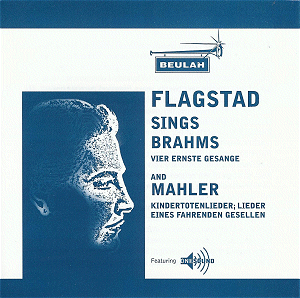

 Kirsten Flagstad
(soprano)
Kirsten Flagstad
(soprano) 
