Because of his long relationship with Peter Pears, which brought
about his prodigious output of vocal music over a thirty five
year period, Britten didn’t write many major non-vocal works after
the success of Peter Grimes in 1945. The exceptions include
the 2nd and 3rd Quartets (1945
and 1975), the orchestral Suite A Time There Was (1966
– 1974), Nocturnal for guitar (1963), Six Metamorphoses
after Ovid, for oboe (1951) and the five works – three solo
Suites, a Sonata for cello and piano, and this Symphony
for cello and orchestra – written at the instigation of Rostropovich.
With hindsight this latter collaboration must be seen as having
had a liberating effect on Britten’s music creating works which
were unlike anything else he ever wrote. The Sonata’s five
movements are quirky, fresh and vital, the solo pieces display
an austerity new, at that time, in Britten’s output and the magnificent
Symphony shows us just what we lost in orchestral composition
in exchange for the operas and song cycles. Yes, there is a complaint
here for one is forever wondering about a further Britten Symphony
for orchestra, a 2nd Piano and/or Violin
Concerto. Although the wish-list is endless but, ultimately,
pointless, one keeps wondering. At least with the arrival of Rostropovich
in Britten’s life we are given a glimpse of what we might have
had in both chamber and orchestral fields.
Rostropovich recorded
both the pieces chosen by Walton and any new recording must
immediately be compared to the master–creator–interpreter’s
own view of the music, for he studied them with the respective
composers. Rostropovich’s recording of the Britten has the added
cachet of being conducted by the composer. Walton starts the
Symphony in a bold way, even managing a Rostropovich
sound in the heavy triple stopped chords; this is an impressive
beginning. But he also knows exactly how to handle the second
theme, holding back to allow the woodwind their solos when necessary
and coming to the fore when he has the lead. The orchestration
for this movement isn’t what you’d expect, with flecks of sound
now here, now there, seldom settling into one continuous line
anywhere. It’s difficult to weld all these disparate elements
together into a convincing whole but Walton achieves this with
seeming ease. If, perhaps, the orchestra is somewhat reticent
it’s because of this quasi Webernian use of sections and solos.
The second, muted, scherzo movement is full of rushing
semi–quavers and whisps of sound from the band. Walton makes
light of his scurrying part, yet miraculously articulating every
note. The slow movement doesn’t quite have the tragedy or gravitas
of Rostropovich and Britten, and is also a trifle too fast for
my liking, and this robs the music of its gravity, but it’s
well done. The cadenza, which links the third and fourth movements,
is well sustained and the finale itself, a passacaglia based
on a very Coplandesque theme has the whiff of triumph and completion
necessary at the end of this difficult road.
Throughout, Walton
is ably partnered by the Philharmonia, but Briger often fails
to delve into the darkness which pervades this work and his
interpretation leaves something to be desired for it is too
often too light.
Walton’s performance
of the Shostakovich 2nd Concerto is wholly
satisfying. He hits exactly the right melancholic tone for the
majority of the first movement; by turns he’s restrained, winsome
and desperate, in the upper register, where he screams in agony.
All in all this is excellent. The cadenza is particularly fine.
The middle movement scherzo has a marvellously bluff
sense of humour to it, the soloist never dominating, this is
a real joint effort. The finale is taken slightly faster
than I expected but this makes it rather playful – an element
I’d never before considered in this work – but the ever returning
cadence is as endearing as it could be. The end, with the mechanical
knockings from the percussion, is quite dispassionate and slightly
distanced from us. This is a fine performance with the Philharmonia
giving full support, with Briger drawing excellent playing from
every department.
Despite being 45
years old the Rostropovich–Britten recording of the Symphony
still sounds well – it was one of Decca’s very best recordings
with a huge dynamic range and fabulous perspective on the performers.
However it exploits the darkness and depth of the music, and
this might not be to everybody’s taste. It is a difficult, and
disturbing, work and a slightly uncomfortable listen, but it
is a towering masterpiece which should be better known. Walton’s
recording is to be welcomed, despite its shortcomings, for he
humanizes the piece in a way I’ve never heard before. As for
the Shostakovich it deserves a full recommendation. A flawed
disk, perhaps, but it has much to commend it.
Bob Briggs
see also Review
by Michael Greenhalgh
























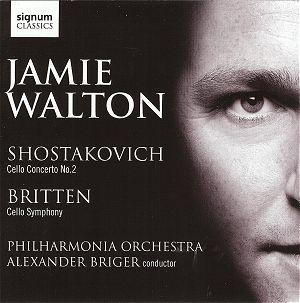

 Jamie Walton
(cello)
Jamie Walton
(cello) 
