MW EXCLUSIVE 4CD sets £18 each or £28 for both postage paid
Search
What's New
Classical CD Reviews
Live Reviews
Jazz CD Reviews
Composers
Resources
Contact Us

Classical CD and DVD reviews. MusicWeb is not a subscription site and it is our advertisers that pay for it. Please visit their sites regularly to see if anything might interest you. Purchasing from them keeps MusicWeb free.
  Classical Editor: Rob Barnett  
Founder Len Mullenger   


CD REVIEW

Making a Donation to MusicWeb

About MWI

Site Map

More Reviews
How to find a review

Books

Film Music

Nostalgia

Records Of The Year

Recommendations

Comment
Arthur Butterworth Writes

Phil Scowcroft's Garlands

Classical blogs

Reviewers Logs

Announcements

Don't Go Here!

Community
Bulletin Board

Web Ring

Reviewers

Helpers invited!

Resources
How Did I Miss That?

British Composers

British Light Music Composers

Other composers

Indexes
   Label
   Masterwork

Discographies
   Composer
   National

Themed Review pages

Complete Books

Programme Notes

External sites
British Music Society
The BBC Proms
Performers
Orchestra Sites
Recording Companies & Retailers
Online Music
Agents & Marketing
Publishers
Other links
Newsgroups
Web News sites etc

Editorial Board
Classical Editor
   
Rob Barnett
Seen & Heard
Editor and Webmaster
   Bill Kenny
MusicWeb Webmaster
   Len Mullenger
Assistant Webmaster
   David Barker

PotPourri
A pot-pourri of articles

MW Listening Room
MW Office
Helping MusicWeb
Advice to Windows Vista users  
Questionnaire    
Site History  
What they say about us
What we say about us!
Where to get help on the Internet
CD orders By Special Request
Graphics archive
Currency Converter
Dictionary
Magazines
Newsfeed  
Web Ring
Translation Service

Rules for potential reviewers :-)
Do Not Go Here!
April Fools

Would you like a hyperlinked weekly summary of the CDs we have reviewed?
Click for further details

Sample: See what you will get

alternatively
Crotchet AmazonUK AmazonUS


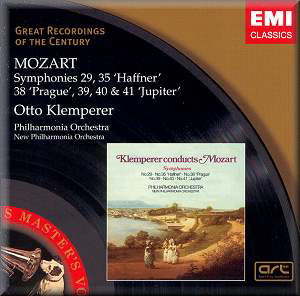
Wolfgang Amadeus MOZART (1756-1791) CD 1
Symphony No. 29 in A, K. 201* (1774) [25:16]
Symphony No. 38 in D, K. 504# (Prague) (1786) [25:53]
Symphony No. 39 in E-flat, K. 543+ (1788) [27:36]
CD 2

Symphony No. 35 in D, K. 385 (Haffner) (1782) [18:17]
Symphony No. 40 in G minor, K. 550+ (1788) [26:56]
Symphony No. 41 in C, K. 551# (Jupiter) (1788) [30:01]
Philharmonia Orchestra, *New Philharmonia Orchestra/Otto Klemperer
rec. Kingsway Hall, +July 1956, #March 1962; Abbey Road Studios, October 1960, *September 1965
EMI CLASSICS GREAT RECORDINGS OF THE CENTURY 3458102
[79:00 + 75:29]
 
Experience Classicsonline


Look carefully - these aren't quite the last six symphonies. The lyrical A major symphony replaces the Linz, and that's no cause for complaint: it's a fine piece of musical craftsmanship, and a nice change of pace. That symphony's first movement also offers a good indication of whether these performances will be for you. The tempo is distinctly measured - though there's ample forward motion - and the orchestral sound is big-boned. In the development, one becomes unusually aware of bass lines when they're carrying the movement's principal motifs. They're properly felt as full-fledged counterpoint, rather than playing a merely supportive role. The other three movements adhere to more conventional conceptions. The finale, while hardly rushed, is as rollicking as anyone else's. 

That basically sums up the set. Listeners accustomed to hearing the winds at parity with the strings, in the manner of the early-music fraternity - or, for that matter, Szell (Sony) - may find the orchestral sound heavy and string-dominated. But Klemperer takes care that important material in the winds emerges clearly - probably via simple dynamic adjustments rather than old-fashioned doublings. His practice of subordinating sustained wind harmonies to the strings' busy work seems logical and correct in any case. Actually, the textures sound richer and more active than in some "historical" accounts. The aforementioned weighty, strongly directional bass lines contribute to that impression; so do the second violins, registering prominently from their position at the conductor's right, as Klemperer preferred. 

It's worth noting that, notwithstanding the prevailing breadth - and the conductor's reputation! - the tempi as such aren't particularly slow. Krips (Philips), for example, is certainly no faster in the opening movements of the Prague and the Haffner. Klemperer's slow movements sing, for all their rigor - his minuets are spacious and sure-footed. Throughout the set, one encounters piano passages that conjure a delicate, magical hush. And, at his best, the conductor offers distinctive insights. The G minor's opening movement, sometimes played for a slick turbulence, here emerges in rueful, elegiac tones; a hint of monumentality only enhances the grandeur of the Jupiter. 

There are a few moments of creaky control, the sort of thing that sometimes crept into Klemperer performances. Here and there, momentum flags for no obvious reason - not so surprising in the comparatively propulsive outer movements, but it also occurs at the repeated bassoon notes at 7:58 in the E-flat symphony's Andante con moto, though it didn't happen the previous time around nor, for that matter, in the immediately preceding phrase! And, in the first movement of the Haffner, the nervous woodwind scale at 1:38 doesn't quite dovetail with the next downbeat, though analogous passages later on are fine. Small, passing flaws, perhaps, but digital mastering magnifies their presence somewhat, and they'll bother some people. 

I suspect that the mixing board has contributed some instrumental spotlighting: even within a forward sonic frame, some of the woodwind soli seem inordinately front-and-center. Otherwise, everything sounds good enough, though a touch of graininess betrays the recordings' age. 

This collection is a worthwhile, even necessary counterweight to the lighter, chamber-scaled performances more recently in favor. To return to the A major - among my favorite Mozart, in case you'd not guessed - if you supplement Klemperer's recording with Britten's (in a "Double Decca" bargain set) or Kertész's (also Decca, possibly in digital limbo), you'll be pretty much set.

Stephen Francis Vasta



Advertising Rates
Visitor stats
MusicWeb International
has over 25,000 Classical CD reviews on offer


Gerard Hoffnung Concerts &
The Bricklayer Story

Naxos Classical


Australian Eloquence CDs on Buywell.com


New Releases

Hyperion
New Releases


Guild Music


MusicWeb sells the Polish
catalogue CDAccord
£10.50 post free W-W


MusicWeb sells the
Arcodiva catalogue
£12.00 post free W-W


£11.50
post-free
world-wide
Try it and see - Sale or Return

MusicWeb can now offer you discs from the following catalogues:
Prices include postage

[Acte Préalable £13.50]
[Arcodiva £12.00]
[Avie from £6.25]
Brilliant Classics
[British Music Society £13.49]
[CDACCORD from £10.50 ]
[ClassicO £12.50]
[Hallé from £11]
[Hortus £14.99 ]

[Lyrita ONLY £11.50 ]
LYRITA Sale or Return
[Onyx £12.00
]
ONYX Sale or Return
[REDCLIFFE £11 ]
[Sheva £11]
[Tactus £11.50 ]
[Talent from £12.00 ]
[Toccata Classics £12.50 ]

Musicweb
Special Offers

Google Ads - for information about privacy matters, click here


Return to Review Index


Reviews from previous months
Join the mailing list and receive a hyperlinked weekly update on the discs reviewed. details
We welcome feedback on our reviews. Please use the Bulletin Board
Please paste in the first line of your comments the URL of the review to which you refer.


You can purchase CDs and Save around 22% with these retailers: