This disc was recorded some two or three years after the ground-breaking
recording by Andrew Parrott, but it could not be more different.
Like Parrott, Harnoncourt has recorded the Vespers in the context
of a religious service, with the relevant antiphons to the Psalms
and to the Magnificat. Harnoncourt’s recording was made live,
in Graz Cathedral, and uses all of the associated spatial possibilities.
The reading is derived from his examination of the surviving part-books
and how the various instrumental parts are notated there; for
example for different movements the cornett parts are notated
in different part-books. Though Harnoncourt provides an interesting
essay in the CD booklet discussing these issues, he does not make
any comments about how he decided on the size of his forces.
This is where Harnoncourt
starts to differ from Parrott. Parrott uses a small vocal ensemble,
whose singers double as soloists, with most movements done one
to a part. Whereas the choral forces used here include the Tolz
Boys Choir, the Choralschola der Wiener Hofburgkapelle and the
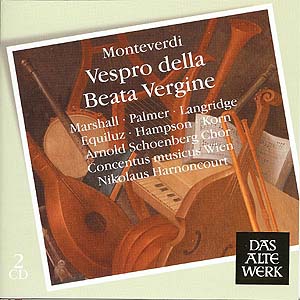
Arnold Schoenberg Choir. Add to this a sextet of soloists: Margaret
Marshall, Felicity Palmer, Philip Langridge, Kurt Equiluz, Thomas
Hampson and Arthur Korn. These are joined by an instrumental
group of some three dozen musicians. This means that Harnoncourt
and his forces produce a large-scale sound in the bigger pieces.
The soloists are all mainstream oratorio/operatic soloists whose
repertoire included an element of early performance, rather
than the period performance specialists used by Parrott.
At this point we
must move towards discarding the Parrott version as a comparison.
The two are just too different and their aims too dissimilar.
Instead we will have to ask ourselves whether Harnoncourt succeeds
on his own terms. Before we completely discard Parrott’s account,
we should note that Harnoncourt ignores Parrott’s scholarship
and performs the Magnificat and Lauda Sion using high pitch.
Performing with
relatively large forces in the apparently resonant acoustic
of Graz Cathedral seems to have encouraged Harnoncourt to be
relatively sedate with his tempos. Granted, the instrumental
interludes have the sort of fizz and bounce that one would expect.
But for much of the time the massed choral sections sound positively
stolid, without any of the rhythmic impetus that I would have
expected. It does not help that the slower speeds and the acoustic
tempt Harnoncourt into some positively romantic tempo fluctuations.
This sogginess fatally
affects the whole performance. Different movements are recorded
in different parts of the cathedral, thus giving us a variety
of acoustic effects. Fatally, the antiphons are highly recessed;
they seem to be recorded at a far greater distance from the
microphone than the rest of the disc. Time and again Harnoncourt’s
direction allows the music to rest and pause when we want it
to move on swiftly. The whole piece has a stop/go feel which
means produces an effect where it seems to add up to less than
the sum of its parts.
The CD booklet fails
to make it clear who sings what, but the boy’s choir definitely
sings the soprano part in the Sonata sopra “Sancta Maria”. Harnoncourt
encourages them to belt out the vocal line, singing the notes
with an attack and separation that would seem more suitable
in Stravinsky than Monteverdi. You lose any sense of the vocal
part being a cantus firmus around which the sonata is
constructed.
In the other movements
where there are vocal lines surrounding a cantus firmus,
the cantus firmus is sung by the choir and the other
vocal lines are taken by soloists. These soloists are distinctly
spot-lit, in a manner more suitable to a later period, with
the cantus firmus sung quietly in the background.
In some of these
movements, you get the distinct impression that some of Harnoncourt’s
speeds were decided by the speed at which the soloists could
sing the faster sections of the music. Both tenors have very
distinctive vibratos which seem entirely out of keeping in this
music. Langridge and Equiluz acquit themselves well, but both
have moments when their faster passage-work is obscured by their
vibrato. This is not so much a problem for Margaret Marshall
and Felicity Palmer, though neither approaches the delicacy
that some other later singers have brought to the parts. Thomas
Hampson and Arthur Korn have the disadvantage of having to sing
the Magnficat in its high key, so we should perhaps not complain
too much that the result sounds rather operatic.
If you are looking
for a large-scale period performance of the Vespers, then frankly
I don’t think this is the version for you. If you really must
have that sort of version, you would do well to investigate John
Eliot Gardiner’s second recording, made in 1991. It bears little
resemblance to anything that Monteverdi might have heard. Taken
on its own terms it works far better than Harnoncourt. This disc,
with its unstrung tempos and slack pacing entirely fails to convince.
Robert Hugill

























 Margaret Marshall
(soprano)
Margaret Marshall
(soprano) 
