As
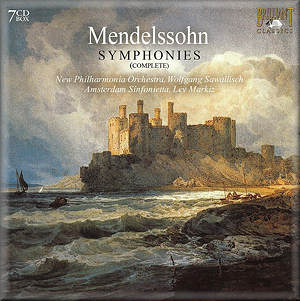
part of their contribution to the Mendelssohn Bicentenary
commemorations Brilliant have done again what they do so well:
taken some recordings no longer in use on their original labels
and repackaged them as complete repertoire at a most attractive
price. This set contains all Mendelssohn’s numbered symphonies
together with his early String Symphonies. Not only is it
great value but it festures good performances in faithful
sound and would be highly recommendable at any price.
Sawallisch’s
1967 Decca set is chosen for the “big” symphonies. Long out
of the catalogue, it is good to see it back again. Sawallisch’s
approach is most definitely big-boned and Romantic: there
is little period inflection here. The opening movement of
No. 1 has a great sense of energy and drive. While it’s obviously
a youthful work – anger rather than high tragedy – Sawallish
pays the music the great compliment of taking it seriously,
and there are still plenty of surprises, such as the well
judged pause before the coda. There is a lovely glow to the
string playing at the start of the second movement, while
the woodwind choir that alternates with it shows a nice sense
of interplay, especially in the undulating clarinet figure.
The minuet reminds you of Schubert’s 5th Symphony,
while the opening of the last movement is just like the opening
of the Mozart 40 finale. For the work of an 18-year old, however,
it’s pretty impressive. No. 2 has a heavy, portentous opening
that then gives way to a much fleeter second subject, and
the lilting allegretto feels like half way between a minuet
and a scherzo. The singing is very good indeed, especially
from the (always excellent) New Philharmonia Chorus. Their
explosion on Die Nacht ist vergangen is really arresting,
punctuated by a leaping violin figure. The soloists are very
distinguished too: Kmennt brings real drama to the recitatives,
while the sopranos blend well in their duet.
The
Scottish brings full-bodied, committed playing. The
folk-inflected main subject is very successful, and quite
foot-tapping, and the scherzo chatters away attractively.
The finale builds in strength towards the majestic – some
might say bombastic – hymn theme at the end which is given
with strength. The opening of the Italian is lively,
but not as breakneck as we’ve come to expect from some “period”
performances. The strings play with incisive attack throughout
the first movement, though Sawallisch brings a surprisingly
restrained conclusion. The Andante’s funeral procession is
well paced, and there is a lovely radiance to the contrasting
major episode. The Menuet is graceful, while the Saltarello
is racy and exciting. The slow introduction to the Reformation
feels a little stodgy, though the large scale of the orchestra
adds weight to the drama that follows. The irreverent perkiness
of the scherzo is a jarring contrast, while the Andante again
showcases the glowing tone of the New Philharmonia strings.
There is a noticeable build in the finale, as the chorale
theme grows in strength, and the closing bars are powerful,
satisfying and surprisingly fleet!
It
will be a long time before anyone challenges the supremacy
of Claudio Abbado’s Mendelssohn set with the LSO on DG: more
than twenty years later this is still the one to beat. However,
you would need high standards indeed not to be very satisfied
with this Sawallisch set. The playing and singing is excellent,
the pacing is well judged throughout, and the sound has the
bloom of the vintage Decca teams of the 1960s. It’s a pity
there is no information about the recording engineers involved.
If
Sawallisch is good, however, the accompanying set of String
Symphonies must surely leap straight to the top of any recommendable
list for this music. The Amsterdam Sinfonietta play this music
with beauty and extraordinary elegance, revealing each work
as a mini masterpiece. For a start the sound is noticeably
clearer on these recordings: they are closer with a lot less
hiss, essential for more intimate works like these. The playing
is lithe, zestful and full of fun. Markiz has a real feel
for the diversity of these works: Mozartian bustle for No.
1 in C, tense and dramatic for No. 7 in D minor. Again and
again I was moved to marvel at the invention of these works:
it’s remarkable to think that Mendelssohn himself suppressed
them (the manuscripts didn’t surface until the 1950s) and
didn’t count any of them as among his official symphonies.
It’s true: intentionally or otherwise, some of them are a
little derivative. The first movement of No. 4 in C minor
sounds like a Bach Sarabande, while Nos. 6 and 2, among others,
sound a lot like early Mozart. 9 feels like Schubert, but
that’s paying it a huge compliment. There are still some strikingly
original works too, though: Nos. 8 and 11 are fully fledged
symphonies, and it is good to have both the string and full
orchestral arrangements of No. 8, a masterpiece that would
not have been out of place among the mature works of any composer.
The playing is warm and sympathetic throughout, highly recommendable
in every way.
This,
then, is a great set to celebrate the Mendelssohn anniversary.
It will satisfy both newcomers and seasoned Mendelssohnians,
and at this price it’s unmissable. Invest with confidence.
Simon
Thompson
























 Amsterdam Sinfonietta/Lev
Markiz
Amsterdam Sinfonietta/Lev
Markiz 
