Editorial Board
MusicWeb International
Founding Editor Rob Barnett Editor in Chief
John Quinn Contributing Editor Ralph Moore Webmaster
David Barker Postmaster
Jonathan Woolf MusicWeb Founder Len Mullenger
Buy
through MusicWeb
for £18 postage
paid (sale or return). You
may prefer to pay by Sterling cheque or
Euro notes to avoid PayPal. Contact
for details
Johannes BRAHMS (1833-1897) CD 1
Sonata in F minor for clarinet/viola and piano, Op. 120
No. 1 (1895) [22:35]
Violin Sonata in G major, Op. 78 (arr. viola Klengel/Rysanov)
(1879) [26:34]
Trio in E flat for horn/viola, violin and piano, Op. 40
(1866) [28:16] CD 2
Sonata in E flat major, Op. 120 No. 2 (1895) [21:35]
Trio in A minor for clarinet/viola, cello and piano, Op.
114 (1892) [25:29] Maxim Rysanov
(viola); Katya Apekisheva (piano CD 1); Boris Brovtsyn
(violin); Jacob Katsnelson (piano CD
2); Kristine Blaumane (cello)
rec. Gnessin College of Music, Moscow - October 2007 (CD1);
Slabodkin Center Music Hall, Moscow – January/May 2008.
DDD ONYX
4033 [77:35 + 47:09]
Obviously
intended as a showcase for Maxim Rysanov, whose name appears
in bold
type, this outstanding pair of discs deserves to be heard
as widely as possible – not just by viola players or admirers
of Brahms’ chamber music. As a viola player myself, I have
no hesitation in describing Rysanov as the greatest master
of the instrument I have ever heard. Today there are more
star-quality viola players than ever before, including
Tabea Zimmermann, Yuri Bashmet, Lawrence Power, Kim Kashkashian
and Nobuko Imai. Yet for me Rysanov is even more exciting
than these illustrious virtuosi. For me the two Brahms
Sonatas have never sounded such great works, and I believe
many listeners will be similarly persuaded by Rysanov’s
phenomenal performances.
Surely there has been too
much emphasis on the autumnal qualities associated with
Brahms’ late music. Is this not a lazy cliché, describing
only one element of these multi-faceted works? In the two
clarinet/viola sonatas there is no shortage of muscularity,
passion, energy, humour or light-heartedness, but it takes
performances of this stature to open up the wide expressive
range which Brahms encompasses in these works. Rysanov
is a great musician who plays the viola – not merely an
outstanding instrumentalist. There is an ease about his
playing, a total expressive freedom which is absolutely
thrilling. Also one quickly takes for granted his perfect
intonation.
The matter of viola tone
is a question of personal taste. The instrument can sound
veiled, foggy or, on the C string, booming, and to some
these qualities may seem ideal. Rysanov produces a fabulous
quality of sound – honeyed yet extremely clear, paradoxical
though this may seem. No matter how forceful he can be
- and his dynamic range is remarkable – he always sounds
as though he has more in reserve.
Tone in itself is only
one aspect. A ravishing sound soon becomes cloying if not
sufficiently varied. Rysanov has an excellent instinct
for those passages of lower emotional temperature which
benefit from a reduction of vibrato or a shadowy tone.
Equally he negotiates the tricky semiquaver arpeggio passages
in the opening movement of the F minor sonata and the final
movement of the E flat sonata with terrific clarity and élan.
These are the passages which usually sound better on Brahms’ first-choice
instrument, the clarinet, but Rysanov completely banishes
any thoughts that the viola is a lesser alternative.
As I suggested, the prevailing
view of Brahms’ late music as autumnal needs revising.
Many performers perhaps temper their approach, allowing
too much “old man’s” nostalgia. After all, Brahms was only
into his early sixties, and his creative rejuvenation motivated
by Mühlfeld’s clarinet playing is especially obvious in
the fire and passion of the Clarinet Quintet.
Rysanov plays the Vivace finale
of the F minor sonata with marvellous energy and extrovert
spirit. Again, the grazioso passage in the variation
finale of the E flat sonata is not only graceful but more
playful and skittish than I ever imagined it. From the
E flat sonata the second movement is truly appassionato as
well as heroic. These are just a few examples of the revelatory
nature of Rysanov’s interpretations.
Having said my piece about
this fabulous viola-player, I must not neglect the other
fantastic musicians on these discs. They are all exceptional
chamber-music players and I quite honestly could not wish
to hear more intensely musical and committed interpretations
of these various works. Brahms’ piano parts are always
demanding, but both Rysanov’s partners are superb in every
respect. There is more light and shade in Brahms than is
often realised – his music does not have to be heavily
Teutonic and strenuous all the time – and these performances
admirably support this view. I had to keep playing these
CDs just to make sure I was not overdoing the superlatives,
but I stand by my first impressions. This really is completely
inspired music-making.
On the question of arrangements,
it has to be said that the reservations I had regarding
these alternative versions of the two trios soon evaporated.
Brahms himself wrote to publisher Simrock “My Horn-Trio
should be provided with a viola part instead of the cello!
With cello it sounds dreadful, but splendid with the viola!
The title should read: Horn or viola!” Brahms is known
also to have rehearsed the A minor Trio – a great work
which has always been overshadowed by the Clarinet Quintet – with
viola. In this version the viola part is particularly difficult,
much of it lying in a high register, but Rysanov makes
it sound effortless and totally natural. In both the trios
the combination of two string instruments with piano is
very satisfying, and on the strength of these performances
I would question why we don’t hear these alternatives more
often.
The G major Violin Sonata
is played here - transposed into D major - in an adaptation
by Paul Klengel (1854-1935), who was “house arranger” at
Simrock. The lowering of key may be disconcerting to some,
but with a performance of this quality any such reservations
should soon be forgotten.
The listed timings are
slightly inaccurate, while the notes (brief but good) include
a section on Brahms and the viola, summaries of the included
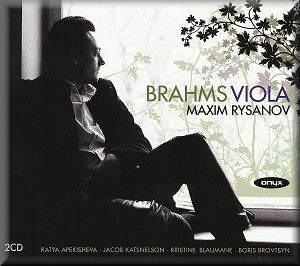
works and biographies of all the players. Happily the foliage
art-work is not too autumnal, and actually very beautiful.
The recorded sound and balance are all one could wish for.
This recording is on my
list of CDs of the year. I’d be surprised if there were
anything classier in the chamber music section. I dearly
hope Onyx will engage Rysanov to record Schumann’s chamber
music including solo viola as soon as possible.
Philip Borg-Wheeler
Please support our advertisers below by clicking on the logos for further information.
























 for details
 Maxim Rysanov
(viola); Katya Apekisheva (piano CD 1); Boris Brovtsyn
(violin); Jacob Katsnelson (piano CD
2); Kristine Blaumane (cello)
Maxim Rysanov
(viola); Katya Apekisheva (piano CD 1); Boris Brovtsyn
(violin); Jacob Katsnelson (piano CD
2); Kristine Blaumane (cello) 
