 |
|
|

alternatively
CD: AmazonUK
AmazonUS
Download: Classicsonline
|
Bohuslav MARTINU (1890-1959)
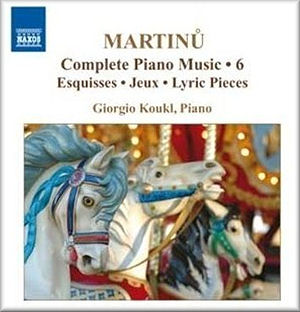
Complete Piano Music - Vol. 6
12 Esquisses, Book I, H. 203 (1931) [11:05]
Jeux, Series I, H. 205 (1931) [5:04]
Jeux, Series II, H. 206 (1931) [10:12]
Tri lyrické skladby (Three Lyric Pieces), H. 98 (1915) [7:08]
Black Bottom, H. 165 (1927) [0:52]
Vecer na pobreží (Evening at the Shore), H. 128 (1921) [7:26]
Písen beze slov (Song Without Words) in D minor, H. 46 (1921) [2:39]
Nocturne, H. 95 (1915) [4:10]
Chanson triste in D minor, H. 36 (1911) [4:22]
 Giorgio Koukl (piano)
rec. February 2008, Conservatorio di Lugano
NAXOS 8.572024 [53:45] 
|
alternatively
CD: AmazonUK AmazonUS
Download: Classicsonline |
Bohuslav MARTINU (1890-1959)
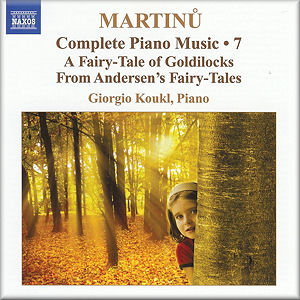
Complete Piano Music - Vol. 7
Pohádka o Zlatovlásce (A Fairy-Tale of Goldilocks), H.28 (1910) [14:11]
Z pohádek Andersenovych (From Andersen’s Fairy-Tales), H.42 (1912) [17:36]
Ballada posledni akordy Chopinovy (Ballade, the last chords of Chopin), H.56
(1912) [3:21]
Merry Christmas 1941, H.285 bis [3:42]
The Little Lullaby, H.122 bis [3:21]
La Danse, H.177 (1929) [1:02]
Le train hanté, H.258 (1937) [2:57]
Prélude, H.178 (1921) [1:25]
Foxtrot narosený na ružku, H.123 bis (1920) [1:16]
Jaro (The Spring), H.127 ter (1921) [2:53]
Detské skladby (Children’s Pieces), H.221 (1932) [1:58]
Avec un doigt, H.185 [0:41] ¹
Giorgio Koukl
(piano)
Chiara Solari (piano, third hand) ¹
rec. April 2008, February 2008, Conservatorio di Lugano
NAXOS 8.572025 [54:52] |
|
|
These two volumes of the complete solo piano music of Bohuslav
Martinu announce the completion of an outstanding undertaking.
The series was originally intended to run to only four discs but
has since trawled further outwards. The catch means it is now,
quite clearly, the most extensive and exhaustive collection of
the works for solo piano ever recorded.
Volume six starts with the 1931 Esquisses H203. They’re written
in pungent neo-classical form, and hints of chinoiserie, Paris-style,
haunt the second of the six, as well as Ragtime. Martinu, though,
always remained far more allusive stylistically than fellow Czech
Schulhoff in this regard. Impressionist hues haunt the Fourth
whilst I’m sure I hear a larky Volga Boatmen embedded in the Ragtime
melos of No.5 – plenty of sinewy articulation here.
Jeux was also written in 1931 and is a locus classicus of
Martinu cross-rhythms. I suggest you start with No.3 of the four
of Book I, which is both fluent and fluid but also sports a characteristically
saturnine neo-classical drive. The second book is no less fine
for all that: in some ways it’s more piquant still, with a warm
and malleable quality to the Andante [No.3] and a martial tune
laced with Prokofiev-like moments [No.6]. We go right back to
1917 for Tri lyrické skladby (Three Lyric Pieces). These take
in a Mussorgsky Pictures feel in the first of the three.
The second starts like an etude, diverts to popular chinoiserie,
then noodles off in the direction of the nineteenth century drawing
room. Weird mélange.
There are pieces you probably have not come across even in literature
devoted to the composer. The Black Bottom is one. It dates
from 1927 and is a delightful minute’s worth of your time. The
sleeve note writers have relied too much on Wikipedia for this
one. Jelly Roll Morton’s Black Bottom Stomp came via Perry
Bradford’s introduction of it in 1919 in Nashville, Tennessee,
not the Black Bottom district of Detroit. Naturally you won’t
be interested in this, but I am.
Vecer na pobreží (Evening at the Shore) dates from 1921
and will intrigue admirers of the composer. In three brief movements
he creates an intimate impressionistic tableau, somewhat reliant
on Griffes possibly, where, in the central panel, the left hand
waves lap into the right hand melody line delightfully and where
the storm in the finale gently eases away. This may seem atypical
but it shows the ease with which he assimilated French models
and distilled them potently. The disc ends with the grand bell
peals of Písen beze slov, the valedictory Nocturne
and the plangent Chanson triste in D minor.
Volume seven carries on the excellent work into ever more obscure
areas of the composer’s repertoire. There were six world premiere
performances in volume six and there are ten here – almost everything
in fact.
Pohádka o Zlatovlásce (A Fairy-Tale of Goldilocks) is the
earliest thing here, dating from 1910 and it sports youthful infatuations;
there are Elektra quotations and swirling dance motifs, as well
as hints of Suk. The second of the four movements is steeped in
even older models – Dvorák, maybe a hint or two even of Smetana
dances. The third panel is melancholic, with fulsome chording,
and the final movement has some insinuating, folkloric plangency.
Z pohádek Andersenovych (From Andersen’s Fairy-Tales) followed
two years later but is less interesting in terms of influence
and musical intention. Pertly conversational, sturdy and pleasingly
lulling though it may be in part it almost entirely lacks distinctive
features.
There then follows a sequence of small-scale works. Some are trinkets,
whilst others are rather more evocative of a time and place. The
Ballada shows his special brand of avuncular chordal drama:
La Danse is a Stravinskian bauble: Honegger haunts the
railroad rhythms of Le train hanté: then we have the strikingly
noble carillon of Prélude. One thing Czechs could do with
ease was a generic foxtrot of which Foxtrot narosený na ružku
is a nice example. These are all good to have for the completist
but Jaro (The Spring) is far, far more important than the
surrounding trinkets. Amazing it’s never been recorded before.
Written in 1921 it’s composed in the footsteps of Suk’s piano
pieces but is spiced with echoes of French impressionism. It’s
a most convincing piece, not quite three minutes in length, but
highly representative of what influenced him in the early 1920s
and where he was to go later in the decade. Make a beeline for
this work.
So Koukl’s pilgrimage has come to its end. He has been a most
worthy guide, and now takes his place at the top table of Martinu
performers on record. At budget price he has no peers. As a complete
cycle this set has no rivals. Individual performances from the
likes of Firkušný, Leichner and others may be more arresting in
isolation but the overarching reach of Koukl proves dominant and
permanent.
Jonathan Woolf
|
|
|























