Editorial Board
MusicWeb International
Founding Editor Rob Barnett Editor in Chief
John Quinn Contributing Editor Ralph Moore Webmaster
David Barker Postmaster
Jonathan Woolf MusicWeb Founder Len Mullenger
George Frideric
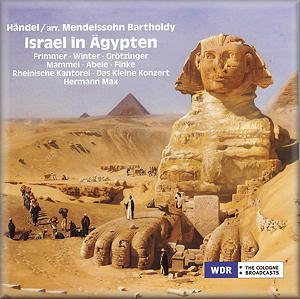
HANDEL (1685-1759)/Felix MENDELSSOHN
(1809-1847) Israel in Ägypten(1739, 1833) [83.00] Monika
Frimmer (soprano); Veronika Winter (soprano); Heike Grozinger (alto);
Hans Jorg Mammel (tenor); Ekkehard Abele (bass); Gregor Finke (bass)
Rheinische Kantorei; Das Kleine Konzert/Herman Max
rec. Live, 26 September 2001, Basilika Knechtsteden
CPO 777 222-2 [43.44 + 39.16]
I have to admit that though I find this recording fascinating,
it is purely for musicological and music history reasons rather
than for the performance itself. Herman Max and Das Kleine Konzert
present a reconstruction of Mendelssohn's performance of
Handel's Israel in Ägypten at the Rhine Music
Music Festival on 26 May 1833.
Mendelssohn had quite a history with Israel in Egypt.
He performed it in October 1833 in Düsseldorf, in Leipzig
in 1836 and again at the Lower Rhine Music Festival in 1842,
finally in Berlin in 1844. In 1845 his edition of the work was
published as part of a planned complete Handel edition by the
London Handel Society.
The work had been premiered in Germany in Berlin in 1831 by
the Sing-Akademie under Carl Friedrich Zelter, a group with
which Mendelssohn had close associations. For their performance,
the Rhine Music Festival committee had managed to get hold of
a 1792 score of the work which was relatively accurate. They
also managed to get a set of parts from Berlin; this was moderately
essential as the Berlin performance had been orchestrated by
J.O.H. Schaum. Mendelssohn would use this orchestration for
his performance in 1833 because the venue had no organ.
Generally Mendelssohn seems to have been ahead of his time when
it came to fidelity to the score. For later performances of
the oratorio he used an organ when it was available and dropped
the extra instruments. For a performance of Solomon with
the Rhine Music Festival he even had an organ transported to
the venue. For the recitatives, Mendelssohn used two cellos
and a double-bass. The original parts are divided into solo
and ripieno, essential, you imagine, as Mendelssohn was conducting
an ensemble of some 275 singers and 134 players in the orchestra.
Mendelssohn was quite keen on returning to the authentic score
and used visits to London to look for original sources of Handel's
oratorio. His critical examination of available historical resources
marks him out from his contemporaries. The London conductor
George Smart showed Mendelssohn a libretto for a performance
which was done during Handel's time - this included numbers
not in some scores. Also Smart was supposed to have the genuine
tempi from his father, conveyed in the form of timings for the
movements. These may be reflected in Mendelssohn's metronome
markings, but bearing in mind the size of his forces we must
doubt whether they relate to Handel's speeds and may relate
better to the larger size Handel centenary commemoration performances.
Mendelssohn added a number of pieces which he found in London,
the most interesting of which for us are the recitatives. These
were thought to be Handel's own but probably date from the
1760s when performances were directed by J.C. Smith. Nevertheless
they make an interesting addition to the work and it would be
well worth other performance groups investigating them.
All this fidelity to the score was partially scuppered by the
nature of the festival itself. A large number of singers came
together for a relatively short time to rehearse the work; as
a result there were cuts and shortenings. So that the choruses
were not performed complete.
Evidently it had been hoped to make this recording with something
approximating the forces used by Mendelssohn, but this did not
prove feasible. So instead Hermann Max conducts a chorus of
29 and an orchestra of 32 (61 musicians to Mendelssohn's
419).
And what of the performance? Well Max's tempi are moderate
rather than fast, but the general feel is crisp and incisive.
The proceedings open with an overture which Mendelssohn had
provided, though it was not newly written. The chorus are similarly
lively and quite light-textured. Both chorus and orchestra have
moments of instability and uncertainty, leading me to wonder
whether a slightly longer recording period might have been favoured.
Whilst their performance has its points and is certainly more
than adequate, there are other more preferable recordings of
the work.
When it comes to the soloists, there is a degree of serious
disappointment. We don't get the bass duet 'The Lord
is a Man of War' and the soprano duet seems to test both
the sopranos when it comes to the upper range. There are similar
problems in the soprano solos - the booklet does not say which
soloist sings which soprano solo. Heike Grotzinger has a pleasantly
fruity alto and Hans Jorg Mammel an attractive lyric tenor.
Without their duet, basses Ekkehard Abele and Gregor Finke are
woefully underused, though all singers get the extra recitatives.
The CD booklet contains a long and informative essay giving
the full background to the 1833 performance and the edition
used by this recording with a libretto with translations. The
disc is relatively poor value at 83 minutes spread over 2 CDs
and I did wonder whether some way of fitting it onto 1 CD could
not have been found.
As a performance of Handel's Israel in Egypt (or
Israel in Ägypten) this is disappointing. But as
a window on early Handel performance practice, it is utterly
fascinating.
Robert Hugill
Please support our advertisers below by clicking on the logos for further information.

























 Monika
Frimmer (soprano); Veronika Winter (soprano); Heike Grozinger (alto);
Hans Jorg Mammel (tenor); Ekkehard Abele (bass); Gregor Finke (bass)
Monika
Frimmer (soprano); Veronika Winter (soprano); Heike Grozinger (alto);
Hans Jorg Mammel (tenor); Ekkehard Abele (bass); Gregor Finke (bass)

