CD 1 [75:58]
Overture no.1 on three Greek themes in G minor, op. 3 (1882)
[15:06]
Overture no.2 on Greek themes in D major, op.6 (1883) [16:35]
To the memory of a hero, elegy, op. 8 (1885) [15:57]
Lyrical poem in D flat major, op.12 (1884-1887) [12:10]
Stenka Razin, symphonic poem, op.13 (1885) [16:08]
CD 2 [75:12]
Characteristic suite for large orchestra, op.9 (1884-1887) [33:29]
Serenade no.1, op.7 (1882) [4:11]
Serenade no.2, op.11 (1884) [3:40]
Two pieces for orchestra, op.14 (1886-1887) [20:36]
Mazurka in G major, op.18 (1888) [7:46]
Characteristic dance (?) [2:40]
Volga boatmen's song (1905) [2:46]
CD 3 [64:14]
The Forest, fantasia for large symphony orchestra, op.19
(1887) [21:23]
The Sea, fantasia for large symphony orchestra, op.28
(1889) [17:32]
Oriental rhapsody for large symphony orchestra, op.29 (1889)
[24:18]
CD 4 [62:56]
Wedding procession, op.21 (1889) [7:33]
Slavonic Festival, op.26 no.4 (1888) [13:27]
Spring, musical picture for large symphony orchestra,
op.34 (1891) [11:14]
Triumphal march, op.40 (1892) [9:07]
Carnival, op.45 (1892) [9:33]
Solemn procession in D major, op.50 (1894) [7:28]
From darkness to light, fantasia in C major, op.53 (18940
[13:18]
CD 5 [56:31]
Chopiniana, suite from Chopin's works, op.46 (1893)
[20:47]
Concert waltz no.1 in D major, op.47 (1893) [9:41]
Concert waltz no.2 in F major, op.51 (1894) [9:22]
Waltz from the ballet Raymonda, op.57 (1896-1897)
[5:25]
Waltz from Ballet suite, op.52 (1894) [5:49]
Polonaise from Ballet suite, op.52 (1894) [5:38]
Waltz from the ballet Lady Soubrette, op.61 (1898) [6:12]
CD 6 [71:43]
Lady Soubrette - ballet in one act, op.61 (1898) [71:43]
Google together the words composers and subsidies
and you'll encounter a widespread theory that increasingly
generous government handouts allowed twentieth century composers
to write music that no longer needed to appeal to a wide public.
That, it is claimed, was in contrast to an earlier era when
composers' incomes frequently depended very much on writing
pieces with mass appeal: as Beethoven himself observed, 'In
order to gain time for a great composition, I must always scribble
away a good deal for the sake of money'.
Many of the pieces so neatly collected together on these six
discs of miscellaneous orchestral works by Alexander Glazunov
fall, in all likelihood, into the category of similarly mercenary
'scribblings'. That is, though, hardly sufficient justification
for so many of them to have fallen into relative obscurity and
their inclusion in Svetlanov's great project of a complete
tour d'horizon of Russian orchestral music gives
us a convenient opportunity for re-evaluation. That process
is made even more potentially valuable by the fact - no doubt
already noticed by more observant readers in the detailed listings
above - that the pieces here are ordered pretty much by opus
number, so giving us the ability to hear something of the way
in which Glazunov's compositional style developed over time.
The first disc in this box opens very promisingly. The
sound quality is both rich and quite reverberant in a way that
suits these often lush scores, even at the risk of occasionally
submerging interesting details of the orchestration. It is also
quickly apparent - though who would have thought otherwise?
- that Svetlanov is a most idiomatic conductor of this music.
While Glazunov may have said that that opening two overtures
were on 'Greek' themes, their frequent diversions into
that seductive brand of musical orientalism familiar to lovers
of Rimsky-Korsakov and Borodin suggest that he was only too
keen to escape the bounds of Europe as soon as possible. Other
influences from the 'Mighty Handful' composers are also
clear - not just stylistically, but even as a source of folk
melodies: Stenka Razin, for example, features
the well known theme from the Song of the Volga boatmen (Yo-oh,
Heave, Ho...), one of the traditional Russian songs that
had been earlier collected and published by Balakirev. The disc
confirms that Glazunov's early work, very skilfully crafted
though it undoubtedly is, as yet lacked a distinctive voice,
though we can clearly see one developing as we move on through
the box set.
The opening Characteristic Suite of the second disc
brings to the fore, for example, Glazunov's increasing interest
in dance. While two of its six pieces are explicitly labelled
as dances (a 'Russian dance' and an 'oriental dance'
- the latter distinctly reminiscent of Rimsky's Young
prince and princess from Scheherazade), there are
plentiful gestures throughout that foreshadow the composer's
later stage works. The orchestration, moreover, is clearly becoming
more adventurous, an aspect effectively emphasised by Svetlanov
whose control of some rhythmically rather tricky passages is
also quite superb. Not everything, however, marks Glazunov -
who, at the time of writing most of the material on this second
disc, was still, after all, only in his early twenties at most
- as entirely innovative by this point: the ersatz Spanish-ness
of the Serenade no.1, for instance, is straight out of
the same stable as Rimsky's Capriccio Espagnol or
Glinka's 'Spanish' overtures or Jota Aragonesa.
The composer's well-documented musical conservatism is again
apparent in the third disc. Progressive musical trends
of the time seem to have held little, if any, appeal to Glazunov
and both The Forest and The Sea are straightforward,
frequently overblown yet also somewhat under-characterised pieces
of late 19th century Russian romanticism. In fact,
if confronted with the music 'blind', there would be
long stretches of both where one would be hard put to guess
what exactly was being depicted at all.
The musical world - I am tempted to say the ocean - of difference
between Glazunov's 1889 depiction of the sea and, for instance,
Debussy's more famous one of 1905 is significant. Even though
the Russian was actually the younger man of the two, he was
much the more reactionary, supposedly referring to Debussy as
a 'recherché cacophonist' and ruefully wondering,
on examining the score of Prélude à l'après-midi
d'un faune, whether 'Rimsky and I [had] influenced
the orchestration of all these contemporary degenerates".
Thus, if Debussy can be seen as a sort of musical equivalent
of, say, Claude Monet, then Glazunov's painter counterpart
would surely be - as several art designers for LPs and CDs have
recognized over the years - the conservative realist Ilya Repin,
the real-life dedicatee of the attractive Oriental Rhapsody
op.29. The latter is an occasional piece that aspires to
a status no higher than a potpourri of those 'exotic'
musical themes, rhythms and orchestral colours so beloved by
the 'Mighty Handful' and their followers when in full
'steppes of Central Asia' mode. Svetlanov and his orchestra
perform it wholeheartedly and with all the sensuality and gusto
at their command.
If the Oriental Rhapsody was an individual potpourri,
then, taken as a complete entity, the fourth disc of
the set can certainly merit the same description. This
is really something of a rag-bag of pieces of varying worth.
Some are more ambitious than others - the very titles of Spring
op.34 and From darkness to light op.53, for example,
suggest at least an intention of depicting some sort of thematic
and musical development. But the other tracks, often little
more than potboilers presumably excused by the necessity of
scribbling away for the cash, are still generally enjoyable,
if on a more superficial level. The Triumphal March op.40, for
instance, will certainly bring a smile to the face of anyone
unfamiliar with it as it takes up a very familiar tune that
is certainly not usually associated with Imperial Russia.
The fifth disc has more of an obviously unifying theme
to it and thus makes a more coherent whole. It plays to one
of Glazunov's undoubted strengths - writing music for dance:
of its ten tracks, nine have the names of specific dances in
the title and no less than five of them are waltzes. The sole
exception is the Nocturne in Chopiniana and that, interestingly
enough, is the only one of the orchestrations of familiar Chopin
works that loses its essential heart in the process of elaboration.
The suite's other three pieces are given an entirely new
form of life in Glazunov's characteristic - and often quite
strikingly Russian - orchestrations. The opening Polonaise,
full of echoing brass and given the full Soviet-era treatment
in this performance, gets things off to an effectively rousing
and foot-tapping start and the quality of music-making never
falters thereafter. The two substantial 'concert waltzes'
- regular Svetlanov party pieces - come off especially well,
and the ballet selections are also quite delightful. The disc
certainly offers a most enjoyable survey of this particular
aspect of the composer's output.
The ballet extracts lead neatly into the sixth disc,
containing just one work, the ballet Lady Soubrette.
This is the least known of Glazunov's ballets and, unlike
Raymonda and The seasons, does not even justify
a separate entry on the usually comprehensive Wikipedia website.
You might nevertheless have come across the score under one
of its alternative titles - Les ruses d'amour (used
for the Hermitage Theatre premiere and the one favoured, as
I seem to recall, on old Melodiya LPs) or The trial of Damis
(the name given it for a subsequent Mariinsky Theatre production).
Lady Soubrette deliberately harks back to the elegant
courtly entertainments of 17th and 18th
century France, even in its plot where, in order to put her
fiancé to the test, an aristocratic young woman masquerades
as her own maid - remember Queen Marie-Antoinette playing at
being a Versailles milkmaid? As many commentators have pointed
out, the ballet's setting is closely linked to the elegant
fête champêtre genre paintings by the French
rococo painter Antoine Watteau and his school and Glazunov's
score was also clearly influenced by the compositional styles
of the earlier era. Dismissed by contemporary critics as rather
frivolous and lightweight, the ballet is nonetheless choc-full
of quite delightful and very danceable melodies and it is a
great pleasure to be able to listen to in full.
A great deal of the enjoyment to be derived from this box set
is generated by the commitment of Svetlanov and his orchestra.
They pay Glazunov the respect of treating his music not just
with evident affection but with respect for his talent as a
creator of beautiful melodies, a highly sympathetic composer
for dancers and an exceptionally skilled musical craftsman.
They also fulfill Svetlanov's stated intention of setting
him in the wider context of the development of Russian music
- an objective greatly helped by the way that the content has
been laid out over the six discs. It is a sad disservice to
Svetlanov himself, on the other hand, that no similar effort
has been made to put these various performances into the contest
of his immensely confusing discography: details of the provenance
of performances and even of the orchestra(s?) involved is simply
non-existent here.
As the second bumper box of three - the first covering Glazunov's
symphonies (reviewed
here) and the third, which I will be considering in due
course, majoring on the remaining stage works and a variety
of orchestral works with opus numbers in the 70s, 80s and 90s
- this is something of a 'bits and bobs' collection.
It will, nevertheless, provide a great deal of interest and
enjoyment to listeners prepared to explore some of the neglected
byways of Glazunov's output.
Let's also, in passing, give its due to the Naxos label
that has issued to date no less than 18 volumes of Glazunov's
orchestral music in a continuing series, though one much more
randomly ordered than Svetlanov's. Conducted variously by
Alexander Anissimov, Konstantin Krimets, Igor Golovschin, Dimitry
Yablonsky and Vladimir Ziva, the discs include all the symphonies
- even the unfinished ninth - and are generally very enjoyable.
I do think, though, that there is something especially valuable
in hearing this wide span of works under a single conductor,
as on the discs under consideration in this review.
Rob Maynard
see also review
by Johnathan Woolf
























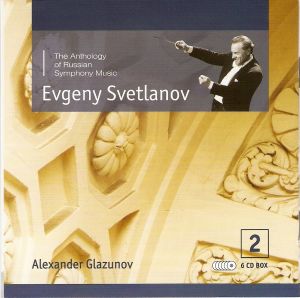
 USSR Symphony Orchestra/Evgeny
Svetlanov
USSR Symphony Orchestra/Evgeny
Svetlanov 
