|
|
|

alternatively
CD: AmazonUK
AmazonUS
Download: Classicsonline
|
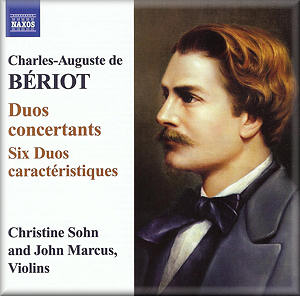
Charles-Auguste
de BÉRIOT (1802-1870)
Duo concertante No. 1 in G minor, Op. 57, No. 1 [16:25]
Duo concertante No. 2 in E minor, Op. 57, No. 2 [20:07]
Duo concertante No. 3 in D major, Op. 57, No. 3 [16:49]
Six Duos caractéristiques pour deux violins, composés
sur des motifs du Ballet Espagnol du Prince M. Youssoupow, Op. 113
[21:27]
 Christine
Sohn and John Marcus (violins) Christine
Sohn and John Marcus (violins)
rec. 21-23 June 2007, St John Chrysostom Church, Newmarket, Canada
NAXOS 8.570748 [74:48]  |
|
|
Charles-Auguste de Bériot was an unlucky man. Ten years
after his birth in 1802, he began living with his violin teacher
after the sudden death of both his parents. After studying with
several prominent traveling performers and even receiving advice
from the great violinist-composer Giovanni Viotti, Bériot
became personal violinist to the Kings of France and the Netherlands
in 1826. But those jobs were both terminated four years later,
when the performer's native Belgium declared its independence.
In 1836 Bériot's first wife died, pregnant, in a
freak horseback riding accident just six months after their
wedding. After he finally settled down to a career teaching
violin at the Brussels Conservatory, where he taught, among
others, the composer Henri Vieuxtemps, Bériot's eyesight
began to fade and he found himself forced into early retirement.
He spent his later years playing the violin in private for eager
Russian noblemen, but, at the age of 62, his career met its
end when, for reasons unknown, his left arm became paralyzed.
But the cruelest twist of fate came after Bériot's
death in 1870: his life-work immediately faded into oblivion.
Ten violin concertos, thirteen sets of variations, a massive
body of work for violin solo and duo, and, according to Keith
Anderson's booklet notes, over fifty collections of music
for students, are nearly all forgotten. His study works are
occasionally performed by young violinists learning the trade,
but the rest of Bériot's output generally was left
unperformed and unrecorded. Six of the ten concertos had appeared
on disc - played by three different violinists. A disc of chamber
music has appeared on the Talent label. Generally though, the
Belgian violinist's name has lain forgotten and overlooked
by album producers and recording artists. Until last year, when
Naxos announced its new series devoted to the romantic violin
repertoire and Charles-Auguste de Bériot was announced
as one of its top priorities. Last August a new disc of violin
concertos appeared featuring Grammy-nominated soloist Philippe
Quint; this August the first release in a series of Bériot's
complete music for solo violin will appear.
This month's new album, however, is a compilation of works
for two violins. The Duos concertants may be familiar
to violin students, who sometimes call upon them to hone their
technique, but they, like the six Duos caractéristiques,
are new to the world of recording. And this disc of premieres
arrives not a moment too soon: together the music represents
a major treat for lovers of the violin.
The Duos concertants, Op. 57, come in three sets which
are each shaped much like a classical sonata: two quicker movements
bracket a slower, more lyrical section. The third duo departs
from the formula considerably, in that it is the only one of
the three written in a major key, the finale is not a rondo
and, more importantly, the opening section has the feel of a
slow movement. The result is a bucolic, agreeable lyricism which
makes the duo hard to forget. The first movement, in particular,
is a stunner, as the first and then second violin take turns
spinning a magical, seemingly endless tune over accompanying
pizzicato.
The longest work on the programme is a set of Six duos caractéristiques
based on themes from the 'Ballet Espagnol' by a Russian
prince named Yusupov. Nikolay Yusupov evidently composed his
own music for violin, including a concerto, and sponsored some
of the elderly Bériot's last concerts. We do not
have the original ballet anymore, or the concerto, but these
duos exude charm, warmth, and, occasionally, a touch of genuine
Spanish flavour. The original work must have been quite a pleasure
to Yusupov's social circle, and this set of violin duos
would have delighted the audiences of the salons with its alternating
love serenades and mock-serious dances. There is an energetic
march, a fandango and a bolero which makes a rousing conclusion
to the set and to the album as a whole.
Generally in these works the first violin is the one tasked
with the greatest technical challenges and rewarded with the
best melodies and flashiest bits of show. Christine Sohn, who
has served as guest leader or concertmaster of the London Symphony,
London Philharmonic, Royal Philharmonic, and Swedish Radio Symphony
Orchestras, is simply extraordinary in the lead role, overcoming
technical challenges with ease and letting each big melody sing.
She has the poise and full, attractive sound of a master, and
if John Marcus, who is quite literally 'second fiddle'
here, does not quite live up to this high level, his role is
such that he does not have to. Indeed, when Bériot gives
him the chance, Marcus's playing impresses too. The performers
have the good taste not to pretend that this music is more than
it is, instead perfectly evoking the intimacy and quiet charm
of a romantic salon performance. The recorded sound is exemplary,
with Sohn in the left channel and Marcus in the right, in sonics
so clear that the performers might as well be in your room.
This disc is, in sum, a must-have for anyone in love with the
sound of the violin. Bériot's music is a consistent
delight, a pleasure for the ears rather than an emotional workout;
the third Duo, and parts of the Ballet Espagnol,
are especially memorable. I will be turning to this album often
when my ears clamour for the rich, aristocratic beauty of the
violin unaccompanied by its string relatives. I imagine that
many a listener with a love for this instrument will agree that
this disc is a delight and a very welcome surprise.
Michael Cookson
See also review by Nick
Bernard
|
|