Editorial Board
MusicWeb International
Founding Editor Rob Barnett Editor in Chief
John Quinn Contributing Editor Ralph Moore Webmaster
David Barker Postmaster
Jonathan Woolf MusicWeb Founder Len Mullenger
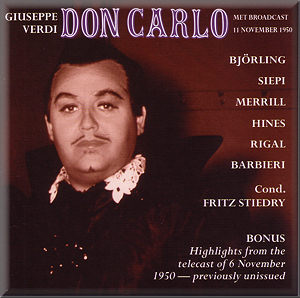
Giuseppe VERDI (1813–1901) Don Carlo(1867) – Opera in 4 Acts Cesare
Siepi (bass) – Filippo II; Jussi Björling (tenor) – Don
Carlo; Robert Merrill (baritone) – Rodrigo; Jerome Hines
(bass) – Il Grande Inquisitore; Lubomir Vichegonov (bass) – Un
Frate; Delia Rigal (soprano) – Elisabetta di Valois;
Fedora Barbieri (mezzo) – Anne Bollinger (soprano) – Tebaldo;
Paul Franke (tenor) – Il Conte di Lerma; Emery Darcy
(baritone) – Un Araldo Reale; Lucine Amara (soprano) – Voce
dal Cielo
Chorus and Orchestra of the Metropolitan Opera House, New
York/Fritz Stiedry
rec. radio broadcast, 11 November 1950 Appendix: Excerpts from the 5 November 1950 telecast WEST
HILL RADIO ARCHIVES WHRA6021 [3 CDs: 68:02
+ 66:53 + 68:49]
There
has always been a special aura surrounding the 1950 Met
production of Don Carlo – the first in the house
since 1922. It was the beginning of a new era – Rudolf
Bing’s – and the soloists were largely sensational. This
was also Jussi Björling’s last new role and the cooperation
between him and Robert Merrill was to become legendary.
The premiere on 6 November was telecast but no recording
seems to have survived. On the other hand the matinée performance
on 11 November was broadcast and a rather poor tape copy
has been circulating among collectors for half a century.
What is presented here is however something completely
different. Ward Marston, foremost among audio restoration
gurus, found more or less by chance a tape, in a collection
of thousands that had been stored in his cellar for several
years. When he listened to it he found that here was a
source that was far superior to anything that had formerly
been available. There was one hang-up though: the first
six minutes were missing. In some other places there were
also small portions missing, partly due to radio presenter
Milton Cross speaking over the music. Through some patching
of sections from inferior sources Marston managed to achieve
a compete recording - moreover in sound that is not far
behind what can be found on contemporaneous studio recordings.
Playing the opera from start may initially be disappointing
since this is from an inferior source with some disturbing
noises. However, just before Jussi Björling’s first entrance,
we reach the newly discovered tape and after that most
of the performance is a pleasure to hear.
The
Metropolitan Orchestra was obviously in fine shape and
the French horns in the prelude are superb. Austrian conductor
Fritz Stiedry hardly belong to the most dynamic Verdi interpreters
and his tempi are rather leisurely but this also brings
gain, insofar as the wonderful orchestration is brought
out. On the other hand expansive tempi put the singers’ breath
control to severe test. In particular soprano Delia Rigal
has problems maintaining the musical line without sagging.
While
the orchestra is in good shape throughout, the precision
in the chorus is rather so-so. This is most obvious in
the chorus that opens Act II scene 2, which is decidedly
sprawling. Presumably there were too many over-aged singers.
What
was performed in 1950 was the four-act version, which was
more or less the norm at the time. There are however numerous
cuts, including second verses in a couple of arias. Far
more serious is the omission of Rodrigo’s Per me giunto in
the prison scene, which is particularly deplorable since
Robert Merrill sings with such ravishing beauty throughout.
It
was a young ensemble that populated the Met stage that
November afternoon. Jussi Björling, then thirty-nine, was
the veteran and Robert Merrill had reached the respectable
age of thirty-three – the rest were twixt twenty and thirty.
The youngest was Lucine Amara, singing the little role
of voice from Heaven. On the premiere night she made her
Met debut – the beginning of a 41-year-long association
with the house. Paul Franke was also rather new – he went
on to sing more than 1500 performances.
Of
the principals it is the two female roles that yield the
least. Argentinean soprano Delia Rigal is shrill and shaky
and lack-lustre in the middle register. Not until the final
duet with Björling does she show her true mettle, when
she sings Ma lassù ci vedremo in a lovely half-voice.
Fedora Barbieri is far more convincing as Eboli and she
has the dramatic power needed, but the singing per se is
more variable.
Greatly
impressive are the deep male voices. Cesare Siepi, like
Ms Amara making his Met debut, had shown a couple of years
earlier through a fine recording of Filippo’s monologue
that he had the measure for the role, but it is still remarkable
that a twenty-seven-year-old can mould an ageing man so
convincingly. There are few recordings that surpass Siepi’s,
vocally and interpretatively. In the following scene, a
high-spot when the right voices are available, he is matched
against the formidable and only slightly older Jerome Hines
as Il Grande Inquisitore – a combat between giants! I have
already mentioned Robert Merrill. The possessor of one
of the most beautiful baritone voices in the history of
opera and with necessary dramatic power he is a well-nigh
ideal Rodrigo.
There
remains Jussi Björling. Every lover of his art, and supposedly
most lovers of great opera singing in general, must have
heard the studio recording of the duet with Merrill from
Act I, made little more than three weeks after the premiere.
There is more forward movement in the studio version, thanks
to Renato Cellini’s faster tempo but the intensity is still
higher on the live recording. Björling recorded nothing
else from this opera – nor did any of his fellow singers
set down their roles complete. This makes the present issue
even more valuable. Björling’s voice is certainly cut out
for the role of Don Carlo: the slim blonde tone, the lightness
of his phrasing and the almost overwhelming glow and brilliance
of his singing. Once again it has to be pointed out that
he was far from being the wooden actor sometimes maintained.
Among competing tenors on other recordings it is only Carlo
Bergonzi (for Solti) and Placido Domingo (for Giulini)
who come somewhere in the vicinity of Björling’s level
of achievement. Maybe the most exalted singing for sheer
beauty comes in the last act in the aforementioned duet
with Elisabetta. It is indeed hard to imagine anyone beating
that. This is a priceless issue.
But
this is not enough. As an extra bonus on the third CD we
are treated to almost three quarters of an hour with excerpts
from the premiere on 6 November – never before released.
The source is an amateur recording from the telecast – with
very variable quality. The anonymous recorder has constantly
been turning the level up and down, resulting in certain
portions being almost inaudible while others are affected
by distortion. Sometimes the recorder has been stopped
and the result is fragmentary. From this Ward Marston has
still achieved something that is fully playable and as
documentation this is just as indispensable as the complete
radio broadcast. Differences in interpretations are minimal
but one gets the feeling that there is some extra nerve
in the singing on the premiere night. The greater part
of the title role is actually included. No true admirer
of Jussi Björling can afford to be without this issue.
Göran
Forsling
Please support our advertisers below by clicking on the logos for further information.

























 Cesare
Siepi (bass) – Filippo II; Jussi Björling (tenor) – Don
Carlo; Robert Merrill (baritone) – Rodrigo; Jerome Hines
(bass) – Il Grande Inquisitore; Lubomir Vichegonov (bass) – Un
Frate; Delia Rigal (soprano) – Elisabetta di Valois;
Fedora Barbieri (mezzo) – Anne Bollinger (soprano) – Tebaldo;
Paul Franke (tenor) – Il Conte di Lerma; Emery Darcy
(baritone) – Un Araldo Reale; Lucine Amara (soprano) – Voce
dal Cielo
Cesare
Siepi (bass) – Filippo II; Jussi Björling (tenor) – Don
Carlo; Robert Merrill (baritone) – Rodrigo; Jerome Hines
(bass) – Il Grande Inquisitore; Lubomir Vichegonov (bass) – Un
Frate; Delia Rigal (soprano) – Elisabetta di Valois;
Fedora Barbieri (mezzo) – Anne Bollinger (soprano) – Tebaldo;
Paul Franke (tenor) – Il Conte di Lerma; Emery Darcy
(baritone) – Un Araldo Reale; Lucine Amara (soprano) – Voce
dal Cielo 
