Symphony 28 isn’t one of Mozart’s best known. It’s
serenade-like, with the violins having the lion’s share of the
attention, sustained by the lower strings and spiced by sporadic
colouring from oboes, horns and trumpets. It’s delightfully light-hearted.
Peter Maag’s account is classy and intimate in scale. The first
movement is all sunny and smiling from its opening notes of the
common chord trimly played in descending order by everyone to
the violins’ response in neat filigree work. It’s fresh without
being smarmy. Veiled and muted violins in the slow movement are
warm and homely. A repeated phrase at tr. 2 0:51 is sensitively
tapered. The oboes and horns’ contributions are sensitively gauged.
The development is more thoughtful but relatively unruffled. The
Minuet contrasts well the opening assertiveness with the later
relaxation ushered in by the horns. The Trio reverses the contrast,
soft-loud-soft, with strings alone in more ornate style. The Presto
finale begins with very delicate violins and sees them shining
and shimmering by turns. The contrasting four quaver groups are
loud then soft from tr. 4 0:43. You have to make allowances for
the sound. The mono recording is very, you could say skeletally,
clear but also so bright the loudest passages have a glassy, wiry
quality. Even so, I found I got wrapped up in the performances.
There are no repeats in the first two movements.
Symphony 29 is one of the best known of
Mozart’s symphonies because of the masterly and organic way that
it evolves. The first movement (tr. 5) theme begins in quiet,
unassuming fashion but soon intensifies when repeated loudly.
The lower strings imitate the upper at only a two beat distance.
A demure second theme (0:49) grows bold (1:08) with oboes and
horns finely balanced with the strings yet making real impact.
The theme is lyrically expanded and transformed on strings (1:29)
with the violins in imitation at a four beat distance. Maag’s
rhythmic articulation is appreciable and the strings’ tremolos
are stimulating. I compared another recording from 1950, that
by the RIAS-Symphonie-Orchester Berlin/Otto Klemperer (Urania
URN 22153). Comparative timings are
Timings |
I
|
II
|
III
|
IV
|
Total
|
Maag |
5:10
|
5:43
|
2:59
|
3:45
|
17:44
|
Klemperer |
8:28
(6:13)
|
5:31
|
3:31
|
3:49
|
21:19
(19:04)
|
Unlike Maag, Klemperer makes the exposition repeat
in the first movement, so the bracketed timings are exactly comparative.
Neither make the second half repeat nor repeats in the second
and fourth movements. Klemperer with a larger orchestra presents
the first theme more deliberately yet brings a more epic intensity
to the tuttis, though the horns are too prominent. His
second theme is more contrasted in its simplicity and its lyrical
transformation is treated affectionately.
The slow movement (tr. 6) features winsome muted
strings and again with Maag’s fine balance the inner string parts
and woodwind contributions are clear. Here the themes come with
their own variations of more rapid, dainty movement. The variation
(1:29) on the second theme (0:43) is particularly appealing and
is taken up by the oboe. Klemperer treats the opening themes more
smoothly and the variations more pointedly. Maag lets them evolve
freshly without such calculated shaping. Maag’s Minuet has an
unassuming start for the violins but a firm tutti repeat.
Its progress is articulated with verve. The Trio is by contrast
more gracious with a pleasing flow which accommodates some louder
moments as another kind of characterful variation. Klemperer is
heavier with these and his Minuet is somewhat sluggish in its
sturdiness. Maag’s finale (tr. 8) is admirably crisp at a tempo
which enables the descending strings’ figures to be cleanly articulated.
This makes the clucking second theme featuring appoggiaturas (0:41)
a mite circumspect. Klemperer brings greater vigour and strength
at a more formal, measured delivery. His second theme is even
more laboured. Both feature exuberant-cum-dodgy horn playing.
For a glorious account of this aspect you have to wait for the
1954 Klemperer with the Philharmonia Orchestra (Testament SBT
1093) which is also more lightly articulated and has a twinkling
second theme.
Symphony 34 was probably intended for a
large orchestra though there aren’t as many wind parts as in Symphony
32. Maag conveys the first movement’s generation of energy well
and makes the contrast for a second theme (tr. 9 1:07) of relaxed
grace and charm. The sforzandi just after the beginning
of the development (3:06) really need more weight. The gauzy delicacy
of the violins’ effects from 3:31 is deliciously realized. The
slow movement spotlighting the strings and featuring divided violas
has a purposeful flow which gives sinew to its floridity and finesse.
The dynamic contrasts and phrasing which give it a pointed emphasis
are well observed. While appreciating Maag’s scrupulous detailing
of the string texture, I felt the second violins might have been
given a shade less prominence in relation to the first violins.
The animated finale, though without repeats, is breezily carried
off. Maag maintains its pep without ever scrambling.
Undoubtedly for large orchestra the dramatic Symphony
32 (tr. 12) finds Maag with the London Symphony Orchestra,
both on fine form in stereo in 1959. A swashbuckling Allegro
spiritoso start is followed by a smiling second theme (0:57).
This is daintier and relaxed with a gentle backcloth of horns
and violas before a terse Mannheim crescendo (from 1:24). There’s
grace and wit in the quieter material and bracing high spirits
in the boisterous. The work is in one continuous movement but
its three clear sections are separately tracked. Maag treats luxuriantly
the second, slow section (tr. 13) which intervenes where you’re
expecting the recapitulation - all languorous leisurely contours.
I can’t imagine an Andante being played this slow today.
It’s more like an Adagio but it’s stylishly done and works
well in this context. The final section (tr. 14), which is the
Allegro spiritoso recapitulation makes for a dashing finish
in both senses of the word. There’s a fuller Mannheim crescendo
this time (from 0:48) and horns that sound as though they’ve just
come in from the hunt. Very enjoyable. I compared the Berliner
Philharmoniker/Karl Böhm (Deutsche Grammophon 477 613-4) also
recorded in 1959. Here are the comparative timings
Timings |
Section
1
|
2
|
3
|
Total
|
Maag |
3:07
|
4:41
|
1:55
|
9:44
|
Bohm |
3:10
|
3:37
|
1:53
|
8:39
|
In the opening section the rhetorical flourishes
of the demisemiquavers of Böhm’s strings’ are more waspish. He’s
more imposing and with beefier brass but the effect is not as
fresh as that secured by Maag. Maag is crisper but also has more
fire, especially from 2:23 in the development. I say this even
if Böhm’s second theme is sweeter. In the slow section Böhm offers
a more orthodox Andante which is graceful and flowing.
It’s also more pensive. If you can accept Maag’s slow motion it’s
warmer. You can happily soak in it and not a detail of the scoring
is missed. In the final section Maag’s sforzandi are more
invigorating. He benefits from being fundamentally leaner in expression.
Finally on this CD, also in stereo, comes the Serenata
Notturna, Mozart’s distinctive take on the concerto grosso.
He uses a concertino of two violins, viola and double-bass
and a ripieno of violins, violas, cellos and timpani. The
concertino here is forward and immediate yet not obtrusively
so. The result is that the music’s juxtaposition of intimate individual
joy and more communal partying is agreeably revealed. Maag brings
an enjoyable swing to the proceedings with a dancing pulse that
is always clear. In the opening movement (tr. 15) the concertino
is all elegance, at times echoed by the ripieno, at times
contrasted by the latter’s confident and neat swagger. Equally
delightful are the subtler effects like the soft thrumming timpani
against ripieno strings’ pizzicato first heard at 1:49.
The second movement is a Minuet which again mixes firmness and
suavity. The concertino has the Trio all smiling and sunny.
It also takes the lead in the busy Rondo finale (tr. 17). It has
all to itself an episode of skittering jollity (0:48) and a second
episode beginning as a solemn Handelian Adagio (1:36) but
before long becoming a light, frothy Allegro. You can feel
the enjoyment in the playing and this adds to your enjoyment in
response.
In sum then, these performances abound with zest,
wit and charm. On the downside the strident earlier recordings
need some getting used to.
Michael Greenhalgh
























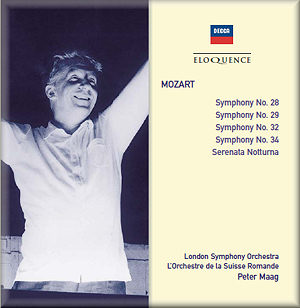
 5Hugh Maguire,
Neville Marriner (violins); Simon Streatfield (viola); Stuart Knussen
(double-bass); 1-3Orchestre de la Suisse Romande, 4-5London
Symphony Orchestra/Peter Maag
5Hugh Maguire,
Neville Marriner (violins); Simon Streatfield (viola); Stuart Knussen
(double-bass); 1-3Orchestre de la Suisse Romande, 4-5London
Symphony Orchestra/Peter Maag 
