Editorial Board
MusicWeb International
Founding Editor Rob Barnett Editor in Chief
John Quinn Contributing Editor Ralph Moore Webmaster
David Barker Postmaster
Jonathan Woolf MusicWeb Founder Len Mullenger
JOSQUIN
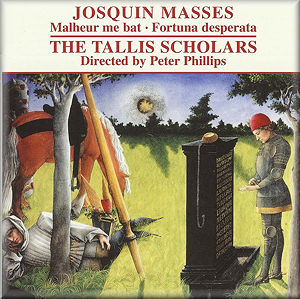
Des Préz (c.1440-1521) Missa Malheur me bat, [39:46] * Missa Fortuna desperata [35:41] ** The Tallis
Scholars (Tessa Bonner (superius*, altus**); Sally Dunkley
(superius)*; Caroline Trevor (superius*, altus**); Andrew
Carwood (altus*, tenor **); Steven
Harold (altus)*; David Gould (altus)**; Julian Stocker (altus)*; Nicholas Todd
(tenor)*,**; Christopher Watson (tenor)*,**; Mark Dobell (tenor**, altus*); Donald
Greig (bassus)*; Robert Macdonald (bassus)*,**; Tim Scott Whitley (bassus)**; Andrew
Westwood (bassus)**; Jonathan Arnold (bassus)*; Stephen Charlsworth (bassus)*)/Peter
Phillips
rec. 2009, chapel of Merton College, Oxford, UK. DDD GIMELL CDGIM042 [75:27]
The reputation of
The Tallis Scholars under Peter Phillips in this repertoire,
Renaissance choral polyphony, is so well established that
it hardly needs a gloss. Formed in 1973 and usually performing
two to a part, the specialist ensemble has an approach
that usually suggests a purity and integrity of
sound. They aim for a cleanliness of line and texture and
for penetration to the words through focused, uncluttered
articulation of the music. Yet this style has not won universal
praise; by some it's seen as too anodyne.
It's thus important
to guard at best against sameness; at worst against sterility.
Three aspects of the ensemble's work stop these charges
from sticking, and are evident in this excellent CD: the
continuing interests of members of the group in scholarly
research; their determination to explore dissimilarities
across the music of the composers they perform as closely
as similarities; and the repertoire itself. If its spirit
is fully entered into, the music of Josquin exudes its
own vitality. That's definitely the case here. Joy, wisdom,
temperance and exultation are all in evidence.
Phillips' essay in
the accompanying booklet (which also has the Latin, English,
French and German texts) may give us a clue to something
in the present recording which has afforded it such life.
He alludes to the current fashion of comparing Josquin
to Beethoven. Of seeing the former also as a hugely influential
composer promoting immense changes in the way music was
conceived and performed. And of the production of an easily-knowable
corpus of profound masterpieces. Specifically, each of
Josquin's 16 or so authenticated masses touches on a different
area of (human and/or divine) experience; and stands in
its own right for so doing.
The two masses here
presented are works of real wonder, are typical of Josquin
at the height of his powers, and are sung with a spirit,
a flare and an engagement that make this recording one
to rush out and buy: there is only really one competitor
to each - The Clerks' Group (Gaudeamus 306, Missa
Malheur me bat; Gaudeamus 220 Missa Fortuna
desperata).
As is common for this kind of composition,
each mass has as its model a secular polyphonic song. Malheur
me bat, once thought to be by Ockeghem is actually
by an obscure Flemish composer, Malcort; while Fortuna
desperata (thought to be the earlier) is by Antoine
Busnoys. What was not so common was Josquin's recourse
to all three voices of each song for the material on which
to base his masses. These masses, then, are in the tradition
of the later 'Parody masses' of Josquin, his contemporaries
and successors. And indeed there is a freshness, a sense
of experiment - of adventure, almost - in the singing of
The Tallis Scholars… listen to the turns and twists of
the Credo in the Missa Malheur me bat [tr.3], for
example.
It's in the Credo of the Missa
Fortuna desperata [tr.8] that one has a good opportunity
to hear the melody of the chanson; given the intricacy
of the reworking of the melodies' substance, such obscurity
is unlikely to yield its secrets without a score. Much
of the basis is mathematical.
For many listeners, though, this
will scarcely matter. We have an outstandingly beautiful
sound, polished, without being perfected, by Phillips and
the Scholars, and the success of which derives from intimate
knowledge of the conventions, practices and deviations
thereof, not to mention the place in history which such
developments took. They also have the necessary musicianship
to negotiate all such complexities. Even these skills would
not be enough if such insight resulted only in a mechanical
exposition of the relationship of chanson to mass, or a
completely empirical rendering of the gorgeous textures
of the latter.
Instead what Phillips and The Tallis
Scholars have achieved on this CD, it's tempting to say,
is nod in the direction of the suggestion that Josquin
strove for a through-composed work of what we could now
call symphonic proportions. Phillips also clearly believes
that it's also through attention to structure - again in
a symphonic context - that the music works. Even if subconsciously.
The components - in this case chanson,
paraphrase and the Ordinary - combine into something both
ethereal and of great power; both pleasing and challenging
to the ear. It needs singers like these to make the amalgam.
The Tallis Scholars - supported by Gimell's usual high
production standards - have succeeded.
Mark Sealey
Please support our advertisers below by clicking on the logos for further information.

























 The Tallis
Scholars (Tessa Bonner (superius*, altus**); Sally Dunkley
(superius)*; Caroline Trevor (superius*, altus**); Andrew
Carwood (altus*, tenor **); Steven
Harold (altus)*; David Gould (altus)**; Julian Stocker (altus)*; Nicholas Todd
(tenor)*,**; Christopher Watson (tenor)*,**; Mark Dobell (tenor**, altus*); Donald
Greig (bassus)*; Robert Macdonald (bassus)*,**; Tim Scott Whitley (bassus)**; Andrew
Westwood (bassus)**; Jonathan Arnold (bassus)*; Stephen Charlsworth (bassus)*)/Peter
Phillips
The Tallis
Scholars (Tessa Bonner (superius*, altus**); Sally Dunkley
(superius)*; Caroline Trevor (superius*, altus**); Andrew
Carwood (altus*, tenor **); Steven
Harold (altus)*; David Gould (altus)**; Julian Stocker (altus)*; Nicholas Todd
(tenor)*,**; Christopher Watson (tenor)*,**; Mark Dobell (tenor**, altus*); Donald
Greig (bassus)*; Robert Macdonald (bassus)*,**; Tim Scott Whitley (bassus)**; Andrew
Westwood (bassus)**; Jonathan Arnold (bassus)*; Stephen Charlsworth (bassus)*)/Peter
Phillips
