Fritz Brun was a pianist, composer and conductor – in my own limited
experience, before the arrival of this disc, I’d only encountered
his name before in the last capacity. He was born in Lucerne in
1878 and studied piano and music theory with a disparate group
of musicians, among them Willem Mengelberg. In 1897 he began studies
in Cologne where he made a lifelong friend in Zurich-born Volkmar
Andreae (1879-1962). From Cologne he moved to Berlin and from
1903 he worked as a piano teacher in Berne, later becoming more
prominent as an orchestral and choral conductor. By 1941 he was
devoting himself entirely to composition.
He’s reckoned to
be one of the leading Swiss composers of the time, alongside
his old friend Andreae, Hermann Suter (1870-1926) and Schoeck
(1886-1957). The last comparison is, on this evidence, very
misleading. Brun’s muse was oriented strongly towards Bruckner
and the Eighth Symphony, written in 1942, and heard in a performance
directed by the composer in 1946, is a heavyweight contribution
to the symphonic literature of his time.
Classically conceived
and with a programmatic and narrative thread – the four movements
correspond to four times during the day – this is an example
of ardent assimilation of Brucknerian models. The opening (midday)
starts with fanfare elements, a vibrancy but also a certain
stridency of utterance as well, one that thins to lightly-grained
orchestration for more intimate material. It’s notable that
Brun avoids starting with dawn, thus offering a somewhat more
skewed and non-linear approach to his material, one that gives
one the chance to begin with vital energy rather than drowsy
awakening. The slow movement is based on a folksong and is again
bathed in Bruckner – sectional, lyric but not in the last resort
especially distinctive though once more orchestrated with skill.
The horns are certainly burnished. The third movement, heard
as if ‘by lamplight’, is warmly textured – the bass clarinet
prominent – and the wind section offers other wispy, insect
pleasures in the alfresco evening. The finale begins with murky
quasi-impressionist refraction before some perky Straussian
elements and lyric curlicues enliven proceedings. The pacing
is canny, the sturdy march themes sinewy.
The companion work
is the Variations on an original theme for piano and string
orchestra, written two years later and performed here by Adrian
Aeschbacher (piano) with the Collegium Musicum Zurich under Paul
Sacher in 1946. This is necessarily a more concise work, one that
seems to pay homage to the memory of the Siegfried Idyll, and
maybe also, sideways, to Frank Martin. Aeschbacher, who is perhaps
best remembered on record for his collaboration with Furtwängler
(and van
Kempen) in Brahms’s Second Piano Concerto, plays with authority
and control. It’s a work strong on internal dynamic contrasts,
on clever moments of chamber intimacy, on easeful reflection and
subtle conjunctions of orchestral voicings.
The recording is
a bit boxy but a pre-edited fragment from the original 78 is
included to show one how the engineers have worked on the source
material to its strong advantage. The Symphony has a rather
muddy sound but it’s perfectly serviceable for its vintage.
There are helpful notes in German and English.
Jonathan Woolf
























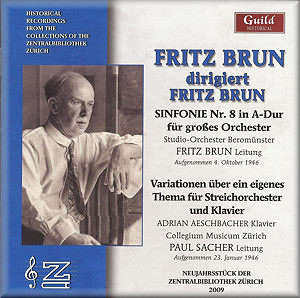

 Studio Orchester
Beromünster/Fritz Brun (symphony)
Studio Orchester
Beromünster/Fritz Brun (symphony) 
