Amy
Marcy Cheney Beach only swam into my ken recently, and
I’m so glad she did. Like her compatriot and contemporary
Charles Edward Ives she hailed from New England, where
she made quite an impact as a child prodigy. She gave her
first public performance at seven and, largely self-taught,
went on to become both a performer and a composer of some
distinction. Unfortunately for such an independent-minded
and talented young woman her husband insisted she limit
her performances to just one a year; the good news is that
she was then able to devote more time to composition, becoming
America’s first female composer of large-scale orchestral
works, such as the
Symphony No. 2 in E minor ‘Gaelic’ (1896)
(on
Naxos,
Bridge and
Chandos).
Given
that she was a piano prodigy it’s hardly surprising that
much of Beach’s output was written for the instrument.
Inexplicably, recordings of her works are still few and
far between, so Guild must be congratulated for taking
on this series with American-born pianist Kirsten Johnson.
My colleague Jonathan Woolf welcomed the first volume of
early works – see
review – and
now we have the second, covering the period 1897-1907.
The first piece, Op. 60, is based on Balkan folk melodies
Beach picked up from two missionaries to Bulgaria. An unusual
source of inspiration, perhaps, but these tunes form the
basis of a most rewarding set of variations. The opening
Adagio
malincolico is surely Chopinesque, but surely there’s
a hint of something much more individual in the music’s
harmonic shifts and twists.
Johnson,
who has an interest in music from this part of the world – she
has recorded two discs of Albanian music for Guild – see
review
1 and
review
2 – also provides very informative liner-notes. As
I’ve said before, informed comments and analyses are most
useful when it comes to less familiar repertoire; if only
all recording companies took the same view. As for the
pieces in Op. 60 – ranging from a minute to four-and-a-half
in length – they cover a wide variety of moods. Variation
II is particularly forthright, masculine even,
in its weight and reach. Contrast that with the finely
wrought Variation IV and you’ll soon appreciate
the cut of this composer’s jib.
St
George’s, Bristol, makes a fine venue for this recording;
the piano sounds warm and detailed throughout, with no
hint of distracting brightness or jangle. But what I admire
most is Johnson’s natural, flowing style, which picks up
so much colour and detail along the way. Those simple arpeggios
and trills in Variation V are finely graded yet
so full of feeling. If you’re looking for rough Bartókian
rusticity in these tunes you’re in the wrong place. It
seems that Beach merely uses these melodies as springboards
for a series of highly expressive inventions. The repeated
rhythms and whirls of the
Allegro all’ Ongroise and
the
Marcia funerale may seem a little
understated but Johnson handles this music with wonderful
poise and restraint. They are miniatures, after all, and
I’m delighted that she isn’t tempted to put them in large,
ornate frames.
Variation
VII is one of the loveliest pieces here, combining
weight and delicacy with a certain rhapsodic quality. Even
in the broader, more declamatory moments – Variation VIII
for instance – Johnson’s sense of musical perspective
ensures these pieces are scaled to perfection. The sombre
Funeral March has a measured tread, the pianist
very much in control of the music’s steady climb to a dynamic
peak and its gentle descent to the valley below. Similarly,
in the Cadenza Johnson finds a good balance between
the music’s outward virtuosity and its inner voices. Just
listen to the bell-like close to this section and the gentle
but expansive reprise of the opening theme. This really
is delectable music, superbly played.
In
the great tradition of children’s pieces – Schumann and
Debussy spring to mind – Beach’s
Children’s Corner artfully
combines an element of grown-up gravitas with child-like
charm. Witness the earnest little Minuet, with its fleeting
glimpses of something more wistful; Johnson phrasing the
Gavotte with grace and a real feeling for the music’s delicate
proportions. Ditto the music-box-like-tinkle of the Waltz,
whose gentle rhythms are so naturally done. A March and
Polka round off the suite, the latter combining
crisp inner detail with plenty of outward sparkle.
Beach’s
transcription of the Richard Strauss song
Ständchen is
sensitively done, the flourishes capturing the swirl of
the orchestral original, Johnson conveying the music’s
surging character as well. Very accomplished writing indeed,
played with orchestral amplitude.
Scottish Legend is
more considered, yet it retains all the ease and fluency
of Beach’s earlier pieces. As for the
Gavotte fantastique it
fuses pointillist dabs with broader swathes of colour,
yet it sounds wonderfully nimble in Johnson’s hands. The
more programmatic
Eskimos – based on Inuit melodies – is
sparer of texture but no less atmospheric for that. The
plain harmonies of
Arctic Night give the piece a
somewhat desolate feel;
The Returning Hunter is
much brighter and more rhythmic and
Exiles has a
restless, yearning air to it.
As
with much we’ve heard thus far there is an economy of style
in
Eskimos, an emotional restraint, that is most
impressive. It’s the kind of writing that can so easily
underwhelm unless it’s played with utter conviction. No
quibbles on that score, with Johnson despatching the animated
final section with her customary elan. The disc ends with
an exquisitely shaped little
Moderato, the perfect
sign-off to an enchanting collection.
Like
Cortez gazing down from that peak in Darien new listeners
will surely marvel at the more compact, but no less revelatory,
landscape unveiled here. Any niggles or no-nos? Absolutely
none. This is heart-warming music played with rare grace
and character; indeed, it could very well be one of my
discs of the year.
Dan
Morgan
























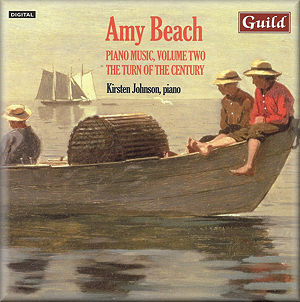

 Kirsten
Johnson (piano)
Kirsten
Johnson (piano) 
