Recordings
can be a stark reminder how time flies. It didn’t seem
that long ago that historically informed performances of,
say, the Brandenburg Concertos, still had an air of novelty
about them. Now the first HIP recordings could be considered
historical. Formerly progressive approaches - first Richter,
then Rilling – strike one as old-fashioned, and what once
were historical recordings seem downright ancient. That
contrast could not have been made more clear with one of
the most recent and one of the oldest recordings of these
Brandenburg concertos appearing on my desk at the same
time.
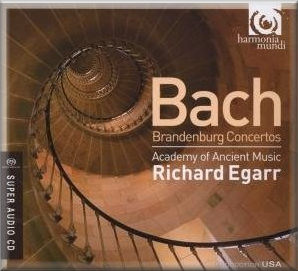
Richard
Egarr’s recording with his Academy of Ancient Musick on
Harmonia Mundi representing the latest in HIP Bach (see
YouTube
video). EMI’s
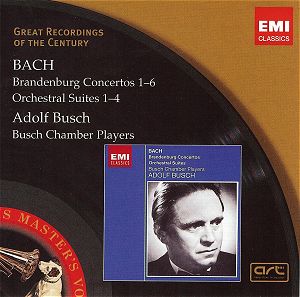
re-issue of the 1935/36 recordings of Adolf Busch and his
Busch Chamber Players stands at the other extreme. That
said, Busch & Co. could be said to have been the HIPsters
of their time.
Direct comparison is telling and interesting, but useless when
it comes to deciding whether they are competitive releases.
The purposes are different. No one will or should get a 70+
year old recording as the first or only recording of these works,
even one where the sound is as decent as on these newly re-mastered
discs. Busch operates outside the competition or, rather, in
the historic division which includes Alfred Cortot and his École
Normal de Musique - the first recording of all six concertos,
also on EMI Classics - as the obvious competitor. You can perhaps
count Pablo Casals’ 1950 Prades Festival recording in the same
company.
For
Egarr, the two most recent major period instrument releases
- Alessandrini/Concerto Italiano on Naïve and Pinnock/Brandenburg
Ensemble on Avie (see
review) - serve
nicely to elucidate contrasts and similarities. Egarr and
Alessandrini use one player per part; Pinnock mostly uses
a small ensemble, switching to one-to-a-part only for the
Fifth Concerto. Egarr’s First Concerto starts boldly with
a dark, round, slightly stuffed horn sound. This is perfectly
executed by the natural horn players who barge in with
the excitement of an ensuing hunt. The darkness has a reason:
Egarr chose the French Baroque pitch for this recording,
which, at A392, is another semitone lower than the standard
Baroque pitch of A415.
Egarr’s
swift Adagio (3:09, Alessandrini 4:02, Pinnock 3:39) does
little to indulge his oboists and the violino piccolo,
but establishes a pleasantly fresh pulse. The ritardando
in the third movement (Allegro) of the First Concerto,
just before the music jolts back out of this brief contemplative
point, is massive. Although Alessandrini beats him by stretching
it to 25, not just 20, seconds and coming to a complete
halt, Egarr makes it sound even more audacious by starting
it a few notes earlier. He keeps the music going throughout,
and then bolts on even more explosively than Concerto Italiano.
It’s one of the few moments where Egarr out-excites Alessandrini,
being usually on the slightly calmer - and saner - side
of things than his Italian colleague.
The
Menuet is a nervously, yet steadily chugging little thing
in Alessandrini’s hands; a bright and graceful dancing
movement with Pinnock. With Egarr it has a contemplative,
incredibly sensuous flow. Put less positively: it’s a case
of muffled lurching. Egarr has no time for any cadenza-improvising
or movement-substituting between the two Adagio-chords
of the Third Concerto. He states, in the accompanying notes,
that “Bach’s ‘Bar’ (the one containing these two chords)
is perfect’” and cites compelling mathematical context
in his support.
The
Presto from the Fourth Concerto just purls along with gentle
ease. The flute vibrato in the opening Allegro of the Fifth
Concerto is tasteful enough. It is not as overt as with
Alessandrini and not as borderline sour as with Pinnock.
The concluding
Allegro could stand representative
of much of the general differences between these recordings:
Egarr buoyant, unintrusive, with a soft flexibility to
the ensemble’s tone; Alessandrini explosive with a bit
more edge, and Pinnock in-between. I particularly love
the silken airiness of the Second Concerto’s
Allegro in
Egarr and the — musicologically incorrect — use of theorbo
basso continuo throughout. The instrument is used
instead (!)
of the harpsichord in the
Adagio ma non tanto of
the Sixth Concerto. The added continuo color, writes Egarr,
was “a delicious luxury I couldn’t forgo.”
Richard
Egarr is not a man of extremes and he performs these works
with a well-judged moderation. His Allegros are not quite
so fast, his Adagios not overly slow and his accents lively
but not spiked. His touch on the harpsichord is soft and
ever-deft. He doesn’t set out to shock or primarily excite,
but to delight. This warm touch reminds of Jordi
Savall’s version with
Le Concert des Nations more
than any other HIP account I know.
The
sound is excellent: rich and with lots of room to bloom — although
on the soft side, further emphasizing the character of
the interpretation. Voices are not as easily separable
as in the Alessandrini recording, which offers more clarity.
The recording is SACD Surround capable, but was reviewed
only in (SACD) stereo. The presentation is up to Harmonia
Mundi’s usual highest standards. Perhaps not a must-have
for anyone who already enjoys two or three HIP
Brandenburgs in
their collection, but a worthy addition. For those who
fear gratuitousness and willfulness in HIP versions, it
might be a first choice, especially as Savall is out of
print.
What
does state of the art 1935 sound mean in 2009? Well, it
means “perfectly listenable”. It means that all the necessary
musical and interpretive information is easily communicated.
It means that the re-mastering did not have to zap the
recording’s soul to leave us with background hiss that
is minimal enough so as not to cause quick listening fatigue.
It still beats listening to (non digital) radio by a good
margin.
My impression of the Busch recording was bemused skepticism
at first. It has, upon a few more listens, changed to bemused
admiration and casual joy. I don’t see myself becoming zealous
about this recording, but the felt and warm urgency of the music-making
combined with the glory that is Bach induces a broad smile.
The First Concerto might open with an Allegro that our spoiled
ears find staid, but at the very latest when we reach the galloping
Third Concerto (played one-to-a-part by Busch’s proto-HIPsters!)
it becomes clear that Busch and his friends were, when playing
Bach, not bound by the traditions of their time. How much of
a Bach playing tradition was there, anyway, in these works?
Nor are they shackled to the interpretive styles then associated
with other music.
Sure,
there are ‘anachronisms’ here and there - and a few off-notes
- but this is miles away from the British “bigger-is-better” Handel
oratorio style that occasionally spilled over to Bach’s
choral works around that time. What
Karl Richter was to Bach performance
in the 1960s, Busch must have been in the 1930s. The Busch
Players used viola da gambas and George Eskdale played
on a Bach trumpet he had made. Only Busch’s son-in-law
- Rudolf Serkin – opted for a concert grand rather than
a harpsichord.
In the thoughtful new liner-notes, Tully Potter suggests that
knowing the dreary big-band performances that Busch was reacting
against would heighten our appreciation especially of the novelty
of these interpretations. More importantly for me, Busch’s relative
modernity allows us to hear much of what was
different
in the musical approach to Bach in that time without having
to hear all that which was unambiguously
worse.
I
find slightly less appeal in the old-style Orchestral Suites
that are also included on this three disc set, but for
curiosity’s sake alone they’re a fine bonus.
Jens F. Laurson
EMI Great Recordings
of the Century page

























 Busch Chamber
Players/Adolf Busch
Busch Chamber
Players/Adolf Busch 
 [44:04
+ 52:16]
[44:04
+ 52:16] 
