Dvořák’s Stabat Mater is one of the most beautiful
choral works ever written. Vaclav Neumann’s performance on DVD
(Arthaus
102019) convinced me of this beyond any reasonable doubt –
his version sits on an equal plane with (on record) Kubelík, Smetáček
and Talich.
Here,
there are no scene-setting camera pannings; rather, the soloists
and conductor enter and all gets underway with no real preliminaries.
Musically, the opening itself does not have the sense of devotion
that Neumann instils. Neither does the chorus establish the
same sense of loss in its handling of the lachrymose descending
lines that permeate this first movement, “Stabat Mater dolorosa”.
Camera angles include impressive views of the chorus (ladies
in a lovely purple, gents in traditional concert dress) and
dissolves from one view to another.
Whereas
in this piece Neumann projected a sense of the vast, Pešek seems
not to look so far ahead, resulting in the first entrance of
the tenor and the subsequent paragraphs sounding rather directionless
and out-of-place; neither accusation could ever be levelled
at Neumann. Pešek’s sense of curbed-in drama seems equally under-developed,
although his technique cannot be faulted - his beat is eloquent
and clear. A particular casualty of this lack of internal fire
is the ninth movement, “Inflammatus et accensus”, where the
orchestral contribution is merely routine. Hear – and watch
– how Neumann elevates archetypal musical gestures to higher
planes here.
The soprano
Eva Randová enters as a beam of light, her pure voice a pleasure
to listen to. Mikulaš’s bass is initially rather heavy, but
the quartet of soloists when they sing together actually gels
into a coherent group. Indeed, the quartet comes into its own
in the quartet, “Quis et homo, qui non fleret”. It does rather
appear that Kachliková is happiest when in ensemble. When she
has a solo, there is not quite enough projection or personality
- crucially, in the “Inflammatus”. In contrast, the bass, Mikulaš,
thrives in his big solo, the fifth movement, “Fac, ut ardeat
cor meum”, as does the tenor, Štefan Margita, in the seventh
movement, “Fac me vere tecum elere”. Margita has a rather light
voice which is not inappropriate in the earlier parts of the
movement. He struggles to be heard later on, and I suspect this
is not a fault of the recording balance.
The chorus
is clearly well trained although I can find all sorts of credits
for all sorts of people, including the two “floral decorators”,
I cannot find the name of the chorus-master. The choral movement,
“Virgo virginum praeclara” is a model of choral good behaviour.
The choir’s tone is rich yet not too heavy, and this movement
even approaches some sort of radiance.
Interesting
to note that Pešek’s teachers include both Neumann and Smetáček,
yet Pešek cannot rise to either’s heights. The true light of
this account is Urbanová, nowhere as touching as in “Fac, ut
portem Christi mortem”, where she inspires Margita to give his
best in response to her caressing phrases. Yet one soloist is
not enough to raise this performance to the heights this Stabat
Mater requires it to scale.
Neither
text nor translation is included, unfortunately, although subtitles
(infrequent) with a choice of translated languages are included.
The original Latin is not an option here, either.
Dvořák’s
Stabat Mater is what might be termed a fragile masterpiece.
It can disintegrate in the wrong hands, and lose its majesty.
Such is the case here, I fear. Go to the Neumann for a sense
of the true worth of this piece.
Colin Clarke
























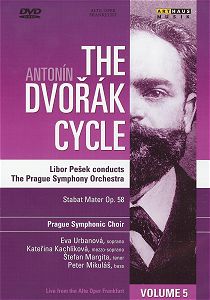

 Eva Urbanová
(soprano); Kateřina Kachlikov (mezzo); Štefan Margita (tenor);
Peter Mikuláš (bass)
Eva Urbanová
(soprano); Kateřina Kachlikov (mezzo); Štefan Margita (tenor);
Peter Mikuláš (bass) 

