František Tůma is one of those interesting figures who seem
to embody, musically speaking a key period of transition in the
history of music. He was born in Kostelec nad Orlicí, where
his father was organist. In all probability the younger Tůma
studied at the Jesuit Seminary in Prague, where his teachers would
have included Bohuslav Matěj Černohorsky (1684-1742),
the widely travelled organist and teacher, with whom both Gluck
and Tartini also studied, and who was a major influence on the
development of music in Bohemia. We know for certain that Tůma
later (from 1722) studied with Fux in Vienna. He went on to become
kapellmeister to Count Franz Ferdinand Kinsky, High Chancellor
of Bohemia who had probably been responsible for making it financially
possible for him to study with Fux. On the Count’s death in 1741,
Tůma went on to work for the dowager Empress Elizabeth, widow
of Charles VI, as musical director of her private chapel and court
composer. He held these posts until 1750 and, until choosing to
spend his last years in a monastery in Geras, he continued to
live in Vienna.
As Rinaldo Alessandrini
observes in his notes to the present CD, “the most striking
feature of Tůma’s instrumental writing is undoubtedly
the heterogeneity of styles”. His training with Fux, and his
earlier, youthful musical experiences - in which we should
probably include the influence of his father’s example - made
him thoroughly competent in the quasi-Bachian use of counterpoint
and fugue. But his ears and mind were open to newer, more
‘modern’ influences too. If, in some movements, one hears
echoes of Bach and Fux one also hears elsewhere some more
distinctly galant movements and more than a few Italianate
elements too. Vivaldi was in Vienna at the end of life and
Tůma would assuredly have been familiar with his music
much earlier than 1740 – as well as with that of many other
Italian masters, both in person and on paper, as it were.
Out of all this
comes some music which eludes most of the easy categories
of modern music historians and which produces some of its
best effects by juxtaposition – the heterogeneity of which
Alessandrini speaks. Not everyone will like Tůma’s eclecticism
but I have to say that I find it exciting and stimulating.
Much as I admire the work of Rinaldo Alessandrini, I am not
entirely sure that he here proves himself the ideal interpreter
of Tůma. Some of these works – particularly the two sinfonie
– seem to cry out for larger forces than the two violins,
one viola, one cello, one double bass and one theorbo which,
along with Alessandrini’s harpsichord, constitute the Concerto
Italiano on this recording. One misses the fuller string sound
which the music seems to invite - indeed require. Nor does
Alessandrini always seem to come up with quite the elegance
that Tůma’s more proto-Haydnesque passages seem to demand.
Where Alessandrini triumphs is in the more obviously ‘baroque’
and, more particularly, the most quintessentially Italianate
movements. Much of Alessandrini’s conducting of Italian baroque
works over the last few years has been genuinely revelatory
– it has uncovered qualities in the works undiscovered by
most previous interpreters but genuinely present in the scores
and wholly appropriate in a modern period-instrument performance.
But here, it is as if the Alessandrini ‘manner’ has been imposed
upon material to which it isn’t always fully appropriate;
has been ‘applied’ and added rather than being a process of
revealing what was there and awaiting discussion. Alessandrini
responds so much more forcefully to the Italian dimensions
of Tůma’s music than he does to what one might call its
more Germanic elements. For this reason the readings don’t
quite do full justice to the creative stylistic tensions inherent
in the music. An important tensional balance has been tipped
a little too fully in one direction. Until Alessandrini and
others came on the scene we didn’t always realise how much
earlier German and English interpreters had made the great
Italian baroque composers speak with a northern European accent.
Now, in a kind of reversal, Alessandrini has made a Czech
who worked in Vienna sound like a native Italian.
These remarks
are meant only to suggest that Tůma presents some genuinely
difficult problems of interpretation and musical style and
that Alessandrini can’t be said to have solved them definitively.
What I do not want to deny is that this CD makes for exciting
and fascinating listening; indeed, I have never heard a performance
directed by Alessandrini that wasn’t exciting. Those
of us who think that Tůma is a composer who hasn’t yet
had his just deserts can (and surely will) enjoy the present
disc, without believing that the final word has yet been said.
Glyn Pursglove























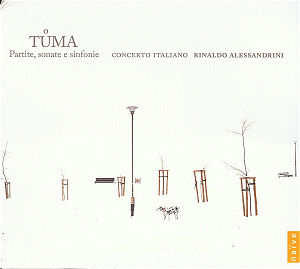

 Concerto Italiano/Rinaldo
Alessandrini
Concerto Italiano/Rinaldo
Alessandrini 
