Salome is a strange creature: part Isolde, part neurotic
and, at first, spoilt teenage brat. Yet Salome inhabits an even
stranger universe where every other character lusts after what
obsesses them be it a soldier who commits suicide following Salome's
rejection or John the Baptist’s tunnel-vision focus on the divine.
Within that context Salome's corrupted sexual awakening towards
her deluded confusion of the bitter taste of blood with the taste
of love is the core of her tragedy.
This live 2007 recording from the Festival della Valle d'Itria
di Martina Franca is only the second complete Salome sung in French,
rather than German, on CD. The translation need not worry purists
as Strauss not only sanctioned the use of Wilde's original French
text but reworked part of the score to match. The festival's artistic
director explains in the booklet that Strauss drew inspiration
first and foremost from Pelléas et Melisande and that Strauss
"understood that it was absolutely necessary to reduce the
crashing sound qualities so beloved of the German post-Wagnerian
pompier, making room for silences, in a never realised desire
to create an almost chamber-music discourse".
Thereby Caldi's conducting eschews the lurid for the lucid,
ditches much of Strauss's kitsch but is still alive to the
drama. The sensuousness of the French vowels are matched with
transparent orchestral layering and extended lines. You can
almost see Salome’s veils being gently tossed into the air
before floating to earth. Many orchestral attacks are cushioned
rather than clipped, timpani are supportive rather than earth-shattering
and orchestral solos, notably from the woodwind, are forward.
The engineering supports the approach with voices comfortably
clear and by reining in crescendo so the dynamic range, such
as in the dance or the orchestral explosion when Salome finally
gets John’s head on a platter, are flattened. Dohnanyi’s set
comes closest to this transparency but whilst the Vienna Philharmonic
are technically finer than the Orchestra Internazionale D’Italia/Dohnanyi’s
Salome is lamed by ghastly vibrato.
The singers will be new to most CD listeners. Soloviy’s surprisingly
deep tones are based on a warm metallic core and her colours
can turn amber or gold. The voice is resonant and vibrant
only occasionally developing an unobtrusive beat in some crescendos.
Soloviy’s emphasis is on developing character through a singing
line noticeably evoking the sensuousness of the French text
when first negotiating with Herod for the Baptist’s execution,
later bringing out a hardened edge as Salome sticks to her
cruel demand. Perhaps Cheryl Studer’s silvery tones in the
Sinopoli set suggest the teenage girl more naturally but Soloviy
still sounds fresh and youthful.
The final monologue is more sensual than usual. Brass and
timps are hedged in the opening crescendo and Soloviy sings
most of Salome’s lines with surprising tenderness. It may
be a drop in temperature too far for some listeners, and she
could arguably use a greater variety of vocal colours, but
singer and conductor do develop a dramatic arch towards Salome’s
triumphant cry “Princesse de Judée!”. What a pity then Salome’s
gentle words, just before Herod’s entry, are ruined by someone
trampling across the stage. Such stage noises are caught throughout
this recording with amazing clarity by the microphones. Was
one placed on the floorboards?
Leonardo
Gramegna’s Herod also has a youthful
voice. His bargaining with Salome after the dance begins with
such romance listeners may wonder if they’d wandered into
La Bohème. The effect is creepy. Elsewhere, especially when
conversing with Herodias he subtly reveals the mania and grotesque
comedy without resorting to caricature.
Strauss told Hans Hotter that John the Baptist should move
as little as possible about the stage and the near frightening
command and implacability of the preacher is certainly borne
out in the great baritone’s live recordings for Keilberth
(1951) and Reiner (1952). Finucci’s imposing Baptist is, in
tune with this production, a much warmer and human creation
yet not matching Hotter in capturing the wild wanderer from
the Old Testament wilderness.
How you respond to this set will depend on what you want from
Salome. Mahler said that there is a volcano underneath the
score. For most listeners the theatrical impact of the German
version is realised as we sense that subterranean force simmering
or even erupting. Sinopoli is often accused of overcooking
the score, plunging into a world teeming with neuroticism,
the Romantic and the disturbing. Karajan goes for a sleeker,
fuller palette but like Sinopoli can still bring intense energy
that threatens to boil over not least in the crucial final
exchange between Herod and Herodias. That same tiny scene
under Caldi does not build with nearly the same violence.
Yes,
there is room for an almost chamber-like discourse but this must
feed into a vivid drama which includes suicide, a strip-tease,
murder and necrophilia. All these aspects together with surprising
clarity balance best in a live 1952 Metropolitan Opera recording
lead by Fritz Reiner. His extraordinary cast is lead by Ljuba
Welitsch who rips Salome from the bar-lines with some of the most
vivid parlando, clear diction and molten silvery tone on record.
Just listen to that gleeful laugh as Salome finally gets John’s
head on a platter and Reiner whips the score into what can only
be described as an orchestral orgasm. Even as you hear fine singers
like Sofia Soloviy, Hildegard Behrens and Cheryl Studer your mind’s
ear will remember how Welitsch did it better. She was truly off
the scale.
David
Harbin
see
also Marc
Bridle's comparative review of Salome on record
























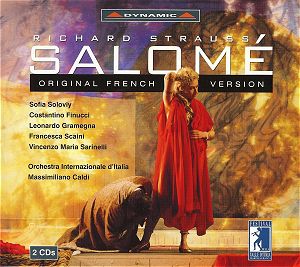

 Sofia Soloviy (soprano) – Salome
