Editorial Board
MusicWeb International
Founding Editor Rob Barnett Editor in Chief
John Quinn Contributing Editor Ralph Moore Webmaster
David Barker Postmaster
Jonathan Woolf MusicWeb Founder Len Mullenger
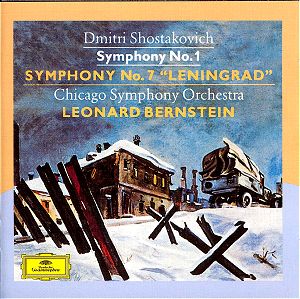
Dmitri SHOSTAKOVICH (1906–1975)
Symphony No.1 in F minor, op.10 (1925) [34:37]
Symphony No.7 in C "Leningrad", op.68 (1941) [80:49] Chicago
Symphony Orchestra/Leonard Bernstein
rec. live, June 1988, Orchestra Hall, Chicago DDD DEUTSCHE GRAMMOPHON
477 7587 [66:43 + 53:11]
When Shostakovich
wrote his 1st Symphony he was a 19 year
old student and he took the world by storm. By the time
he came to create his mammoth 7th Symphony,
written during the siege of Leningrad in the Great Patriotic
War, he had endured the wrath of the Party machine with
his opera Lady Macbeth of the Mtsensk District.
He had also written the 5th Symphony,
which he claimed was a Soviet Artist’s Reply to Just Criticism.
Do we believe this? Of course we don’t, at least we don’t
now we know the details behind the composition. This is
spelled out quite clearly in Testimony - which I
believe is the autobiography of the composer, although
there is still conjecture over this point.
The 7th Symphony has
never, really, reached the popularity of the astonishing 8th – a
truly great, and thoroughly devastating, war Symphony – or
the 5th or 10th. The
stumbling block has always been the notorious middle section
of the first movement where a simple theme is repeated
over and over again, with the orchestration growing in
size over a repeated two bar side-drum figure. Originally
we were told that this was supposed to depict the Nazi
war machine as it attacked the city but later Shostakovich
said that it was a portrait of Stalin (as is the scherzo
of the 10th) and his machinations. It
takes a performance of some stature and subtlety to make
this music sound frightening and monolithic - not just
a poor man’s Bolero.
Bernstein
recorded the 7th Symphony in the early
1960s with his own New York Philharmonic. It was initially
on 2 LPs in a boxed set coupled with the 1st Piano
Concerto played by André Previn.
The Symphony was re–issued on CD SONY SMK 47616
T3, and the Concertoon CD SONY SMK 89752. If memory serves me correctly,
it wasn’t entirely successful in both performance and sound.
This DG version, however, is magnificent. Everything goes
right from start to finish. Bernstein holds the first movement
together magnificently. The opening paragraph, with two
wonderful tunes which are never used in the development
section - mainly because there is no development section per
se - is very well handled. Oddly, the trumpets which
punctuate the timpani blows at the start are somewhat brazen
and rather vulgar but this sound soon stops. Then comes
the middle section. Here, Bernstein slowly screws up the
tension, keeping a rock-steady tempo. By the time we reach
the climax all hell is about to break loose and take over.
But the “recapitulation” bursts in and the music calms
down. Beautifully done here, the gradations of volume are
very well handled. The final page, with its ghostly, not
to say ghastly, reminiscence of the middle section is quite
hair–raising in its simplicity.
The delicate,
dance–like, second movement is light and airy, feeling
like ballet music at times. The unruly elements are kept
in check and this is as fine an exposition of this movement
as one could hope for. The slow movement seems more beautiful
and less stressful than I’ve ever heard it before. Towards
the end, Bernstein injects the music with a large dose
of tragedy and the movement ends in desperation, which
is how the quiet opening of the finale begins. Before long,
however, Bernstein has pulled out all the stops and we’re
plunged back into the fighting, tension and strain of the
first movement. The volume grows, the orchestration fills
out and the coda, which so often can sound bombastic, is
built, not as a victory, but certainly not as a tragedy,
rather as real defiance in the face of adversity – whether
it be Stalin’s subjugation of the Russian people or the
Nazi war-machine.
This is a very
great performance in every way: the playing, the direction
and the intelligence which Bernstein brings to his interpretation.
The 1st Symphony,
which precedes the first movement of the 7th on
CD1 isn’t quite as successful. Here Bernstein seems to
over-point the grotesque nature of much of the music. That
said, there is still much to admire in his view, and the
slow movement is especially well done.
This issue
won a Grammy in 1991 and I am not surprised. The engineers
have excelled in creating a wide dynamic range which encompasses
the very quietest of whispers and the largest orchestral
sound thrown at them – and there are some very big sounds
from the full orchestra. Priced at just a little more than
one single CD this is well worth having even if you have
other versions of these works. It’s doubtful you’ll ever
hear them played with such passion and searing, white hot,
insight and intensity ever again.
Reviews
from previous months Join the mailing list and receive a hyperlinked weekly update on the
discs reviewed. details We welcome feedback on our reviews. Please use the Bulletin
Board
Please paste in the first line of your comments the URL of the review to
which you refer.













 Chicago
Symphony Orchestra/Leonard Bernstein
Chicago
Symphony Orchestra/Leonard Bernstein