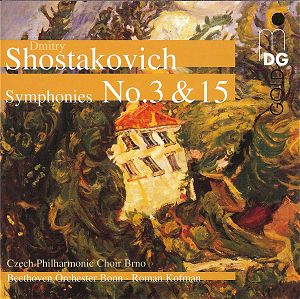
Readers of these pages will have come across earlier instalments
of this cycle from the Beethoven Orchester, Bonn and its general
music director and conductor Roman Kofman. Reactions have been
somewhat muted, but knowing MDG’s high standards with SACD production
I was still keen to hear what the team might make of these two
less often heard numbers in Shostakovich’s grand symphonic canon.
Approached in isolation,
this is a very well produced recording. MDG’s standards are
always very high, and their 2+2+2 SACD discs have always sounded
very good, even if, like me, you’ve never quite had the heart
to rebuild your system to accommodate the speaker configuration
indicated in the back of the booklet to these discs. I bet if
this cycle had appeared 20 years ago everyone would have been
raving about it, but such things do not exist in isolation,
and cycles of Shostakovich symphonies are no rarity on the shelves
these days.
The programme begins
with the superficially more approachable Symphony No.15.
Kofman and the Beethoven Orchester play with plenty of accuracy,
the dynamic range is impressive, and the individual soloists all
make excellent contributions. I was a little impatient with the
rather pedestrian tempi in both of the 1st and 3rd
Allegretto movements, and gingerly reached down my set with the
Moscow Philharmonic Orchestra conducted by Kirill Kondrashin.
Despite the sonic disadvantages of tape hiss and some interesting
perspectives, this recording was made in 1974, during the composer’s
lifetime, and presumably with some consultation as to the work’s
intentions. Comparing the two recordings is like comparing chalk
and cheese, the rough-hewn but grittily convincing Kondrashin
being the chalk, the tasteful but overly creamy and polite Kofman
very much the cheese. Timings aren’t everything, but here they
tell us a fair bit:
Conductor
Movt. 1 2
3 4 Total
Kondrashin (1974)
7:07 13:47
4:24 15:12
40:40
Kofman (2005)
8:30 17:10 4:35
15:32 45:56
Particularly
the first two movements show marked differences. The first movement
I just feel as being too slow, with none of the spark which
adds that essential sense of danger to all those witty twists
and turns. Kondrashin’s second movement has that strange bathroom
acoustic with those brass chorales, but his subsequent lower
string passages are filled with menace. Kofman goes for lush
and eloquent grandeur and has a magnificent brass section, but
there is little to grip the listener where the music becomes
more sparing. Kondrashin’s cello solo is filled with bleeding
anguish: Kofman’s is more lyrical and soulful, and those chiming
chords from wind to brass are nice enough but have little of
the chilling, operatic impact we have from the Moscow band,
who will no doubt have had the chimes of the Kremlin ringing
into their souls for decades. There is just too little going
on to sustain this slower tempo, and the whole thing ends up
becoming rather sad and soggy.
The
third movement perks up a little, but still retains the ‘accuracy
over energy/passion’ which this music so badly needs to keep
everything alive. The return of more sinister elements in the
Adagio opening movement fail to take the listener from
their comfort zone, and while the subsequent Allegretto is
nicely played I think most of us will have started yawning and
playing with the TV remote by this time.
Timings
for the Symphony No.3 are also of interest. 1972 vintage Kondrashin
comes in at 26:20, and Kofman at 29:13. I plucked another more
modern recording from the shelf just to be fair, and found Neeme
Järvi with the Gothenburg Symphony Orchestra on DG from 2001
to be somewhere in between , at 27:31. To be fair, the energy
levels in this symphony are at a higher pitch with the Beethoven
Orchester than in the previous work, but this also has something
to do with the nature of the music. The madness of the central
Allegro is crisp and efficient, and the Czech Philharmonic
Choir Brno sounds passionate and authentic. It’s only when you
put this up against other recordings that you have the feeling
there are other worlds to be discovered. Järvi’s orchestra in
that same Allegro are brutal and crushing. The sonics are less
spectacular as I had remembered, and that aura of resonance
begins to sound cumbersome and artificial, but the wildness
and drive in the music are on a different level. With the final
chorus the pendulum swings in Kofman’s direction, with Järvi’s
massed forces straining to be heard through a woolly mass of
acoustic boom. Referring back to Kondrashin, tape hiss and all,
and the soul of the music becomes a pillar of salt around which
the massed cascade of Shostakovich’s ideas dance and cling.
The dry acoustic makes this less of an aural feast than either
of the more modern recordings, but this, like its sibling the
Symphony No.2, was built for speed rather than comfort. Kondrashin’s
way with Shostakovich’s neurotic writing is often beyond the
pain barrier and the bass drum may sound like someone thwacking
a mattress with a baseball bat, but once heard, never forgotten.
The entry of the choir raises the hairs on the back of your
neck like no other recording I know.
Going
back to Kofman is a bit like doing your teeth with a shaving
brush – you can do the motions, but it doesn’t really get the
job done. There are some good moments, but, for example, the
dynamism in the accents throughout the penultimate Largo have
by no means the same impact as with Kondrashin. That elderly
recording does have its weaknesses, but there is a feeling that
there is no such thing as a transitional passage – the ears
are held in a vice-like grip from beginning to end.
In
conclusion, this recording has many fine qualities, but the
end results don’t knock any of the other versions I know off
the shelf – including one which I haven’t mentioned; that with
Rudolf Barshai on the bargain Brilliant Classics label which
I would put somewhere closer to Kondrashin in the ‘must have’
stakes. You may be tempted by the SACD technology, and MDG’s
engineering is very good, but the musical experience is the
one which will keep bringing you back to a recording, and surround-sound
sonics may not be enough in this case.
Dominy Clements

























 Beethoven
Orchester Bonn/Roman Kofman
Beethoven
Orchester Bonn/Roman Kofman
