The use of the double choir, or cori spezzati, may have
effectively begun at St. Mark’s in Venice although there is some
evidence that it happened elsewhere in the Veneto before Adrian
Willaert’s adoption of the practice at St. Mark’s in the middle
of the sixteenth century. However it soon spread across Italy
and beyond. Indeed it became a major characteristic of the sacred
music of the Spanish baroque and Latin America. The phenomenon
is discussed in Anna Tedesco’s ‘The polychoral tradition’ in volume
34 of Early Music (2006, pp.342-344), reporting on a conference
held at the Palazzo Giustinian Lolin in Venice in 2005, ‘The polychoral
tradition in Italy, the Iberian Peninsula and the New World’.
This CD presents
an anthology of polychoral music written for the churches of
Rome, roughly between the last quarter of the sixteenth century
and the first half of the eighteenth. Given that Giovanni Giorgi
died in 1762 it seems unlikely, although his birth date is unknown,
that he “was born in Venice in the first quarter of the 17th
century” as François Filiatrault suggests in the booklet notes!
ATMA do not offer
here the more extreme employments of polychorality – some documents
describe the use of as many as ten choirs, often raised each
on a separate platform and often each with its own organ or
other instrumental accompaniment. This anthology is made up
of pieces written for three choirs - such as the two motets
by Marenzio and those by Victoria and Ugolini - and for two
choirs: the motets by Palestrina and Giorgi.
Palestrina’s is
the major voice here, and much else on the disc might be thought
of as music written in a more or less direct line of descent
from his powerful example. That is true even of Marenzio, whose
work displays more obvious debts to the secular madrigal tradition
than Palestrina allowed himself when setting sacred texts. Palestrina’s
two motets stand out as work of monumental - but far from merely
heavy – beauty. Benevoli’s ‘Gloria’ makes good use of its three
choirs and the motets by Giorgi - which presumably belong to
his years as maestro di capella at St. John’s Lateran
in Rome, from 1719-1725 - are all (especially the striking ‘Terra
Tremuit’) decidedly interesting examples of later writing, grandly
baroque, in the polychoral manner.
Most of the material
is sung a capella, though a few pieces are accompanied
by continuo bass, in the form of Sylvain Bergeron’s theorbo,
Karen Kadevarek’s cello and Réjean Poirier’s positive organ.
The thirteen voices of the Studio de musique ancienne de Montréal
blend well, are attentive to detail and sustain the occasional
solo duties very decently. Just occasionally a little more emotional
intensity wouldn’t have gone amiss, but all of these performances
enable us to enjoy some complex and rewarding music.
The recorded sound
has – as it needs to – a generous but focused sense of space,
whether heard on a standard player or an SACD model. Of course,
this is one kind of music for which SACD is particularly well
suited. Still, the very best recording techniques can never quite
give us the real experience of such music - leaving aside such
questions of authenticity as the use of female voices. An exercise
of active imagination is needed, however good performances and
recording may be. Such music was part of a complex sensual and
spiritual experience. Leibniz – who was in Rome in 1689 – left
a descriptive catalogue of the baroque Catholic experience, writing
of “The strains of music, the sweet concord of voices, the poetry
of the hymns, the beauty of the liturgy, the blaze of lights,
the fragrant perfumes, the sacred vessels adorned with precious
stones, the statues and pictures that awaken holy thoughts, the
glorious creations of architectural genius, with their effects
of height and distance …”. Polychoral writing both took advantage
of – and reinforced – the heights and distances of the great baroque
churches of Rome and it played its part in the complex of effects
which Leibniz describes. Sitting at home, a considerable effort
of imagination is needed even to begin to put this music into
appropriate context. Perhaps future technology will develop to
allow a kind of virtual experience of music and place, at which
point reviewers will need to comment on the smells and the statues
as well as the singing!
Glyn Pursglove
























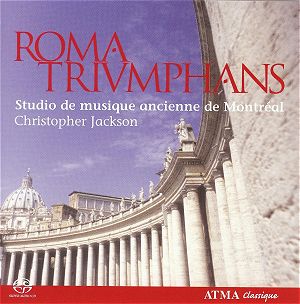

 Studio de musique
ancienne de Montréal/Christopher Jackson
Studio de musique
ancienne de Montréal/Christopher Jackson  [61:32]

