Editorial Board
MusicWeb International
Founding Editor Rob Barnett Editor in Chief
John Quinn Contributing Editor Ralph Moore Webmaster
David Barker Postmaster
Jonathan Woolf MusicWeb Founder Len Mullenger
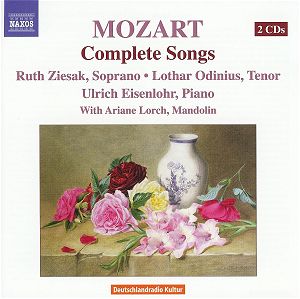
Wolfgang Amadeus MOZART (1756–1791) Complete Songs
CD 1 1. Sehnsucht nach dem Frühlinge, KV 596* [2:34] 2. Der Frühling, KV 597** [3:02] 3. Das Kinderspiel, KV 598* [1:47] 4. Auf die feierliche Johannisloge, KV 148**
[2:19] 5. Lied zur Gesellenreise, KV 468** [2:19] 6. Lantate: Die Ihr des Unermesslichen Weltalls
Schöpfer ehrt, KV 619** [6:47] 7. Wie unglücklich bin ich nit, KV 147* [0:55] 8. Komm, liebe Zither, komm, KV 351**† [2:05] 9. Die Verachweigung, KV 518* [4:13] 10. An Chloë, KV 524** [2:30] 11. Der Zauberer, KV 472* [2:12] 12. Das Lied der Trennung, KV 519** [4:51] Franz SCHUBERT (1797–1828) 13. Luisens Antwort, D.319* [3:08] Wolfgang Amadeus MOZART 14. Die betrogene Welt, KV 474** [3:17] 15. Als Luise die Briefe ihres ungetreuen Liebhabers
verbrannte, KV 520* [1:39] 16. Lied des Freiheit, KV 506** [2:20]
17. Oiseaux, si tous les ans, KV 307* [1:29]
18. Dans un bois solitaire, KV 308** [2:52] Josef MYSLIVEČEK (1737–1787)
(arr. MOZART) 19. Ridente la calma, KV 152* [3:19]
CD 2 Wolfgang Amadeus MOZART Die Zufriedenheit: Was frag ich viel nach Geld
und Gut, KV 349**
1. Version with mandolin accompaniment† [2:40]
2. Version with piano accompaniment [1:43] 3. An die Freude, KV 53* [2:57] 4. Verdankt sei es dem Glanz der Großen, KV
392** [2:27] 5. Sei du mein Trost, KV 391* [2:43] 6. Ich würd auf meinem Pfad, KV 390** [1:59] 7. Die Zufriedenheit: Wie sanft, wie ruhig fühl’
ich hier, KV473* ** [2:54] 8. Die Alte, KV 517* [3:17] 9. Die kleine Spinnerin, KV 531* [2:17] 10. Lied beim Auszug in das Feld, KV 552**
[1:42] Zwei deutsche Kirchenlieder, KV 343 11. O Gottes Lamm, dein Leben* [2:02] 12. Als aus Ägypten Israel** [1:38] 13. Des kleinen Friedrichs Geburtstag, KV 529*
[2:19] 14. Das Veilchen, KV 476* [2:38] 15. Das Traumbild, KV 530** [3:56] 16. Abendempfindung an Laura, KV 523* [4:44] 17. Einsam bin ich, meine Liebe, KV Anh. 26**
(fragment) [1:12] Ruth Ziesak
(soprano)*; Lothar Odinius (tenor)**; Ariane Lorch (mandolin)†;
Ulrich Eisenlohr (piano) (all tracks except †)
rec. DeutschlandRadio Kultur Studio, Siemens Villa, Berlin Lankwitz,
Germany, 25-30September 2006, 12-14 February 2007
Sung texts and translations can be accessed at www.naxos.com/libretti/557900.htm NAXOS 8.557900-01
[53:40 + 43:07]
I know the metaphor has been used before but the record business
is sometimes very similar to the London buses: you wait and wait
in vain and then suddenly they appear two or three in succession.
There hasn’t been a set of the complete Mozart songs for many
a moon that I know of but in March this year soprano Sophie Karthäuser
and baritone Stephan Loges with Eugene Asti appeared with a wholly
delightful set (review)
and here, less than half a year later, comes Ruth Ziesak and Lothar
Odinius with another complete set. In fact theirs is ‘even more
complete’. They give us two versions of Die Zufriedenheit
KV 349, one with piano and the other with mandolin, and they differ
quite a lot. They also include two German church songs KV 343,
probably composed in Salzburg 1779, and finally a fragment, Einsam
bin ich, meine Liebe, that so to speak ends in mid-air. In
a couple of the songs they also include more verses than Karthäuser
and Loges. Completists may want the Naxos for these additions
but, honestly, they don’t add much to the general picture of Mozart’s
vocal writing: the two church songs are agreeable in all their
simplicity but easily forgotten. The concluding fragment hardly
begins until it is over, while the alternative mandolin version
of Die Zufriedenheit is interesting as not being just a
transcription. It is probably the original and it is simpler and
more like a folksong to fit in with the discreet accompaniment.
Those who already own the Karthäuser/Loges set need not rush to
the record store.
This is not to say
that the Naxos set lacks merit. Ulrich Eisenlohr – the mastermind
behind the Naxos complete Schubert cycle – is at the piano.
The experienced Lieder singers Ruth Ziesak and Lothar Odinius
– both also taking part in the Schubert cycle – share the songs
and in a couple of instances singing together. With this in
mind we can rest assured that there is a great deal of accomplishment
here.
The distribution
of songs between the two singers differs quite a lot, even though
in quite a few instances the women are allotted the same songs
and the men the same, so there is ample room for direct comparison.
Both ladies have fresh, light and glittering voices and seem
ideal for lyric Mozart and both have frequently sung roles like
Pamina in the theatre. The first song on the Naxos set, Sehnsucht
nach dem Frühlinge – the theme of which also appears as
the theme of the final movement of Mozart’s last piano concerto
– turned out to be instructive as comparison. Ruth Ziesak is
truly spring-like in her reading, singing like a rippling spring
brook; Sophie Karthäuser is a mite – but just a mite – less
brilliant but just as affecting. However – and this was practically
my only objection to her singing in my original review – she
is so fast that she seems rushed and the song loses some of
its charm. This is again noticeable in Der Kinderspiel,
where Ziesak is eager and soubrettish, even childlike, while
Karthäuser and Loges sing it as a duet and are even more lively
– but also slightly rushed. The same thing happens again once
or twice with Ziesak sounding more balanced, more relaxed and
Karthäuser more forward-moving and eager but not so warm. By
and large these two sopranos are extremely accomplished and
it is only natural that close comparison can sometimes lead
to a listener preferring the one in certain songs and the other
in other songs. Ziesak is certainly lovely all through the Naxos
set and if I single out Als Luise die Briefe ihres ungetreuen
Liebhabers verbrannte as possibly the best thing in the
whole programme, the next moment I feel the same about Der
Zauberer and Ridente le calma and …
As for that lovely
song readers may flinch when they see it attributed to Josef
Mysliveček. Recent research has led scholars to believe
it was a work by the Czech composer, since there exists in the
National Library in Paris a version of the song for voice and
orchestra under Mysliveček’s name, which differs only slightly
from Mozart’s version. The two composers met in Bologna in 1772
and became friends and Mozart’s song was only published after
his death, Constanze claiming it to be an original work.
Some readers may
also raise an eyebrow when seeing a Schubert song included in
this programme. But there is an explanation to this in Eisenlohr’s
exhaustive liner-notes. Ludwig Theobul Kosegarten’s poem Luisens
Antwort, which Schubert set, was written as a direct answer
to Schmidt’s Das Lied der Trennung and there are, as
Eisenlohr says, ‘echoes of Mozart’ in Schubert’s music. It is
even possible that Schubert knew Mozart’s song. Luisen’s
Antwort is well sung by Ziesak and the Mozart song is sung
with plangent tone and nervous insight by Lothar Odinius. This
is one of his best interpretations as is his reading of the
remarkable cantata Die Ihr des unermesslichen Weltalls Schöpfer
ehrt, KV 619, dramatic and with roots in Freemasonry. It
was written in July 1791, when he was also working on Die
Zauberflöte, which is KV 620, and also contains references
to the Masonic world. Odinius’s reading is powerful and filled
with pathos. The darker tenor voice seems to me preferable to
Karthäuser’s lighter soprano, although there is no lack of drama
in her reading. Odinius is generally keen with words and he
uses his voice with great flexibility but compared with Stephan
Loges’s extremely nuanced singing he sometimes feels a bit prosaic.
He sings Komm,
liebe Zither with mandolin accompaniment and the soft and
recessed sounds of the instrument inspire him to a likewise
scaled-down reading, mellifluous and beautiful. Loges, with
much more active accompaniment, is livelier and faster and with
no lack of beauty and nuance. Odinius is a lyric tenor but he
has weighty tone and I wouldn’t be surprised if he will before
long be singing heavier repertoire as a complement to the Mozartean
roles. His powerful An Chloë points in that direction,
strong but nuanced. Like Loges he decorates the melodic line
tastefully. Ich würd auf meinem Pfad and Das Traumbild
are other highlights on this set.
Ulrich Eisenlohr’s
accompaniments are mainly unobtrusive and supportive rather
than ends in themselves, which no doubt was Mozart’s intention.
The recording can’t be faulted. Whichever of the two sets one
chooses one will be richly rewarded. Forced to make a choice
I would opt for the Karthäuser/Loges set, primarily for the
superbly nuanced singing of Stephan Loges, but no one buying
the Naxos set is likely to be disappointed. Diehard lovers of
these songs need both sets.
Göran Forsling
Please support our advertisers below by clicking on the logos for further information.

























 Ruth Ziesak
(soprano)*; Lothar Odinius (tenor)**; Ariane Lorch (mandolin)†;
Ulrich Eisenlohr (piano) (all tracks except †)
Ruth Ziesak
(soprano)*; Lothar Odinius (tenor)**; Ariane Lorch (mandolin)†;
Ulrich Eisenlohr (piano) (all tracks except †) 
