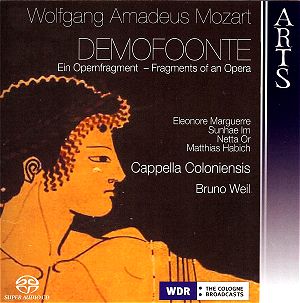
Looking over the track-listing for this release, and one can be
forgiven for wondering what on earth is going on. Basically, Demofoonte
is the thirteenth of 27 major opera dramas by Metastasio (1698-1782).The
libretto is one that is among the most frequently set to music
ever. By the year 1800 it had inspired at least 73 operas by,
amongst others, Vivaldi, Gluck, Paisiello, and Galuppi. Wolfgang
Amadeus Mozart was a composer who used Metastasio’s work more
than that of any other poet, so it is no surprise that he would
have been interested in this libretto. While he never completed
his version, Mozart certainly made at least two attempts to work
on the project, mentioning progress in letters to his sister.
The resulting release
consists of the six arias which Mozart completed. These usefully
sum up the key moments of the plot, and German author Sabine
Radermacher has created a number of spoken text passages based
on Metastasio’s original drama in order to fill in the missing
story lines. The whole piece has then been bulked out with instrumental
compositions by Mozart from between 1769 and 1778, which provide
sufficient scenarios and material to complete a satisfactory
‘night at the opera’. The work opens with Mozart’s Symphony
in G K 74 from 1770, although it should be noted that the
authentication of the work has been questioned. Written during
Mozart’s first trip to Italy, the work has a suitably overture-like
character, similar to that of an Italian sinfonia, and
with suitably simple orchestration. Further selections include the “cassation” music K63
and 99. Four pieces from the ballet/pantomime Les Petits
Riens K299b form the conclusion. This was written in
1778 in Paris, and is all that remains of another failed project,
the composition of the opera Alexandre et Roxane. These
movements provide a light and playful conclusion after
all of the preceding heavy drama. The whole work concludes with
a real party piece, the Gavotte in F.
The spoken texts are
given in mildly gruff but expressive German by actor Matthias
Habich, who has the role of the protagonist Demofoonte. I suspect
most non-native speakers will zap past the spoken passages. Dodgy
translations of these texts are given in the booklet, alongside
the sung libretti and plenty of synopsis information. The story
is a complicated one, involving impending sacrifices, enigmatic
statements from omniscient Gods, secret marriages discovery, disaster
and last minute reprieve. The pioneering Cappella Coloniensis
lead by conductor Bruno Weil play with all of the early music
verve one might anticipate, and the WDR co-production has lead
to a very good SACD recording. Soloists are Eleonore Marguerre,
Sunhae Im and Netta Or, all of whom are given remarkably demanding
coloratura arias, or in any case arias with considerable range.
Netta Or is an almost stereotypical wobbly soprano as Creusa in
Non curo l’affetto, but the demands of the music make any
alternative almost impossible. Eleanore Maguerre has a straighter
vibrato, being allowed a more lyrical part as Timante. I don’t
quite understand the male role of Timante being given a soprano
voice, but no explanation of this is given so I shall have to
let that pass. Marguerre has one of the highlights of the whole
production, in the dramatic Misero me – Misero pargoletto,
when all seems darkest and all hope seems lost. Sunhae Im has
the most directly impressive singing voice, opening proceedings
with In te spero, o sposo amato with noble purity of tone.
H.C Robbins Landon points out how Mozart may have identified with
prince Timate in this aria, seeing the secret marriage with Dircea
as comparable with Mozart’s relationship with Constanze. Im also
expresses a nice amount of ‘schmerz’ in Se tutti i mali miei.
The live performance has a sizeable chunk of applause at the end,
but audience noise during the recording is notable by its absence.
So, what is the end
result? The ultimate effect is a kind of ‘Readers Digest’ condensed
Mozart opera, with no choruses or ensemble singing. The arias
which we do have are, if perhaps not Mozart’s best ever, are certainly
of a quality to suggest that his intentions were nothing less
than 100% serious, though the plan to create an entire opera is
never explicitly suggested in Mozart’s correspondence. The additional
music has been well chosen, and will seem perfectly natural if
you don’t know it too well already. The arias here were of course
known before this recording, but this is a fine way of ‘rescuing’
a great deal of such fine music and bringing it beyond the bounds
of academic or purely concert performance; that of a few surviving
‘fragments’ in isolation. The booklet notes point out that there
is a deal more substance in the 50 minutes or so of original music
for Demofoonte than in most of Mozart’s other ‘official’
opera or stage production fragments. What is nice about having
the extra pieces is, to my mind, that the pacing of the drama
is left over to the imagination. If one can imagine the piece
as a combined opera/ballet entertainment then there is much to
be said for such a solution. After this production I am sure that
others will come up with other ideas, but for the time being I’m
glad to have this as a new Mozart ‘discovery’.
Dominy Clements

























 Matthias Habich - Demofoonte (actor)
 [47:37 + 46:29]
