Editorial Board
MusicWeb International
Founding Editor Rob Barnett Editor in Chief
John Quinn Contributing Editor Ralph Moore Webmaster
David Barker Postmaster
Jonathan Woolf MusicWeb Founder Len Mullenger
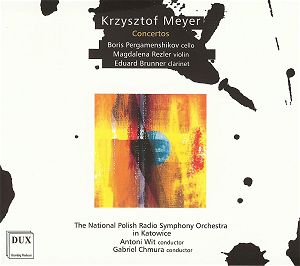
Krzysztof MEYER (b.1943)
Cello Concerto No.2, op.85 (1994/1995) [27:54]
Violin Concerto No.2, op.87 (1996) [30:49]
Clarinet Concerto, op.96 (2001/2002) [20:57] Boris Pergamenshikov
(cello)
Magdalena Rezler (violin)
Eduard Brunner (clarinet)
National Polish Radio Symphony Orchestra in Katowice/Antoni
Wit (op.85); Gabriel Chmura (opp.87, 96)
rec. 19 February 1998 (op.85), 15 May 2002 (op.87), 3 June
2003 (op.96), Polish Radio Studio in Katowice, Poland. DDD DUX 0594 [79:42]
Here are three
very fine contemporary concertos.
Krzysztof Meyer
studied with Krzysztof Penderecki and Nadia Boulanger. In
his early works, the first four string quartets and first
three symphonies, he experimented with the sounds which we
associate with the Polish avant-garde of the 1960s. Subsequent
works have shown an interest in tradition. His output is
large and varied – including the first book, in Polish, on
Shostakovich. These three concertos are the merest tip of
the compositional iceberg and make a good introduction to
the composer.
The Cello
Concerto No. 2, despite many moments of seriousness
is quite a light-hearted work. In four movements, the first
is little more than an introduction to the whole piece,
with some colourful bells, and a long-breathed theme for
the soloist. A furious allegro ensues, full of filigree
work for the soloist accompanied by percussion, interspersed
with outbursts for the orchestra, which grow increasingly
more angular. The third movement is a lament, with a ghostly,
faster, middle section. The finale is quick and spiky with
a cadenza coming just before the very fast final bars.
There are occasional flashes of the 1960s Polish avant-garde
but they seem more long distance recollections rather than
any kind of homage. Meyer exploits the full range of the
instrument in both fast and slow music.
The Violin
Concerto No. 2 begins slowly and there’s much atmosphere
and a sense of foreboding. At the start the music is lyrical
and dissonant, restrained, but it grows in intensity to
a passionate climax, the whole falling away to the music
of the opening. A violent scherzo follows without a break.
It’s fast and furious and never gives up until its abrupt
conclusion. The third, slow, movement is a dirge over a
sustained bass, but it never becomes depressing. There’s
always something going on which catches the attention and
keeps the interest. The finale is fast and culminates in
a cadenza and quick coda.
The Clarinet
Concerto starts with a cadenza. The orchestra quietly
slips in behind the soloist then the action starts, but
it’s stopped quite quickly. The second movement is short
and angular. Fast music leads into the slow third movement,
brooding and dark, full of intensity, then the rhythmic
finale. This music is more angular than the two string
concertos, and it’s much shorter, but no less demanding.
All three works
are brilliantly scored, full of tunes and are very satisfying
to listen to. The tunes might not seem memorable at first
but please do persevere with them, you’ll find, and enjoy,
them.
I am sure that
the performances are very committed – they certainly sound
it – and most persuasive. It’s a fine disk by any standards.
The sound is full and the balance between soloist and orchestra
is very good, with a good perspective all round. The notes
are good too.
This is well
worth investigating.
Bob Briggs
Please support our advertisers below by clicking on the logos for further information.

























 Boris Pergamenshikov
(cello)
Boris Pergamenshikov
(cello)
