|
Making
a Donation to MusicWeb
About MWI
Site
Map
More
Reviews
How to find a review
Books
Film
Music
Nostalgia
Records Of The Year
Recommendations
Comment
Arthur Butterworth Writes
Phil
Scowcroft's Garlands
Classical
blogs
Reviewers
Logs
Announcements
Don't
Go Here!
Community
Bulletin Board
Web
Ring
Reviewers
Helpers
invited!
Resources
How
Did I Miss That?
British
Composers
British
Light Music Composers
Other
composers
Indexes
Label
Masterwork
Discographies
Composer
National
Themed
Review pages
Complete Books
Programme
Notes
External sites
British Music Society
The BBC Proms
Performers
Orchestra Sites
Recording Companies & Retailers
Online Music
Agents & Marketing
Publishers
Other links
Newsgroups
Web News sites etc
Editorial
Board
Classical Editor
Rob Barnett
Seen & Heard
Editor and Webmaster
Bill Kenny
MusicWeb Webmaster
Len Mullenger
Assistant Webmaster
David Barker
PotPourri
A
pot-pourri of articles
MW
Listening Room
MW
Office
Helping
MusicWeb
Advice
to Windows Vista users
Questionnaire
Site
History
What
they say about us
What
we say about us!
Where
to get help on the Internet
CD
orders By Special Request
Graphics
archive
Currency
Converter
Dictionary
Magazines
Newsfeed
Web Ring
Translation Service
Rules
for potential reviewers :-)
Do
Not Go Here!
April Fools
|

 |
 |
|
alternatively
CD:
Crotchet
AmazonUK
AmazonUS
Download: Classicsonline
|
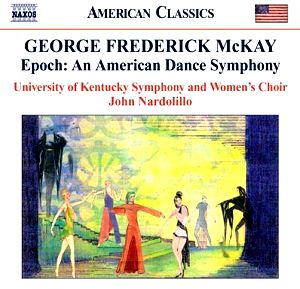
George
Frederick McKAY (1899-1970)
Epoch - An American Dance
Symphony (I. Symbolic Portraits;
II Pastoral; III. Westward;
IV. Machine Age Blues) (1935) [62:52]
University of Kentucky Women's Choir
University of Kentucky Symphony/John Nardolillo
rec. Singletary Center for the Arts Concert
Hall, Lexington, Kentucky, USA, 6-8 February
2007
NAXOS AMERICAN CLASSICS 8.559330 [62:52]
|
|
|
George McKay’s
Epoch is a symphony to be
dance-interpreted rather than a
symphony of dance vitality.
McKay’s natural
lyrical inclination is given full
rein here in a work that explores
in philosophical numbers the essence
of four American poets. This is
the listener’s first impression
in Symbolic Portraits which
is laced with some tart dissonances
that rise once to yelp and howl.
This pepper adds savour to the cantabile
flow of a movement that tracks the
life and spirit of Edgar Allen Poe.
The orchestration is lucid, adept
and generally transparent. It carries
the redolence of Ravel, Bax in his
more transparent textures, Patrick
Hadley and George Butterworth. Pastoral
(Sidney Lanier) includes a women’s
choir with the orchestra. Their
vocalise contribution is balmy and
has some kinship with the vocalise
in Vaughan Williams’ Oxford Elegy.
The music has a warm Palladian outdoor
air that radiates contentment: clover,
benevolent insect-hum, the sun,
cooling shade and birdsong. It is
not quite as saturated as Bax’s
Spring Fire but it is in
that vicinity. Westward! (Walt
Whitman) includes statuesque brass
writing that shouts epic resolve,
gritty determination and frontier
defiance with a moment of writing
that recalls Roy Harris at 12:07.
Then about 2:23 the toe-tapping
rhythm of city life emerges but
by no means soulless and still in
touch with rustic idylls which continue
to enwrap the composer at the slightest
excuse. The prominent and affecting
song of the cor anglais and the
oboe momentarily suggests a link
with Aranjuez but the impression
comes and goes in an instant. Folk
Dance at 13:28 suggests the
composer was familiar with Petrushka
as well as turkeys in the straw.
Machine Age Blues (Carl Sandburg)
is vehement, sometimes iron-clad
mechanistic, with sirens and corrugated
rattles, rivet guns and jack hammers.
It is not as wild as Mossolov’s
Steel Foundry nor as overpowering
as Honegger’s Pacific 231 but
it belongs to the same literature.
It takes a while to get to The Blues
(5:10) but when they come they are
disconsolate and heart-weary. There
are some jazzy ululations and Gershwin-like
piano articulation at 8:22 but McKay
keeps returning to his lyrical True
North as we hear even in this last
movement. A phalanx of saxophones
ruffle the Charleston velvet at
10:23 onwards as a metropolitan
futuristic world strikes a dissolute
meld with Jazz. An unnervingly iterated
siren wail leads to a closing roll
of drums.
The progress of
the music has to be followed across
clear pauses as the composer moves
from episode to episode within the
movements. Structurally it could
have done with more variation but
that is to criticise it for staying
true to a consistent mood. The symphony
was originally a multi-media event
– not quite in the Scriabin sense
but certainly one in which dance,
singing, music and spectacle played
complementary parts. Even so the
music can be appreciated in its
own right as a series of poetic
tableaux. As a work it is predominantly
reflective and evocative rather
than dramatic. It is a fascinatingly
distinctive yet low key revival
skilfully presented and yielding
its rewards in intensely pensive
currency.
Rob Barnett
|
|
Advertising
Rates
Visitor
stats
MusicWeb
International
has over 25,000 Classical CD reviews on offer
Gerard
Hoffnung Concerts &
The
Bricklayer Story

New
Releases

New
Releases


MusicWeb
sells the Polish
catalogue CDAccord
£10.50 post free W-W

MusicWeb sells the
Arcodiva catalogue
£12.00 post free W-W

£11.50
post-free world-wide
Try
it and see - Sale or Return
MusicWeb
can now offer you discs from the following catalogues:
Prices include postage
Musicweb
Special
Offers
Google Ads - for information about privacy matters, click here.
|