Firstly, I guess that the name and the music of Gian Francesco
Malipiero are little known in the general run of classical music
appreciation - especially in the United Kingdom and the USA. Secondly,
based on this first volume of Symphonies, I believe that
listeners will be pleasantly surprised at what appears to be a
great symphonic cycle that is just waiting to be (re)discovered.
It seems ironic that such music as this can have remained in relative
obscurity for so many years. I understand that this series was
released on the Marco Polo label some 15 years ago – but I imagine
that many people, me included, will have missed them first time
around.
A few words about
Malipiero’s career will not go amiss. He was born in Venice
in 1883 to a musical family; his grandfather was the opera composer
Francesco Malipiero. However, family problems prevented the
young Gian from having a consistent musical education. After
a period in the Vienna Conservatoire he had some composition
lessons with Marco Enrico Bossi. Unfortunately he was forced
to spend time studying on his own. Much of this self-study involved
perusal of the scores of Monteverdi and Frescobaldi. This deep
understanding of this these (then) largely forgotten works was
to lead the composer to a great interest in historical Italian
music- it was an interest that was to yield great fruit in later
years. Malipiero attended a number of lectures by Max Bruch
in Berlin between 1910 and 1911 and was later to come under
the spell of Debussy, Stravinsky and Casella. Interestingly
he was largely ambivalent about the Austro-Germanic tradition:
his definition of ‘symphony’ was markedly different to that
of Mahler, Bruckner and other post-romantic composers.
One anecdote about
the composer’s younger days repays telling. In 1913 he won four
composition prizes at the Accademia Nazionale di Santa Cecilia
in Rome by the rather dubious precedent of submitting five different
works under five different names.
It is difficult
to place Malipiero in context as his music is not generally
known to a British audience. But for the record, Malipiero himself
suggested that his Pause del Silenzio for the orchestra
(1917), his Rispetti e Strambotti for chamber ensemble,
(1920) and L'Orfeide for the stage (1918, 1922) are amongst
his best works. Few would doubt that the symphonies are his
crowning achievements. But other contenders for the palm are
the Fourth String Quartet (1934) - he wrote eight - his
chamber opera Sette canzoni (1920) and the First Violin
Concerto (1932). All these works await rediscovery.
In addition to his
work as a composer, Malipiero was to devote much time to teaching
at the Venice Liceo Musicale and the Parma Conservatory. One
of his star students was Luigi Nono. He wrote a number of books
including studies of Stravinsky and Vivaldi. Yet perhaps the
greatest debt that musicians and listeners owe to Malipiero
is his work as an editor. He produced a complete edition of
Monteverdi’s compositions and latterly edited many of Vivaldi’s
concertos. Additionally he produced performing editions of music
by Galuppi, Tartini and Stradella.
It is very difficult
to describe Malipiero’s music. For one thing it is hard to relate
their sound-world to that of other composers. One is reminded
of the late Elvis Presley when asked who he sang like. His immortal
reply was “I don’t sing like no-one”. And the same can be said
of Malipiero. Certainly there are hints of Stravinsky and Debussy
in many passages. But when one starts hearing Charles Ives,
Edward Elgar and Ottorino Respighi it is perhaps time to give
up and allow the man to speak for himself.
Unfortunately, most
scholars declare that Malipiero’s music is quite uneven in its
quality. Woodhouse, in the sleeve-notes, declares that “all
[his] works deserve far more attention than they nowadays usually
receive … despite the undeniable, disconcerting unevenness of
his huge output”. But any artist has an inalienable right to
be understood by his best works. Malipiero is generally regarded
as a great composer when judged by these standards. Dallapiccola
once stated that Malipiero was “the most important musical personality
that Italy had since the death of Verdi”.
He was to destroy
much of his music written before 1914; however the Sinfonia
del mare (1906) is one that has survived that cull. It is
a very good place to begin an exploration of his music. This
work is usually regarded as more ‘symphonic poem’ than a ‘classic’
symphony. This is the composer’s Sea Symphony – although
it is a far cry from that of Vaughan Williams! Even a superficial
hearing will suggest Debussy’s La Mer. However it is
unlikely that the Malipiero could have heard that piece when
he wrote the present piece only a few months after the premiere
of the Frenchman’s great work. Fundamentally, this ‘Sinfonia’
is a musical representation of the changes and chances and moods
of the Adriatic as seen (probably) from the Lagoon. It is a
lovely work that will present few problems to listeners.
The Third Symphony
was composed in 1944-45. Malipiero has written about this work
that it was “connected to a terrible date, 8 September 1943
when the bells of St Mark’s Cathedral did not ring for peace
but to announce new torments, new suffering.” The reason for
this, the composer said, was that “the Germans had invaded Italy.
I heard the sound of their steps, of their heavy boots announcing
death and martyrdom. The bells cancelled all that: they created
a special state of mind. Here is my Third Symphony written
at one of the most terrible times.” Malipiero closes his thoughts
on this work by asking, “Have you ever heard, from the lagoons,
Venice all vibrating with bells? She becomes a huge musical
instrument.”.
The work is in four
movements with the ‘scherzo’ placed after the slow movement.
From the first bar to the last the listener is aware of the
ringing of bells – either explicitly or implicitly; it is the
work’s leitmotiv. Listen out for some delicious sonorities in
the slow movement: the composer makes excellent use of the piano,
creating a kind of gamelan-like soundscape. But it is the rather
obtuse ‘scherzo’ that stole the show for me in this piece. Novel
use of instruments and a lopsided formal construction do nothing
to lessen the fact that this is a minor masterpiece of orchestral
writing.
I have listened,
carefully to this Symphony twice. On the one hand it
is a work that can be appreciated on a one-off hearing, yet
I believe that this is music that only reveals its delights
and depths with application and repeated hearing which may not
be realistic to expect from the majority of listeners. There
is great beauty in these pages, as well contemplative moments
and even intimations of darkness. Yet, for all that, this is
an optimistic work.
The Fourth Symphony
is subtitled ‘in memoriam’. It is dedicated to Natalie Koussevitzky,
the wife of the great conductor. As an aside Peter Grimes
was also dedicated to this lady, as were a number of other compositions.
The first movement
is a touch ‘eccentric’ and I guess that it is a little imbalanced.
There is a lot of energy here, and much of the music seems a
little ‘rough cut.’ Waterhouse is right when he states that
‘a two bar refrain for trombones, tuba and bassoon interposes
itself three times “into the music’s flow like some rough and
knobbly obstacle”. However the slow movement is perfect. It
is the heart of the work and is ‘elegiac’ in mood. This is not
easy music to listen to. Sometimes there is a harshness that
may seem alien to music designed to be ‘in memory’ of a friend.
The ‘scherzo’ is
hardly as impressive as that of the Third Symphony, although
it is a relief after the intensity of the slow movement. There
is much energy here and the dissonance suggests vitality rather
than violence. The last movement is an interesting set of variations
on a theme ‘salvaged from Malipiero’s early, repudiated one-act
opera Canossa (1911-12). It is the most accomplished
part of this Symphony. My first reaction is that it lacks
unity, and that for an elegiac work it is devoid of warmth.
It is only in the last pages that I sense hope and optimism.
But I guess that this was the composer’s intention.
Fundamentally, this
is a great CD. I know that I missed out on this music the first
time around – and I regret this. These are great, if somewhat
idiosyncratic works that well deserve attention and study. I
am not an authority on Italian music from any century – but
I guess that symphonic cycles of the magnitude of Gian Francesco
Malipiero’s are few and far between. And to discover a series
of works that are great music, inspiring, beautiful and thoroughly
enjoyable is a great thing. I hope that Naxos quickly releases
the remaining symphonies and other orchestral works as soon
as possible.
I should add that
the playing by the Moscow Symphony Orchestra and their conductor
Antonio de Almeida is stimulating. To my mind, they are great
advocates of Malipiero’s music. The programme notes by John C.G.
Waterhouse are informative, well written and essential reading.
Bear in mind that there is little other information to assist
listeners.
John France
























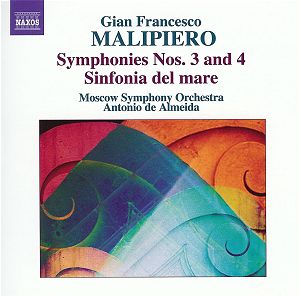

 Moscow Symphony
Orchestra/Antonio de Almeida
Moscow Symphony
Orchestra/Antonio de Almeida 
