It is unusual to
come across a book devoted to one
opera, especially when that opera
is relatively unknown. However the
story behind the creation of Sullivan’s
Ivanhoe is particularly interesting.
It was composed by the best known
of Victorian composers and is to
my knowledge the longest running
English opera ever staged. It stretched
to 155 consecutive performances
with a double cast, all of whom
were trained by Sullivan who had
the work completed within a schedule
of six months. In 1995, the British
public were reminded of the work
when Roderic Dunnett (‘Opera Now’
magazine reviewer) in his BBC radio
‘Britannia at the Opera’ series
presented a compressed version of
Ivanhoe in a new studio recording
in an hour-long version.
Readers of this
book are likely to be those to whom
the Savoy operas and some of Sullivan’s
orchestral works are known. Many
will be fascinated by the detail
surrounding this opera, penned only
a decade before the composer’s death.
For some time, Sullivan had been
criticised by the establishment
and told that his talents were being
frittered away on his lucrative
comic operas. He, himself, believed
that Gilbert’s lyrics were cramping
his style. It therefore comes as
no surprise to find that as early
as 1885 he told Richard D’Oyly Carte
that he wished to move on from the
comic opera tradition. Following
a suggestion by Queen Victoria to
write a grand opera he was duly
motivated. This in turn motivated
D’Oyly Carte to build a new theatre
for the work. The opera’s subject
would need to be popular and lend
itself to presentation as a spectacle
so that it could draw in large audiences.
Jeff Dailey has
researched his subject thoroughly
and one wonders whether this book
originally formed the backbone of
a thesis, for the detail is exacting
and the footnotes extensive. I found
it a fascinating read. He has a
clear style of writing, free from
Americanisms. He always presents
his material in context to explain
to the reader those events that
relate to the situation under discussion.
He identifies that only top performers
are likely to cope with Ivanhoe,
which he likens to Lohengrin
or Les Huguenots in complexity
and length.
Recordings (apart
from the 60+ 78 rpm records that
exist) are detailed and valid comments
about them are made. Dailey rightly
explains that one cannot form a
fair opinion of the quality of the
work from these non-professional
recordings. Of those listed, however,
he seems to have overlooked what
is probably the finest recording
of two soprano arias from Ivanhoe
found on an English Opera disc.
They show off Sullivan in a good
light. These are sung by Deborah
Riedel with Richard Bonynge and
the Opera Australia orchestra (Melba
MR 30110 - see
review).
Dailey teases out
some interesting facts that make
fascinating reading. From diary
entries and elsewhere we are given
an accurate picture of how Julian
Sturgis came to be chosen as librettist
and the way Sullivan wrote the piece.
Having given himself only six months
to complete his task, Carte realised
that the composer might not finish
in time so he put a clause in the
contract to make sure the finished
score was delivered and rehearsal
process accomplished in time for
the production to open on the day
the theatre building was completed.
Sullivan delivered late and had
to pay Carte £3000. An interesting
point concerns the orchestra and
compares its size with that used
for The Golden Legend and
for Savoy operas like The Mikado.
As a literature
scholar, Dailey is clearly knowledgeable
about Scott and the writers of the
various Ivanhoe stage productions.
He shows how certain arrangements
of plot order can work on the stage.
It also helped that the audience
of the day would have known the
Ivanhoe story in detail
before they set foot in the theatre.
As a musician, he analyses quite
carefully in a long section the
various musical motifs applied to
build the framework of the score.
Interestingly, these motifs play
a strong role in the first two acts
and not the third. Is this intended
- an oversight or was Sullivan so
pushed for time that he ignored
the fact? Dailey provides insight
into the detail of the band parts:
again this makes interesting reading.
Meticulous over scoring detail,
Sullivan apparently added a ‘G flute’
to the piccolo part at a late stage
of rehearsal to accentuate the brilliance
once he had been able to assess
the acoustics of the new theatre.
Leaving no stone unturned, we are
provided with detail (and the critics’
backgrounds) of those who spoke
against Ivanhoe so that the
reader can make a fair assessment
of the work in the 21st
Century.
It is a pity that
we are not given any cast lists
and no comment/information is made
about the leading singers of the
double cast. Ben Davies, Charles
Kenningham, Esther Pallister, and
Margaret Macintyre were names associated
with grand opera and some of them
appear in photographs within the
book. The fact that five were American
and that the casts revolved so that
the lead opposites would vary might
have interested the readers. From
a letter by Miss Macintyre to Sullivan
we find that the rehearsals ran
each day from 12.30 to 4.00 pm and
that the singers’ contracts required
attendance at all rehearsals. Mention
is made of the scenery designers,
but readers interested in staging
will be disappointed that no comment
is made on how Ivanhoe’s
nine scenes might have been achieved
on stage. Drawings must exist and
reviewers do in fact make some reference
to visual detail. The only detail
given is that the striking of the
Burning Castle scene requires a
12 minute interlude, unhelpful to
Sullivan’s wish that the opera be
staged in three acts.
The ten illustrative
plates are for some reason placed
together - usually so only when
a different high definition gloss
art paper is used. The pictures
could have used up the page size
more profitably. They mainly focus
on members of the cast and on a
very young Julian Sturgis. More
would have been welcome as there
is plenty of illustrative material
to be found in The Graphic and the
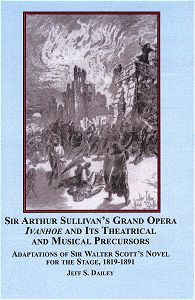
Illustrated London News. The only
scene from the opera is shown on
the book cover.
There are 50 pages
of well-spaced appendices, covering
the various adaptations, places
of performance and synopses of Scott
and Sturgis’s Ivanhoe for
comparison as well as Harris’s La
Basoche. Despite the book’s
high price, which will sadly restrict
circulation, this is excellently
researched material whose publication
is timely since a professional recording
of Ivanhoe by Chandos is
being planned for release in 2009-10.
Raymond J
Walker