It’s intriguing to imagine how the reputations of today’s leading
musicians will fare after their deaths. Some figures from the
past remain in high esteem: conductors Otto Klemperer and Eugen
Jochum, pianist Sviatoslav Richter or violinist David Oistrakh
are, for instance, all still highly lauded performers.
In
other cases, reputations may even grow. Take for example two
famous conductors long associated with the Philadelphia Orchestra.
Appreciation of Leopold Stokowski’s artistry seems to increase
year by year as newly-unearthed, charismatic - if sometimes
idiosyncratic - recordings come to light. Similarly, Eugene
Ormandy’s consistent high standards - which seemed almost to
bore contemporary critics during his lifetime - are much better
appreciated now that they can no longer be taken for granted.
And even one of the conductors featured on this Heifetz disc,
William Steinberg, has recently found a champion in David Patmore,
author of the admirable Naxos A-Z of Conductors, who
has singled him out as ripe for rediscovery.
There
are, though, some musicians who suffer precipitate declines
in public esteem after their deaths. Herbert von Karajan offers
an obvious example, even though some valiant rearguard actions
have lately been fought on his behalf in the media. Perceived
for so long and by so many as the world’s leading conductor,
there was, after his death, only one way his reputation could
go. And perhaps the same may have been true of the so-called
“violinist of the century” Jascha Heifetz.
In
1976 a certain Herbert R. Axelrod produced a substantial scrapbook-cum-biography
of Heifetz. Apart from his musical interests, Mr Axelrod’s
main claim to fame was as a publisher of books on tropical fish.
Heifetz’s critics would certainly appreciate the suggestion
that a man attracted to tropical fish – all colourful glitter
on the outside but essentially unemotional, unresponsive and
uncommunicative on the inside – might also have admired the
violinist for, perhaps, those very same qualities.
But
that line of criticism – encouraged by Heifetz’s sternly aloof
and patrician manner on stage – is not entirely fair. There
was, as RCA’s complete 46-volume Heifetz Collection on
CD made abundantly obvious, far more to its subject than the
caricature version. Incidentally, while individual volumes
are still available, the full boxed set of the Collection
– complete with numbered commemorative medal (mine is #789)
– seems to have disappeared from circulation, although I see
that Amazon.com is currently offering just one “as new” priced
at a mere $2,469.99!
In
reality, as his peers all knew, Heifetz was not just a great
technician but a masterly artist of great versatility, sensitivity
and musicianship, especially so in the intimately collaborative
area of chamber music.
The
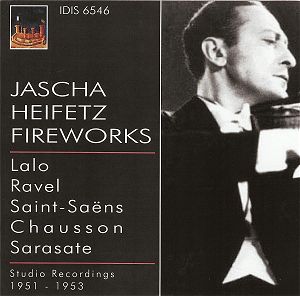
disc under review – with its catchpenny title Jascha Heifetz
Fireworks – focuses more, however, on showy virtuosity and
will do, therefore, little to alter the common prejudice. Its
contents are, moreover, very well known. In fact, five of the
six pieces can be found – in exactly the same order of presentation
– on volume 22 of the RCA Collection where, perhaps more
accurately, they are termed “showpieces” rather than “fireworks”.
Meanwhile, the Ravel may be found on volume 8. Side by side
comparisons of the new disc with the older RCA accounts show,
to my own ear at least, that no improvement has been made in
the (generally very good) sound.
Heifetz’s
note-perfect performances need detain us little. He provides
– exactly as advertised – the expected coruscations and then
some. Lalo’s Symphonie espagnol (performed here in the
four movement version more often heard at that time) evokes
the pastiche Spain so beloved of such 19th century
non-Iberian composers as Bizet, Glinka, Rimsky-Korsakov, Chabrier
and Moszkowski. Heifetz is, however, let down by a tubby-sounding
orchestra that appears never to have got closer to Spain than
a package trip to Benidorm. Just six years later the London
Symphony Orchestra was to show a far more stylish way to do
these things on its classic Decca LP España (now CD 443
580-2) – but then they had zarzuela specialist Ataulfo
Argenta to lead them.
Havanaise goes more successfully, if only because
Saint-Saëns has, in his wisdom, given the orchestra a rather
lower musical profile: they have little of any great musical
interest to do and are clearly there to accompany the
soloist. But there is a real change with Zigeunerweisen.
Having listened to this Heifetz performance at least twice a
week over a ten year period (the final allegro molto vivace
section was the “signature tune” of my BBC radio programme)
I know it pretty much inside out - yet it emerges here, as always,
fresh as a daisy. I have yet to hear another soloist, however
eminent, carry the piece off with such verve and panache. And
for some inexplicable reason the RCA Victor Symphony Orchestra
sounds a far more alert and lively band on 16 June 1951 than
they had been just a few days before (Symphonie espanole)
or would be a few days later (Havanaise).
Ever
on the lookout for interesting repertoire, in 1941 Heifetz had
recorded Chausson’s concerto for violin, piano and string quartet.
Ten years later, the same composer’s far better known Poème
may not have been such an adventurous choice but this is certainly
another fine performance, eschewing the silky dreaminess adopted
by some violinists in favour of a more open and directly forthright
approach. This “poem” is less a Romantic sonnet by Keats than
a stirring lay by Thomas Babington Macaulay – but its artistic
credentials are, none the less, never in doubt. Conductor Izler
Solomon’s strong contribution evidently impressed Heifetz, for
three years later they were to collaborate again - this time on
the world premiere recoding of Max Bruch’s Violin Concerto No.
2.
Saint-Saëns’s
Introduction and Rondo Capriccioso also goes well, but
the real highlight of the disc comes with the Ravel. Recorded
with a different orchestra and conductor, Heifetz sounds revitalised
by the musical challenges of Ravel’s far spikier 1920s take
on “gypsy” music. Although he made recordings of this work
in its violin/piano form in both 1934 and 1972, this was his
only recording of the full orchestral version. The performance
also benefits from better engineering, with a far brighter and
clearer sound picture than on the earlier recordings. It is
both a genuine triumph and a real “firework” with which to end
the disc.
Rob Maynard