There was a time when there were no turntables or CD players.
As not everyone was able to go to the opera to hear the fashionable
works of their time, the only alternative was an arrangement of
complete operas or parts of them for keyboard or for different
kinds of ensembles, from piano trios to flute quartets or wind
ensembles. The number of arrangements of an opera was an indication
of the popularity and reputation of its composer. By that standard
André-Ernest-Modeste Grétry was one of the most popular composers
of the second half of the 18th century.
Grétry
was born in Liège in the Southern Netherlands - now Belgium
- where he had his first musical education as a choirboy in
one of the city's churches. Later on he studied in Rome and
worked for some time in Geneva. It was there that he became
acquainted with the opéra comique which was to influence
his career decisively. In Paris Grétry produced no less than
six such works, which were very successful. In time Grétry rose
to a position of wealth and influence. Although he had close
ties with the French royal family he still had some success
with his music after the Revolution of 1789, despite facing
a change in public taste and needing to adapt his compositional
style.
Grétry's
popularity was not restricted to France. Apart from his native
country, where he received official honours, his works were
performed in Germany, Austria and Italy. This is also reflected
in the arrangements: none other than Wolfgang Amadeus Mozart
wrote a series of variations on a chorus from Grétry's opera
'Les mariages samnites'. And Jan Ladislav Dussek arranged two
overtures for keyboard with violin ad libitum. This is
another sign of the reputation of Grétry, as Bohemian-born Dussek
was one of the leading keyboard players in Europe and was soon
to rise to prominence as a composer himself.
A
special work in the programme is the 'Passage de l'Acheron par
Grétry', written by Dieudonné Gaubert. He sang as an haut-contre
in the Paris Opéra from 1798 to 1828 and in this capacity had
participated in a number of performances of Grétry's works.
His composition for keyboard and declamation is a tribute to
the composer on the occasion of his death in 1813. It is a kind
of 'Apothéose de Grétry' which describes how the composer crosses
the Acheron and arrives in the Elysian fields where he is welcomed
by the likes of Rameau, Gluck and Philidor.
Interestingly
Grétry remained popular - or perhaps regained popularity - during
the 19th century. This is testimony to the pieces by composers
like Boëly and César Franck. Both were interested in the music
of the 18th century, but - as Manuel Couvreur states in the
programme notes - there was a political aspect to this Grétry
revival too. "The quartet in Lucile, 'Où peut-on
être mieux qu'au sein de sa famille?' ('Where is it better to
be than in the bosom of one's family?') became a 'loyal air'
under the Restoration. After Louis-Philippe's accession to the
throne of France, the opéras-comiques that he had loved in his
youth found renewed lustre".
In
the case of Franck the fact that Grétry was of Belgian origin
may have played a role as well. That was definitely the case
with Félix Godefroid, who was from Namur and was mainly known
as a brilliant player of the harp. But he also was an accomplished
pianist, and he wrote two virtuosic fantasies on items from
two of Grétry's operas.
The
Belgian pianist Arthur De Greef transcribed a suite of 'Danses
villageoises' in 1901, and that was probably the last time someone
paid this kind of tribute to the composer Grétry. In our time
he is still waiting to be recognized as one of the great opera
composers of the late 18th century. It would be nice if this
disc could play a part in such a process.
The
artists have made a good choice of music which is played with
zest and technical assurance. The use of period instruments,
among them a piano by Érard from 1882 in the last three items,
and the recording greatly contribute to the atmosphere of the
drawing room where this kind of music was played. Anyone interested
in this period of (French) music history should look for this
disc.
Johan van Veen























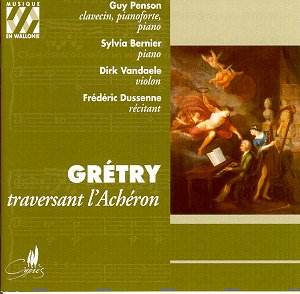

 Guy Penson (fortepiano, harpsichord), Sylvia Bernier (fortepiano),
Dirk Vandaele (violin), Frédéric Dussenne (reciter)
Guy Penson (fortepiano, harpsichord), Sylvia Bernier (fortepiano),
Dirk Vandaele (violin), Frédéric Dussenne (reciter)
