Johann Friedrich
Fasch was a German composer of the
generation of Bach and Telemann,
but he is still in the shadow of
those masters. In his time he was
one of the most famous composers
in Germany, who was put by some
at the same level as Telemann. The
music on this disc gives evidence
of his reputation. The compositions
recorded here belong to the part
- about one third - of Fasch's output
which has been preserved in Dresden.
It was for the court orchestra in
Dresden - arguably the best in Germany
at the time - that Fasch composed
the works performed by Tempesta
di Mare. From October 1726 to June/July
1727 Fasch spent nine months in
Dresden. There he composed vocal
works for the Roman Catholic court
chapel and instrumental music for
the court orchestra. Among his colleagues
at that time were Johann David Heinichen,
the Kapellmeister, and the
violinist Johann Georg Pisendel.
He knew both of them very well,
as they had been members of the
(second) Collegium Musicum in Leipzig,
which he founded in 1708 while studying
there. After his return to Zerbst,
where he was active as Kapellmeister
from 1722 he continued to write
music for Dresden, probably at the
request of Heinichen and Pisendel.
The Dresden scene
seems to have had a considerable
influence on Fasch's compositional
style. In the booklet Barbara M.
Reul suggests it was Heinichen who
urged Fasch to incorporate elements
of the Italian style in his works.
And the items in the programme on
this disc certainly show Italian
influences. The very first work
is a good example: the title 'ouverture
grosso' suggests a mixture of the
overture-suite - a basically French
form - and the Italian 'concerto
grosso'. And indeed, especially
the opening overture and the closing
'aria en pologneise', contain contrasts
between a 'concertino' - consisting
of strings or wind or a combination
of both - and 'ripieno' (the full
orchestra). At the same time Fasch
didn't forget his German roots,
as the counterpoint in the overture
proves.
A combination of
several elements is also characteristic
of the next item, the Concerto in
B flat. This is not a solo concerto,
but rather an orchestral concerto,
with elements of the concerto grosso.
There are also features of the suite:
the last two movements are a bourrée
and a passepied. Whereas the second
movement, aria andante, reflects
the 'gravitas' which is a feature
of German music, the two closing
movements are rather modern for
its time. The trio section of the
bourrée is set for transverse
flute, oboe and bassoon, without
basso continuo. It is this aspect
of his music which makes Barbara
M. Reul write that "Fasch's exciting
texture and timbre changes - the
basso continuo group occasionally
rests to let the other musicians
shine - not only herald the advent
of the pre-classical period, but
also emphasize Fasch's awareness
of, and insight into, what the future
would hold, at least in musical
terms".
The last work is
another Concerto, this time more
uniform in style: just three movements,
allegro - andante - allegro. It
exists in two different versions;
the andante being the only movement
entirely different in both versions
is recorded twice. It is another
beautiful piece of music which impressively
demonstrates Fasch's skills in integrating
strings and wind in his scoring.
One may conclude
from this description that this
is a very interesting production
which should be an additional encouragement
to further explore Fasch’s orchestral
music. He was certainly more than
just one voice in the choir: there
are enough specific features to
earn him a place of his own in music
history.
One can only be
grateful to Tempesta di Mare for
this recording. Although it was
recorded live I did not hear any
disturbing noises, so either the
audience behaved with exemplary
discretion or the engineers have
done a fantastic job. There is a
pretty big difference in the way
British and German ensembles play
German baroque orchestral music.
One need only compare performances
of Telemann's overtures by, for
instance, Collegium Musicum 90 on
the one hand, and the Akademie für
Alte Musik Berlin on the other.
Tempesta di Mare is somewhere between
these two. The playing is characterised
by a differentiation between the
notes, a mostly good articulation
and in general a good sense of the
typical idiom of German orchestral
music of that period. On the other
hand, there is too little dynamic
shading, not just between notes,
but also on single notes, and sometimes
the differentiation and articulation
could have been a bit sharper. I
would have liked the performances
to be more sparkling, with more
'attack' and with sharper edges.
Having said that
there is plenty to enjoy here, not
the least the creativity and originality
of Fasch's compositions. It is to
be hoped that this disc will encourage
music-lovers to further explore
the oeuvre of a still underrated
master of the German baroque.
Johan van
Veen












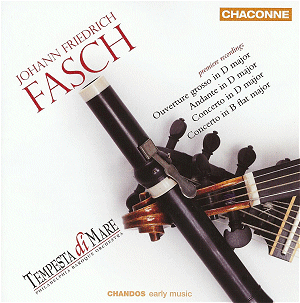

 Tempesta di Mare (Philadelphia Baroque Orchestra)/Gwyn
Roberts, Richard Stone
Tempesta di Mare (Philadelphia Baroque Orchestra)/Gwyn
Roberts, Richard Stone