Editorial Board
MusicWeb International
Founding Editor Rob Barnett Editor in Chief
John Quinn Contributing Editor Ralph Moore Webmaster
David Barker Postmaster
Jonathan Woolf MusicWeb Founder Len Mullenger
George CRUMB (b. 1929) Makrokosmos I and II (1965) [65:20] Ellen Ugelvik (piano)
rec. 18-21 May 2007, Sofienberg Church, Oslo, Norway. Hybrid SACD.
DDD SIMAX CLASSICS PSC1263 [65:20]
George Crumb's Makrokosmos
I and II is varied, compelling, at times beautiful
and stimulating music for piano. It forms a cornerstone
of the century's solo keyboard music, though it no
so entrenched in the repertoire as it ought to be.
Recordings like this one may go some way towards changing
that.
Both Makrokosmos
books are played here with total commitment, sensitivity
and great technical brilliance by Ellen Ugelvik. Norwegian,
Ugelvik has a policy of seeking out new contemporary
works for exposure on disk - often for the first time.
She also collaborates with such composers as Louis Andriessen,
Christian Blom, Alwynne Pritchard - and George Crumb.
It's not clear here how far the two were in touch in
the production of this recording. It's certainly authoritative
with a light but steady pair of hands.
Crumb's approaches
to music were those of a child from a highly musical
family which had access to a broad range of scores and
experiences; he was no ideologue or theoretician from
the academies. Although he did receive a formal musical
education, his views on humans' relationships with nature
and the primacy of mystery and sonority play a greater
role in his music - as is the case with Berg, perhaps,
a composer Crumb has always admired.
The Makrokosmos are
just as redolent as the music of Webern, though: sparse,
translucent, precise, expressive almost to the point
of non-being. At the start of his career in the early
1960s Crumb bided his time. Perhaps to thoroughly assimilate
and adjust these Second Viennese School influences; and
others such as Mahler, Dallapiccola, Debussy and of course
Bartók. A slow rate of compositions grew steadily. Before
long, George Crumb was thought of as the leading American
composer of his generation.
A persistent feature
of these works was an extra-musical apparatus - numerologies,
symbols and naming conventions - in support of the awe
Crumb felt for his natural subject matter in particular.
The two Makrokosmos are
typical in shunning counterpoint, and any kind of attention
to over-rich timbres or textures. A pulsing and exposed
simplicity is achieved - not quite crystalline, as is
Boulez's piano music; nor yet reductive as is Cage's.
Silence and pause, space and reflection are not so important
to Crumb as they are to, say, Elliott Carter or Lukas
Foss. There are also quotes
in Makrokosmos from earlier composers, Chopin,
Rachmaninov, perhaps, and Richard Addinsell!
The work was completed
in 1972/3 and is described as 24 "fantasy pieces
after the Zodiac for amplified piano". There is
also a part for a whistler. Crumb notated the very demanding
whistling part(s) in the bass clef. Women performers
have to transpose. Any performer - it's obvious - needs
to practise in order to achieve significant voice control
and precise intonation so as to make the most of these
parts. Similarly the pianism required for Makrokosmos is
not insignificant … Crumb insists that the pianist stay
seated and minimise gesture: this is music to be heard
not observed!
At the same time, Makrokosmos is
built on drama and the impact of - unexpected but never
spurious - vocal effects. Ugelvik scores well here. Her
real gift in this recording is to have made such a secure,
expert and unambiguous fusion between respecting and
reflecting Crumb's compositional technique on the one
hand, and to have drawn out almost every drop of his
penetrating imagination on the other.
Volume 8 in Robert
Shannon's complete Crumb edition (Bridge 9155) would
be another recommendation; the composer himself is known
to have responded warmly to Laurie Hudicek's recording
from 2002 (on Furious Artisans 6805) of the first Volume
only. Ugelvik's must now be considered a worthy front-runner.
Each part takes
about half an hour to play; Crumb has admitted that Debussy's
two books of Préludes were amongst his models.
Each piece is linked to a sign of the Zodiac, has the
initials of someone born under that sign; many have titles
like "Atlantis ca 10,000 BC" and "Ghost
Nocturne for the Druids of Stonehenge".
So this is clearly
music to be listened to very carefully; close attention
to the extra-musical resonances may not be essential
- or add much - for everyone. Ugelvik seems aware of
this; she projects the music as broadly and openly as
possible. Either way, harmonic and tonal consistency
on Crumb's part coupled with the way the Ugelvik has
so completely absorbed the required idiom make concentrated
listening to Makrokosmos on the sensitively-recorded
SACD a spell-binding experience.
Mark Sealey
Please support our advertisers below by clicking on the logos for further information.
























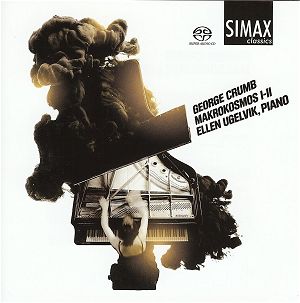

 Ellen Ugelvik (piano)
  [65:20]
