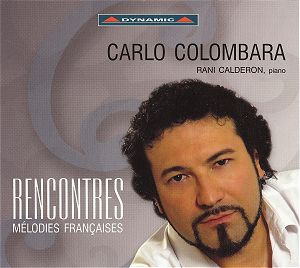
Carlo Colombara was born in Bologna and studied there with Paride
Venturi. In 1986 he was declared the best Italian singer at the
renowned G.B. Viotti Competition in Vercelli. The following year,
he won the "Concorso As.Li.Co." in Milan and debuted
at some of Italy's most prestigious opera houses in quick succession.
His great breakthrough was in 1989 when he made his La Scala debut
in I vespri siciliani under Riccardo Muti. Since then he
has had a successful career at the most prestigious opera-houses
around the world. He has also recorded extensively and my first
encounter with his powerful black-tinted voice was as the bass
soloist in Verdi’s Requiem on the acclaimed Naxos recording
about ten years ago. That he had lyrical capacity was obvious
so it came as no surprise that he also would venture into art-song.
The present collection of Mélodies Françaises, recorded
in his native town a year and a half ago, is dedicated to one
of the truly great performer of French songs, Gérard Souzay, who
passed away in August 2004, aged 86.
According to an
obituary in The New York Times Souzay’s voice was
"not huge, but rich in color and tone,
supple and sensual and lovely". The obituary also states
that he was "a sensualist, reacting viscerally to the music
and allowing it to carry him in new directions in a given concert."
I presume that Carlo Colombara felt the same and wanted to go
in the same direction. The great difference between the two
singers is that Colombara’s voice is huge and black. I am deeply
impressed that he more often than not manages to scale it down
to Mélodie proportion and express so many of the finer
nuances of these songs. Many of these are filled with exquisite
fragrances that can only be caught in the singers’ equivalent
of water-colour painting. For a grand operatic bass, whose everyday
artistic life is devoted to large canvases in oil, this is no
easy task and the effect is sometimes, to change the metaphor,
of a Formula 1 car on a go-cart track. He sings softly, nuanced
and with fine attention to the texts – delivered in good French.
When revved down his super-engine loses in quality, becomes
less focused, gets slightly pinched and monochrome. There is
even a tendency for intonation to waver. When he then changes
gear and employs his full voice it is like a new singer: thrilling,
imposing, with tremendous ring – though occasionally slightly
wobbly – and with dramatic conviction. The problem then is that
he sometimes becomes too large for the songs. In effect it is
like two different singers who try to share the same body. Souzay,
despite his smaller instrument, was also able to open up and
sing with rather darkish tone and a certain vibrancy but he
kept within the boundaries of what could be termed ‘Gallic elegance’.
This
is not to say that it is a bad recital. Hahn’s L’heure exquise
is finely shaded, the two Poulenc songs intimate and atmospheric.
Throughout the programme he shows deep commitment and an understanding
of the texts. It is only the hang-up that some songs become
underpowered and others too overheated. In some songs the contrasts
between the intimate and the outgoing are too great. He is an
expressionist instead of an impressionist.
Where
he definitely scores is in the two concluding song-cycles, by
Ibert and Ravel, on the theme Don Quichotte. In 1932
those two plus Delannoy, de Falla and Milhaud were asked – unknown
to each other – to write music for a Don Quichotte film
starring the great Feodor Chaliapin. The winner was Ibert; Ravel
ended up suing the producers but in vain. His cycle was published,
however, and has been quite successful without any connections
with the film. It was to be his last composition. Both cycles,
conceived for bass voice and one of the greatest singing actors
in operatic history, give plenty of opportunities for expressivity.
Comparing Colombara with Chaliapin’s own recording of the Ibert
cycle I was impressed indeed. Chaliapin was unique in his self-exposition
but Colombara isn’t too far behind and here all his histrionic
qualities are in their element. When he fines down his voice
in the final song, Chanson de la morte de Don Quichotte,
he is extremely touching. He is no less accomplished in the
Ravel cycle, singing the rhythmically intricate Chanson romanesque
with great relish and letting his hair down in the concluding
Chanson à boire. José Van Dam sings both cycles on an
Erato recording and his is a smoother approach, but bearing
in mind the intended original singer with his larger-than-life
image Carlo Colombara may be the more idiomatic. Van Dam also
sings them with orchestral accompaniment, so the readings are
more complementary than competitive.
Rani
Calderon gives good support at the piano but the recording seems
less than ideally focused. There is a kind of aura around the
voice that tends to blur the image slightly. As always I would
have appreciated translations of the song texts.
This
recital is a bit uneven but there many good intentions are well
realized and at its best – in the two concluding Don Quichotte
cycles – it rises to considerable heights.
Göran
Forsling
























 Carlo Colombara (bass); Rani Calderon (piano)
